Radiator Not Heating Up? MK Fix Guide
TL;DR
Cold at the top means air — bleed it. Cold at the bottom means sludge — needs a power flush. Cold in the middle means limescale. One radiator cold while others are hot is almost always a stuck TRV pin (give it a gentle tap with a spanner). Upstairs cold? Air plus poor balancing. Downstairs cold? Weak pump. All radiators cold? Boiler issue. Use the table in this guide to match symptom to fix.
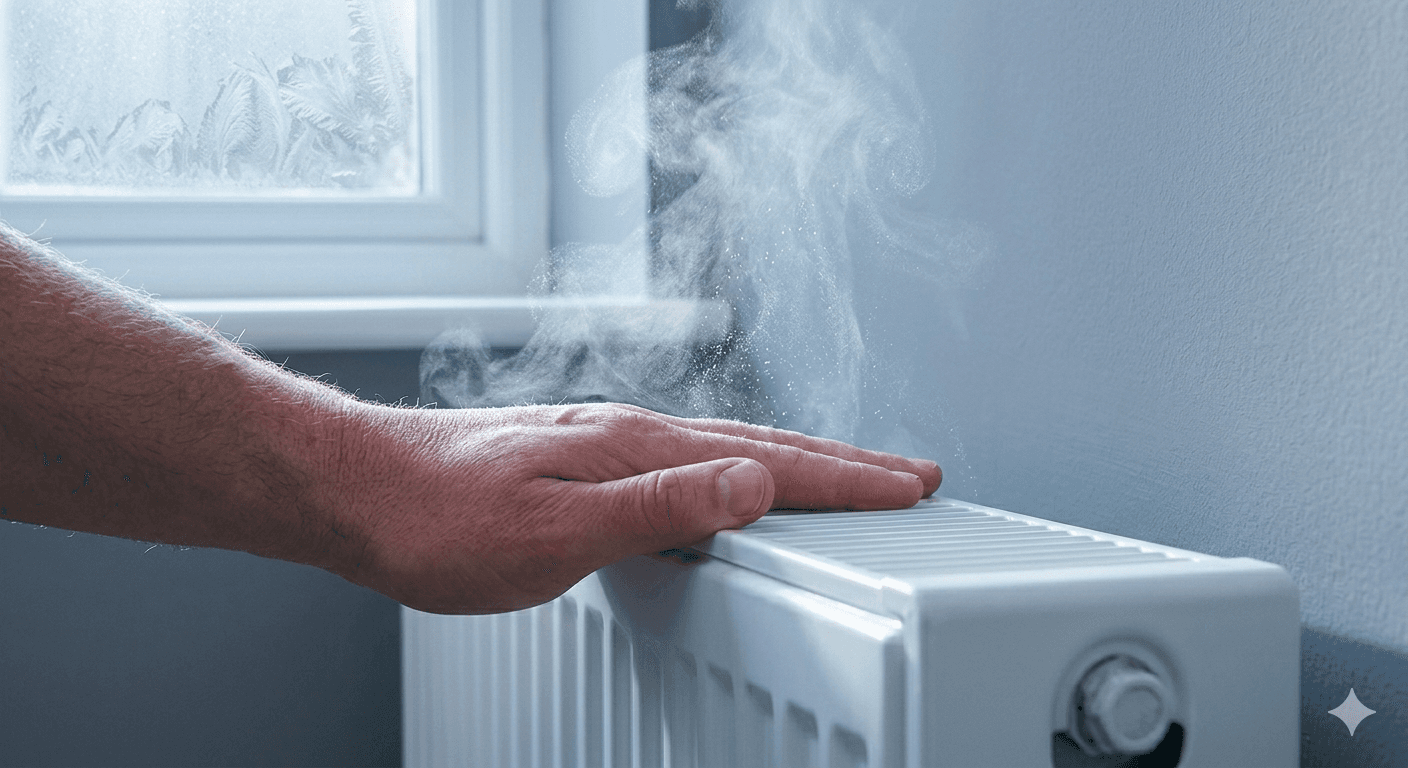
"My radiator isn't heating up" is one of the most common heating callouts we get across Milton Keynes — and the cause depends entirely on where on the radiator the cold spot is, and whether it's one radiator or several. This guide walks through the eight most common scenarios and tells you exactly which is which, and what to do about each.
Most causes are fixable yourself. A few need a Gas Safe engineer. The diagnostic table below covers all eight at a glance, with full explanations underneath.
Diagnostic Table: Match Your Symptom to the Cause
| Symptom | Likely Cause | DIY Fix? | MK Engineer Cost |
|---|---|---|---|
| Cold all over, one radiator | TRV stuck closed or lockshield closed | Yes — tap TRV pin or open valves | £60 - £140 if valve replaced |
| Cold at top, warm at bottom | Air trapped | Yes — bleed it | Free DIY |
| Cold at bottom, warm at top | Sludge build-up | No — power flush needed | £450 - £800 power flush |
| Cold in the middle, warm at edges | Limescale build-up (hard water) | Partial — chemical flush | £200 - £400 |
| One radiator cold, all others hot | TRV pin stuck down | Yes — gentle tap with spanner | £60 - £120 if replaced |
| All upstairs cold, downstairs hot | Air in system + needs balancing | Partial — bleed, then engineer balance | £90 - £160 |
| All downstairs cold, upstairs hot | Failing circulation pump | No — pump replacement | £220 - £380 |
| Every radiator cold | Boiler fault or pump seized | No — Gas Safe required | £90 - £400+ |
Scenario 1: Radiator Cold All Over (One Radiator Only)
The radiator is stone cold from top to bottom while others on the same circuit are fine. Two likely causes:
- TRV (thermostatic radiator valve) is closed. Turn the dial fully clockwise to off, then fully anticlockwise to 5 or max. Wait 10 minutes. If it warms up, the TRV was just set low. If not, the pin underneath the dial may be stuck — see scenario 5 below.
- Lockshield valve is closed. The opposite end of the radiator from the TRV has a plain valve with a plastic cap (the lockshield). Lift the cap and use a spanner or specific lockshield key to turn the valve anticlockwise a couple of full turns. This was probably knocked off during a recent decoration or DIY job.
Scenario 2: Cold at the Top, Warm at the Bottom
Air trapped at the top of the radiator. Bleeding fixes it. Full walkthrough in our how to bleed a radiator guide. Five-minute job, £2 of kit needed.
Scenario 3: Cold at the Bottom, Warm at the Top (Sludge)
If your radiator is hot at the top and cold along the bottom edge, you've got sludge — iron oxide sediment built up over years of corrosion. It settles at the lowest point of the radiator and blocks circulation.
Bleeding won't fix this. Tapping won't fix it. The radiator needs a chemical flush — either at the system level (a full power flush of all radiators, £450-£800 in MK) or sometimes just removing and flushing the affected radiator individually (£90-£160).
Sludge is common in Bletchley and parts of Wolverton where the housing stock is older and systems may not have been flushed for a decade or more. We cover this in more depth in our piece on common central heating problems in Milton Keynes.
Scenario 4: Cold in the Middle, Warm at the Edges
Less common but quite specific to harder water areas. Limescale builds up across the bottom of the radiator and creates cold zones in the middle while water still flows around the edges. The fix is similar to sludge — a chemical flush or descaler treatment, usually £200-£400 in MK depending on number of radiators.
Scenario 5: One Radiator Cold, All Others Hot (Stuck TRV Pin)
This is hands-down the most common scenario, and the fix is genuinely free. Inside every TRV is a small spring-loaded pin that pushes up to let water flow and pushes down to block it. Over the summer when the heating is off, the pin can corrode in the closed position. When you turn the heating back on in October, the radiator stays cold.
How to free a stuck TRV pin:
- Find the TRV (it's the valve with the temperature dial, usually 1-5 or *).
- Turn the dial fully clockwise to "off", then unscrew the head completely anticlockwise. It should come off in your hand, revealing a small brass pin sticking out of the valve body.
- Press the pin down with your finger. It should spring back up easily.
- If it's stuck down (won't spring back), tap it gently sideways with a small spanner or the wooden handle of a screwdriver. Don't hammer it. A gentle wiggle plus a tap usually frees it.
- Once it's springing freely, refit the head, turn the dial back to 3 or 4, and wait 20 minutes. The radiator should now heat up.
If the pin won't free up at all, the TRV needs replacing — usually £60-£120 fitted in Milton Keynes. We cover TRV replacement and other heating fixes as part of our heating repair service.
Scenario 6: All Upstairs Radiators Cold (Downstairs Fine)
Two things tend to be going on here:
- Air collects at the highest points of the system. Bleed all upstairs radiators first — start with the one furthest from the boiler.
- The system is unbalanced. Downstairs radiators are closer to the boiler and tend to get hot first. If lockshield valves haven't been adjusted, downstairs grabs all the flow and upstairs gets little. An engineer can balance the system in about an hour.
After bleeding, check boiler pressure and top up if needed using our repressurise your boiler guide.
Scenario 7: All Downstairs Radiators Cold (Upstairs Fine)
This is the opposite problem and is usually a circulation pump issue. A weak or partially seized pump can't push water down through the longer return runs to ground floor radiators, so they stay cold while upstairs (which sees water by gravity-assist) stays warm.
Pump replacement is gas-safe-registered work and typically £220-£380 in Milton Keynes including the new pump. Sometimes the pump just needs a manual restart — there's a small slot on the pump head that can be turned with a flat screwdriver to free a stuck impeller — but this is engineer-only territory.
Scenario 8: Every Radiator in the House Is Cold
If no radiators are getting hot at all, the issue is upstream — at the boiler itself. Check:
- Boiler is firing (you can hear the burner) — if not, check thermostat, programmer, pressure gauge
- Boiler is showing any fault codes
- Boiler pressure is within range (1.0-1.5 bar cold)
- Pump is making any noise when heating calls for heat
If hot water from the tap still works but no radiators heat, this is the classic "heating side fault" — usually a diverter valve, pump, motorised valve or PCB issue. See our full guide to central heating not working in Milton Keynes.
Diagnostic Flowchart (Quick Reference)
- Is more than one radiator affected? No → scenarios 1, 2, 3, 4, or 5. Yes → continue.
- Are all radiators cold? Yes → scenario 8 (boiler-side fault). No → continue.
- Are only upstairs cold? Yes → scenario 6 (air + balancing). No → continue.
- Are only downstairs cold? Yes → scenario 7 (pump failing). No → continue.
- Mixed pattern: bleed all affected radiators and recheck. If still cold, call an engineer.
Cold Radiators in Specific MK Areas
We see a few patterns across Milton Keynes:
- Older properties in Bletchley, Wolverton, Stony Stratford: Sludge is the most common cause. Many systems are 25+ years old and have never been chemically flushed. Power flush usually solves multiple-radiator problems at once.
- Newer estates in Tattenhoe, Broughton, Westcroft: Stuck TRV pins are the typical issue, especially after the first cold snap of the season.
- Mid-1980s housing in Newport Pagnell and Wavendon: Combination of limescale and unbalanced systems — partial flush plus balancing tends to fix things.
For more cross-cutting heating problems and noises see our cold radiators and noisy pipes guide.
What You Should NOT Do
- Don't remove a radiator from the wall yourself unless you know how to isolate both valves and catch the water — flooded floors are easy.
- Don't add proprietary "leak sealer" or "radiator silencer" liquids without an engineer's advice. They can gum up the boiler.
- Don't keep topping up pressure if the system keeps losing it — see our boiler losing pressure article.
- Don't open the boiler casing or touch any gas-side components. That's Gas Safe registered work only.
When to Call a Gas Safe Engineer
- You've bled the radiator and it's still cold
- Black or brown water came out when you bled it
- Multiple radiators are cold in a pattern that doesn't match scenarios 2, 5 or 6
- You suspect a pump or boiler issue
- TRV pin won't free up with a gentle tap
- The whole system is cold
- You smell gas — leave the property and call 0800 111 999
Plumbline MK are Gas Safe registered and cover all Milton Keynes postcodes for heating diagnostics, TRV replacement, pump replacement, balancing and power flushing. We give a fixed-price quote before starting any work. Routine annual servicing picks up many of these issues before they leave you with cold rooms.
Need expert help? Contact Plumbline MK for a free, no-obligation quote. Call 07805 844 016 for same-day response across Milton Keynes and surrounding areas.
Frequently Asked Questions
Why is just one radiator cold when the others are fine?
The most common cause is a stuck TRV pin. When heating is off through the summer, the small brass pin inside the thermostatic radiator valve can corrode in the closed position. Unscrew the TRV head, locate the pin underneath, and tap it gently sideways with a spanner — it should spring back up. If it doesn't, the TRV needs replacing, usually £60-£120 fitted in Milton Keynes.
Why are my upstairs radiators cold but downstairs is fine?
Two things are usually combining: air has collected at the highest points of the system (so upstairs radiators need bleeding), and the system isn't balanced (downstairs radiators are taking all the flow). Bleed each upstairs radiator starting with the one furthest from the boiler. If they're still slow to heat afterwards, you need an engineer to balance the lockshield valves — about £90-£160 in MK.
How do I free a stuck TRV pin?
Turn the TRV dial fully clockwise to "off", then unscrew the head completely anticlockwise to expose the pin. Press it down with your finger — it should spring back. If stuck, tap it gently sideways with a small spanner or the wooden handle of a screwdriver. Don't hammer or force it. Once moving freely, refit the head and turn the dial back up to 3 or 4.
Do I really need a power flush?
If your radiators are cold along the bottom edge while the top is hot, yes — that's sludge sitting in the bottom of the radiator and only a chemical flush will shift it. A power flush across the whole system is typically £450-£800 in Milton Keynes. Single-radiator flushes (removing and flushing one radiator off-site) are cheaper at £90-£160. An engineer can advise which is the right level of intervention based on the state of the water that comes out.
Can I fix a cold radiator myself?
Several scenarios are safe DIY: bleeding an airlock, opening a closed TRV or lockshield, tapping a stuck TRV pin free. None of these involve gas or electricity. What's not DIY: anything that requires removing the boiler casing, replacing a pump or motorised valve, or doing a power flush. Those are Gas Safe registered jobs and a competent local engineer can usually do them same-day.
Need Professional Advice?
Our Gas Safe registered engineers are ready to help with all your heating needs. Get a free, no-obligation quote today.