Vaillant F22 Error: Low Pressure Fix for Milton Keynes Homes
TL;DR
F22 on a Vaillant means the water pressure in the heating system has dropped too low for the boiler to fire safely, usually below about 0.5 bar. The fix is normally a five-minute job you can do yourself: open the filling loop until the gauge reads around 1.2 bar, close it, then reset the boiler. If the pressure drops again within days there is a leak or a tired expansion vessel, and a Gas Safe engineer needs to find it.
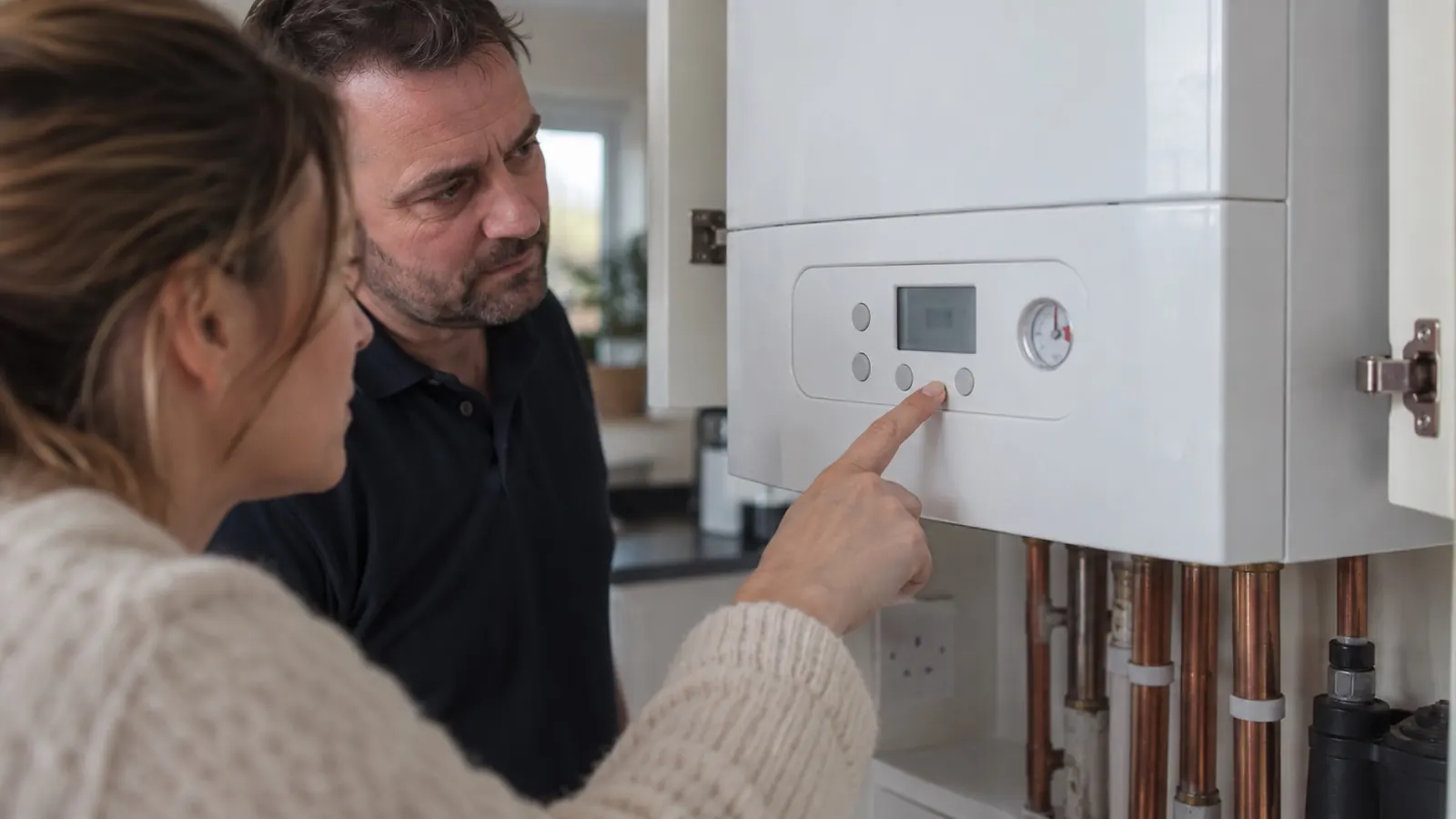
F22 is the Vaillant fault we see most often in Milton Keynes, and it is also the one homeowners can most often clear themselves. A good share of the F22 calls we get could have been sorted in five minutes with no visit at all, if the person had known what to do.
This guide covers what F22 means, how to repressurise a Vaillant step by step, how to track down the leak that keeps bringing it back, what a repair quote is made of if you do need us, and how to stop it recurring.
What F22 means
A sealed heating system runs at around 1 to 1.5 bar when cold, rising a little as it heats. That pressure is what keeps water moving round the radiators and makes sure there is enough water in the boiler to carry the heat away from the burner.
F22 is Vaillant's low water pressure lockout. When the pressure drops below the minimum, around 0.5 bar on most ecoTEC models, the boiler refuses to fire because running it dry would overheat the heat exchanger. It is a protective shutdown doing its job, not a sign of damage. On older ecoTECs you will see a needle gauge under the boiler sitting well below 1 bar. Newer models show the pressure on the display. Vaillant's own literature lists the full fault codes if you want the manufacturer's wording.
What causes it
Roughly in the order we find them across MK:
- A slow leak somewhere in the system. The most common cause by a distance. A weeping radiator valve, a pinhole in a pipe under a floor, a joint that has worked loose. Often the water evaporates before you see it.
- Recently bled radiators. Bleeding lets air out and takes pressure with it. Bleed several without topping up afterwards and F22 is almost guaranteed.
- Pressure relief valve weeping. The PRV should only open when pressure is too high, but once one has passed water it often will not reseal. Look for a drip from a small copper pipe on the outside wall behind the boiler.
- Expansion vessel lost its charge. The vessel inside the boiler has an air cushion that absorbs expansion as the water heats. When the charge goes, pressure swings high when hot (and the PRV dumps water) then low when cold. The pattern is the giveaway.
- Filling loop left slightly open. Pressure creeps up, the PRV releases it, and you end up losing water rather than gaining it.
- Faulty pressure sensor. Least common. F22 with a gauge that reads perfectly healthy.
Cause and fix at a glance
- One-off F22 after bleeding radiators. Repressurise. DIY.
- Pressure drops every few days. Leak. Find and fix. Engineer.
- Copper pipe outside dripping. Failed PRV, or expansion vessel behind it. Engineer.
- Pressure swings high when hot, low when cold. Expansion vessel. Engineer.
- Pressure keeps creeping up on its own. Filling loop not fully closed. Check it. DIY.
- F22 with a healthy gauge reading. Pressure sensor. Engineer.
How to repressurise a Vaillant (step by step)
This is a safe job. You are adding water to the heating system, not touching anything inside the boiler or anything to do with gas.
- 1. Find the filling loop. A short flexible silver braided hose with a small valve at each end, usually under the boiler or in the airing cupboard. Both valves should be closed (handle across the pipe). Some newer Vaillants have a built-in filling key or lever instead; the boiler's manual shows where.
- 2. Switch the boiler off at the front panel. Not essential, but it makes the gauge easier to read.
- 3. Open the valves slowly. A quarter turn on the first, then a quarter turn on the second. You should hear water moving and see the gauge start to climb.
- 4. Stop at around 1.2 bar. Anywhere between 1 and 1.5 bar cold is fine. Close the second valve, then the first, firmly.
- 5. Reset the boiler. Switch it back on and press the reset button. F22 should clear and the boiler should fire.
- 6. Check again in 24 hours. This is the step everyone skips. If the gauge is still around 1.2 bar the next day, you are done. If it has dropped noticeably, you have a leak and topping up again is only delaying the visit.
If you overshoot and the gauge goes well above 2 bar, bleed a radiator to bring it down. If the filling loop is missing or the valves will not turn, stop and call us rather than forcing anything.
Finding the leak yourself
If F22 keeps coming back, a little detective work before the engineer arrives can save diagnosis time.
- Radiator valves. Run a dry tissue under both valves on every radiator, the thermostatic one and the lockshield at the other end. A weep too small to see will mark the tissue. White crusty marks on a valve are dried-out limescale from a slow leak, and in MK's hard water they show up quickly.
- The PRV pipe outside. Find the small copper pipe coming through the wall near the boiler, usually at low level. Any drip or a green or white stain below it means the valve is passing water.
- Pipe joints you can see. Under the boiler, in the airing cupboard, behind the toilet where heating pipes pass.
- Ceilings under bathrooms and bedrooms. A faint brown ring on the ceiling below is a heating pipe leaking under the floor above.
- The condensate pipe. Not a heating leak, but a frozen or blocked condensate pipe can make water appear under the boiler and confuse the picture.
Do not take the boiler's casing off to look inside. Anything behind the case is a Gas Safe registered engineer's job.
When to call an engineer
- F22 returns within a few days of repressurising.
- Water is dripping from the PRV pipe outside.
- You have found a damp patch but not the source.
- Pressure climbs well above 2.5 bar when hot and drops right back when cold.
- You have topped up more than twice in a month. That is not normal and every top-up is putting fresh oxygenated water into the system, which feeds corrosion.
Our guide to a boiler losing pressure goes into the leak-hunting side in more depth.
What a repair quote is made of
We do not list prices here because an F22 repair is priced on what is actually causing it. What decides it:
- Diagnosis time. A weeping radiator valve is found in minutes. A pinhole under a chipboard floor in a 1980s grid-square house can take real detective work, sometimes with a thermal camera.
- The part. A radiator valve or PRV is a small part and a short job. An expansion vessel on an ecoTEC is a bigger job because of where it sits, and sometimes an external vessel is the sensible route rather than a like-for-like swap.
- Access. Lifting floors, moving kitchen units, or getting to pipes in a boxed-in run all add time.
- Boiler age and parts availability. Current ecoTEC parts are easy. Parts for older Vaillants may need ordering.
The honest bit: if the engineer finds a leak at a radiator valve, the repair is small and you should not be talked into anything else. An F22 is not a reason to replace a boiler. The one time to have the bigger conversation is an old boiler with a failed expansion vessel and a heat exchanger that is already showing its age, and then it is a conversation, not a sales pitch. See our boiler repair page for how we work.
Stopping it coming back
- Top up after bleeding. Always glance at the gauge after you bleed a radiator.
- Do not over-pressurise. Keep it between 1 and 1.5 bar cold. Higher just works the PRV and the joints harder.
- Annual service. The expansion vessel charge and the PRV are checked, and joints are looked over for the early white marks. Our boiler servicing covers this.
- Fit a magnetic filter if there is not one, to keep debris off the pressure sensor and out of the pump.
- Glance at the outside pipe once a month. It takes ten seconds.
Frequently asked questions
Will F22 damage my boiler?
No. It is a lockout that stops the boiler running without enough water. The risk is the leak behind it, dripping onto a floor or the boiler's electrics.
Why does it keep coming back after I top up?
Because the water is still going somewhere. A leak or a failed expansion vessel are the only realistic explanations, and repressurising repeatedly just postpones finding it.
How often should I need to top up?
A healthy system holds pressure for months. Once or twice a year after bleeding radiators is normal. Every few weeks is not.
Is 0.5 bar dangerous?
No. The boiler will not fire below it, which is the point. Top it up and find the leak.
If you are in Milton Keynes or one of the surrounding towns and F22 will not stay away, get in touch. We are a Vaillant Advance installer, Gas Safe registered (957816), and happy to talk you through the top-up on the phone before anyone books a visit.
Need Professional Advice?
Our Gas Safe registered engineers are ready to help with all your heating needs. Get a free, no-obligation quote today.