Vaillant F75 Error Code: Causes and Fixes for MK Homes
TL;DR
F75 means your Vaillant boiler started the pump but did not detect the small rise in water pressure it expects, so it shut down to protect itself. The usual causes are a faulty or sludged pressure sensor, a tired pump, low system pressure or trapped air. Check the gauge reads between 1 and 1.5 bar, top up if needed, bleed the radiators and reset once. If F75 comes back, the sensor and pump need testing by a Gas Safe engineer.
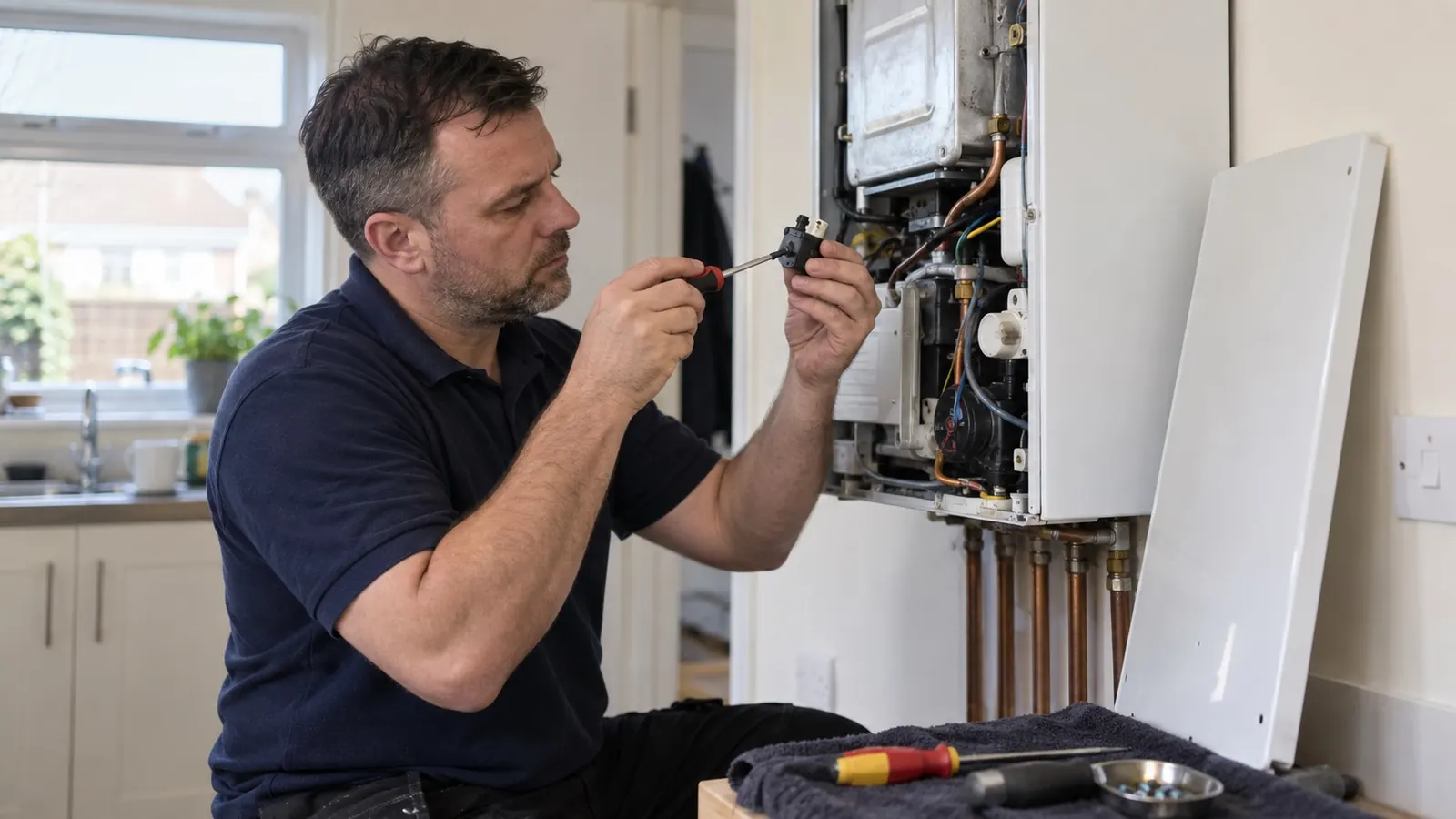
If your Vaillant is showing F75, you are in good company. It is one of the fault codes we see most often across Milton Keynes, particularly on ecoTEC Plus and ecoTEC Pro boilers that have been in for five years or more. It is rarely dangerous, but the boiler will not fire until it clears, so you have no heating and, on a combi, no hot water.
This guide explains what F75 means, what causes it in MK homes, the safe checks you can do yourself, and the point at which it becomes a Gas Safe engineer's job.
What F75 means
When a Vaillant fires up, the pump starts first to push water round the system. As it does, the boiler expects to see a small rise in water pressure. That rise is how it knows water is actually moving and the heat exchanger will not overheat. F75 is the boiler saying: I started the pump, but I did not see the pressure change I was expecting. It shuts the burner down as a precaution.
It is a safety lockout on the water side, not a gas fault. Vaillant's own fault code guidance describes it as an error detecting a pressure change when the pump starts, and lists the pressure sensor and pump as the things to check. F75 is often confused with F22, which is different: F22 means the system pressure has simply dropped too low, and you can usually fix that yourself by topping up. F75 can happen with the pressure looking fine.
What causes F75 in Milton Keynes homes
In rough order of how often we find them:
- A faulty or sludged pressure sensor. The most common cause on older ecoTEC boilers. The sensor sits in the flow and either fails outright or gets coated in black magnetite sludge, so it stops reading properly. In MK, where hard water and older systems go together, sludge is a frequent culprit.
- A tired or seized pump. The motor runs but the impeller is stuck or worn, so the pump cannot make the pressure rise. Common after a summer of standing still.
- Low system pressure. If the gauge is well below 1 bar, the sensor may not register any rise when the pump runs.
- Air in the system. Trapped air stops water flowing properly past the sensor.
- Sludge and debris generally. An older system without a magnetic filter builds up debris that coats the sensor and clogs the pump.
- A wiring or circuit board fault. Less common. A damaged sensor cable or failing PCB can throw the same code, usually intermittently.
Cause and fix at a glance
- Gauge below 1 bar: low pressure. Top up at the filling loop. You can do this.
- Cold patches on radiators, gurgling: air. Bleed the radiators and top up. You can do this.
- F75 returns straight after topping up and resetting: pressure sensor. Engineer.
- Grinding, rattling, or silence from the pump when it should run: pump. Engineer.
- Black water when you bleed a radiator: sludge. Engineer, and the system needs cleaning, not just a new part.
- F75 with no pattern at all: wiring or PCB. Engineer.
Safe checks you can do yourself
None of these involve the gas side or taking the casing off. They clear a fair share of F75 calls without a visit.
- 1. Check the pressure gauge. With the system cold it should sit between 1 and 1.5 bar. If it is below 1 bar, find the filling loop (usually a braided silver hose with a small valve at each end, under or near the boiler) and open the valves slowly until the needle reaches about 1.2 bar, then close both firmly. If your Vaillant has a built-in filling key, the manual shows where it is.
- 2. Bleed the radiators. Turn the heating off and let it cool. Start with the radiator furthest from the boiler and work back. Top the pressure up again afterwards if it has dropped.
- 3. Reset once. Press and hold the reset button for about three seconds. If the cause was a one-off air pocket or pressure dip, it will fire and run. Do not keep resetting. If it locks out again, there is a real fault, and repeated resets only strain the pump and the board.
- 4. Listen to the pump. When the boiler tries to fire, a healthy pump gives a smooth low hum. Grinding, rattling or total silence means the pump, and that is an engineer job.
- 5. Look for leaks. Damp patches under the boiler, around radiator valves or along visible pipework. A slow leak drops the pressure over and over and brings F75 back every time you top up.
When it needs a Gas Safe engineer
If you have topped up, bled, and reset once, and F75 is still there, stop. Specifically, call an engineer if:
- F75 returns within hours of a reset.
- The pressure keeps dropping after you top it up.
- The pump grinds or is silent.
- The boiler is in permanent lockout and will not reset.
- Water is coming from the boiler casing.
The pressure sensor and the pump both live inside the casing. Removing the casing and replacing either is a Gas Safe registered engineer's job. We carry the common Vaillant parts for these faults on the van, so most F75 calls in MK are sorted in one visit. See our boiler repair page for how we work.
What an F75 repair quote is made of
We do not print prices here because the honest figure depends on what has actually failed. What we can tell you is what the quote is built from, so you know what you are paying for.
- The diagnosis. An experienced Vaillant engineer can usually identify the failed component quickly by testing the sensor reading and the pump. You should be told what is wrong before anything is fitted.
- The part. A pressure sensor is a small, inexpensive part. A pump is a bigger one. A circuit board is bigger again. Age and model affect availability.
- The labour to fit it, which for a sensor is short and for a pump or board is longer.
- Whether the system caused it. If the sensor failed because the system is full of sludge, a new sensor will fail the same way. An honest quote then includes cleaning the system, and on a badly sludged older system that means a powerflush and a magnetic filter. That is not padding the bill. It is the difference between a repair that lasts and one you pay for again next winter.
The point a sales-led firm would not make: on an ecoTEC that is otherwise sound, F75 is almost never a reason to replace the boiler. It is a sensor or a pump. If someone tells you F75 means you need a new boiler, get a second opinion.
Stopping F75 coming back
- Annual servicing. A yearly service catches pump wear, sensor fouling and slow pressure loss before they lock the boiler out. It also keeps the Vaillant warranty valid. See boiler servicing.
- A magnetic filter. Catches the sludge before it reaches the sensor and pump. If your system does not have one, it is the best single addition to an older Vaillant.
- Inhibitor in the system. Stops the corrosion that makes the sludge in the first place. It gets topped up at the service.
- Watch the gauge. A glance once a month. If it needs topping up more than a couple of times a year, there is a leak to find.
- Clean the system when it needs it. An older system in MK's hard water that has never been flushed usually benefits from one.
Need F75 sorted in Milton Keynes?
Plumbline MK is Gas Safe registered (957816) and a Vaillant Advance installer. We cover Milton Keynes, Bletchley, Newport Pagnell, Wolverton, Stony Stratford and the surrounding towns. Get in touch, tell us the model and what the boiler is doing, and we will tell you straight whether it is worth trying the checks above first.
Frequently asked questions
Can I reset my Vaillant when it shows F75? Yes, once. Hold the reset button for about three seconds. If it runs normally afterwards, the cause was probably a one-off. If F75 comes back, stop resetting and get it diagnosed.
Will F75 clear on its own? Very rarely. It is triggered by a measurable fault, so it usually needs something doing. The exception is a temporary air lock or pressure dip that resolves once you bleed and top up.
Is F75 dangerous? No. It is the boiler protecting itself by refusing to fire. If you smell gas, see water leaking or hear banging from the boiler, treat that separately: leave the property and call the National Gas Emergency Service on 0800 111 999.
Can I keep using the boiler with F75 showing? No, because it will not fire. Forcing it with repeated resets is a bad idea. If the underlying fault is poor flow and the boiler does eventually light, the heat exchanger can overheat.
What is the difference between F75 and F22? F22 means the system pressure has dropped below the minimum, usually after a leak or bleeding radiators, and topping up normally fixes it. F75 means no pressure rise was detected when the pump ran, which points at the sensor or the pump and usually needs an engineer.
Need Professional Advice?
Our Gas Safe registered engineers are ready to help with all your heating needs. Get a free, no-obligation quote today.