How to Repressurise Your Boiler in MK
TL;DR
Find the filling loop (silver braided hose underneath the boiler), open both valves slowly anticlockwise, watch the gauge rise to between 1 and 1.5 bar, then close both valves tightly. Check for leaks. The process is the same on Worcester, Vaillant, Baxi and Ideal — only the valve location differs. If pressure drops again within days, you have a leak and need a Gas Safe engineer.
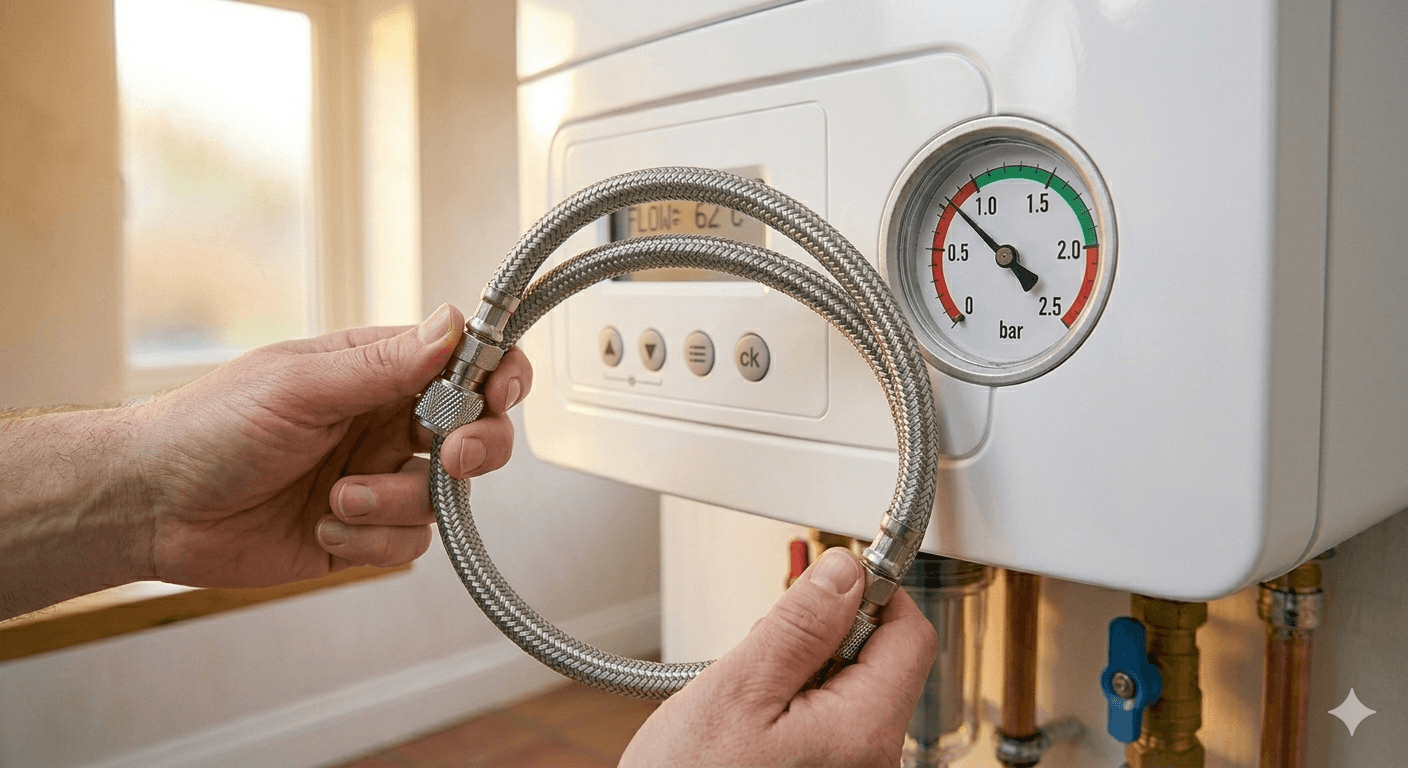
Low boiler pressure is one of the most common fault calls we deal with across Milton Keynes — and the good news is that nine times out of ten you can fix it yourself in under five minutes. This guide explains exactly how to repressurise your boiler, covers the differences between the four big brands (Worcester Bosch, Vaillant, Baxi and Ideal), and tells you when low pressure is a sign of something more serious that needs a Gas Safe engineer.
What Boiler Pressure Should Be
Modern combi and system boilers run on a sealed pressurised circuit. The gauge on the front of the boiler tells you how much pressure is in that circuit:
- Cold system (heating off, water cool): 1.0 to 1.5 bar
- Hot system (heating running, radiators warm): 1.5 to 2.5 bar
- Lock-out threshold: typically below 0.5 bar — the boiler will refuse to fire
- Pressure relief valve trip: usually 3 bar — system will dump water outside
If your gauge sits below 1 bar when the system is cold, repressurising is the fix. If it sits above 2.5 bar when cold, you've overfilled and need to bleed some out — see our radiator bleeding guide for the easiest way to do that.
When You Should Repressurise
- After bleeding one or more radiators
- Following a boiler service or repair
- If you see a low-pressure fault code (F22 on Vaillant, EA227 / E9 on Worcester, F75 / F12 on Baxi, F1 / L2 on Ideal)
- If the boiler keeps locking out on a cold morning
- After draining and refilling a radiator
When You Should NOT Just Keep Topping It Up
If your boiler pressure drops back down within hours or days of repressurising — and you haven't bled any radiators — you've got a leak somewhere. Repeatedly topping up a leaking system causes serious long-term damage: limescale build-up inside the boiler, sludge in the radiators, and eventually a failed heat exchanger.
If you've topped up more than twice in a month, stop and book a boiler repair. The full troubleshooting steps are in our boiler losing pressure guide.
What You'll Need
- Your boiler manual — or a 2-minute online search for "[brand model] filling loop" — to confirm valve location
- A torch — the filling loop usually lives underneath the boiler in a poorly lit cupboard
- A small cloth — to wipe up the inevitable drip
- Patience — open valves slowly. Rushing causes water hammer and stresses the seals.
Step-by-Step: How to Repressurise Your Boiler
- Turn off the boiler. Switch it off at the main control or front panel. Not strictly essential but it stops the boiler firing while you work.
- Locate the filling loop. Look underneath the boiler. You're looking for a silver braided hose, usually about 30cm long, with a valve at each end. On some models the filling loop is internal — see the table below for brand-specific notes.
- Check both valves are currently closed. They should sit at right angles to the pipe (handle perpendicular). If they're inline with the pipe, they're already open — close them first.
- Open the first valve slowly. Turn it a quarter turn anticlockwise. You should hear nothing.
- Open the second valve slowly. Turn it a quarter turn anticlockwise. You should hear water flowing into the boiler — a soft hissing or rushing sound.
- Watch the pressure gauge. The needle will start climbing. Keep watching — this is not a fit-and-forget step.
- Close both valves at 1.2 bar. When the needle reaches 1.2 bar (somewhere between 1 and 1.5 is fine), close the second valve, then the first, by turning them clockwise until they stop. Hand-tight is enough.
- Wipe up any drips. A few drops from the filling loop are normal. Significant leaking after closing isn't — call an engineer.
- Turn the boiler back on. Press the reset button if a fault code is showing. The boiler should fire normally.
- Recheck pressure in 24 hours. Should still be 1-1.5 bar cold. If it's dropped, you may have a leak.
Filling Loop Location by Brand
| Brand | Filling Loop Location | Target Pressure |
|---|---|---|
| Worcester Bosch | External silver braided hose underneath the boiler on most Greenstar models. Newer Greenstar 8000/Lifestyle models have an internal "Easy Filling" key (a small white plastic key clipped to the boiler). | 1.0 - 1.5 bar |
| Vaillant | Under the boiler on the right-hand side for ecoTEC Plus and Pro models. The valve is usually a blue or white plastic tap. Some newer Vaillants have an internal filling system operated from the control panel. | 1.0 - 1.5 bar |
| Baxi | Underneath the boiler, behind a small drop-down panel on Platinum and Duo-tec models. Often two black plastic valves at right angles. Some older Baxi models use an external silver hose. | 1.2 - 1.5 bar |
| Ideal | External silver braided filling loop underneath the boiler on Logic and Vogue models. Look for two valves with red or blue handles. Newer Heat models have an "Auto-Fill" feature. | 1.0 - 1.5 bar |
| Other (Glow-worm, Potterton, Alpha) | Almost always an external silver braided loop underneath. Same principle: open both valves slowly, watch gauge, close at 1.2 bar. | 1.0 - 1.5 bar |
What If You Can't Find the Filling Loop?
A few situations to consider:
- Internal filling loop: Some newer Worcester, Vaillant and Ideal boilers have built-in filling systems operated from the control panel — no external hose. Check your boiler manual. Operation is usually: hold a specific button, watch the digital pressure readout climb, release at 1.2 bar.
- Removed filling loop: A few installers (incorrectly) remove the filling loop hose after install. You'll need an engineer to refit one.
- Hidden behind cabinetry: In some Milton Keynes new-builds, the filling loop is hidden behind a removable kitchen cabinet panel below the boiler.
If after a thorough look you genuinely can't find it, don't force any valve you're not sure about. Call us and we can usually talk you through it on the phone, or come out the same day if needed. We cover everywhere from Bletchley up to Newport Pagnell.
Can You Overfill a Boiler?
Yes, easily. If you open the filling loop and walk off to make tea, the gauge will climb past 1.5 bar, past 2 bar, and eventually hit 3 bar — at which point the pressure relief valve trips and dumps water out of an external pipe on the wall of your house.
If you've overfilled to between 1.5 and 2.5 bar cold, the easiest fix is to bleed a small amount of water from a radiator. Open the bleed valve briefly, let water out into a container, close it, and recheck the gauge.
If pressure has climbed above 2.5 bar cold or 3 bar hot, the boiler has likely tripped its pressure relief and dumped water outside. You'll see this as water on the driveway or pavement under an external white plastic pipe sticking out of the wall. The system will need a proper recheck — see our piece on common central heating problems in MK.
Why Does My Pressure Keep Dropping?
If you've repressurised but the pressure drops back down within days, something is letting water out of the system. Common causes ranked by frequency:
- Pressure relief valve dripping (look for water at the external white pipe outside)
- Failing expansion vessel — internal to the boiler, common after 8+ years
- Microleak from a pipe joint or radiator valve
- Cracked radiator, often from sludge corrosion in older systems
- Faulty pressure sensor giving false low readings
Full diagnosis is in our boiler losing pressure article.
When to Call a Gas Safe Engineer
Repressurising via the filling loop is water-side work and completely safe DIY. But these situations need a professional:
- You can't locate or operate the filling loop after 10 minutes of trying
- Pressure drops below 0.5 bar repeatedly
- You hear a hissing noise that doesn't stop when valves are closed
- The pressure relief pipe outside is dripping
- Any fault code that doesn't clear after repressurising and resetting
- You smell gas — leave the property, call 0800 111 999
Plumbline MK are Gas Safe registered and cover all of Milton Keynes for boiler repair, servicing and emergency callouts. Annual boiler servicing catches expansion vessel and pressure-side issues before they leave you with no heating.
Need expert help? Contact Plumbline MK for a free, no-obligation quote. Call 07805 844 016 for same-day response across Milton Keynes and surrounding areas.
Frequently Asked Questions
How often should I have to repressurise my boiler?
A healthy sealed heating system should only need repressurising once or twice a year, usually after bleeding radiators at the start of the heating season or following a service. If you're topping up monthly, weekly, or more often than that, you've got a leak somewhere in the system and need a Gas Safe engineer to investigate.
What if my boiler doesn't have a filling loop?
Most modern boilers have a filling loop — either external (a silver braided hose under the boiler) or internal (operated from the control panel). If neither is present, your boiler may have an alternative filling system specific to that brand and model. Check the manual or call a Gas Safe engineer. Never improvise a filling method using mains pipework.
Can I overfill the boiler?
Yes. If you leave the filling loop open the gauge will climb past 1.5 bar, past 2 bar, and at around 3 bar the pressure relief valve will trip and dump water outside. Stay with the boiler while filling, and close both valves the moment the gauge hits 1.2 bar. If you do overfill slightly, bleeding a radiator briefly will release the excess.
Why does my pressure keep dropping every day?
Daily pressure drops always mean water is leaving the system somewhere. The four most common culprits are a dripping pressure relief valve (water on driveway under external pipe), a failing expansion vessel inside the boiler, a microleak at a pipe joint, or a cracked radiator. A heating engineer can usually diagnose which on a single visit.
Can a heating leak be hidden inside walls or under floors?
Yes — pinhole leaks in pipework under floorboards or behind plaster are one of the trickier causes of constant pressure loss. Engineers use thermal imaging cameras or leak detection gear to find them. If your pressure drops daily and there's no visible damp patch or external relief valve drip, a leak detection callout is the next step.
Need Professional Advice?
Our Gas Safe registered engineers are ready to help with all your heating needs. Get a free, no-obligation quote today.