How to Bleed a Radiator: MK Step Guide
TL;DR
Turn off the heating, fit a radiator key to the bleed valve at the top, give it a quarter turn anticlockwise, wait for the hiss to stop and a steady drip of water to appear, then close the valve. Check your boiler pressure afterwards and top up to 1.2 bar if it has dropped. Bleed downstairs first on combi systems, upstairs first on vented systems. Black or dirty water means sludge — call a Gas Safe engineer.
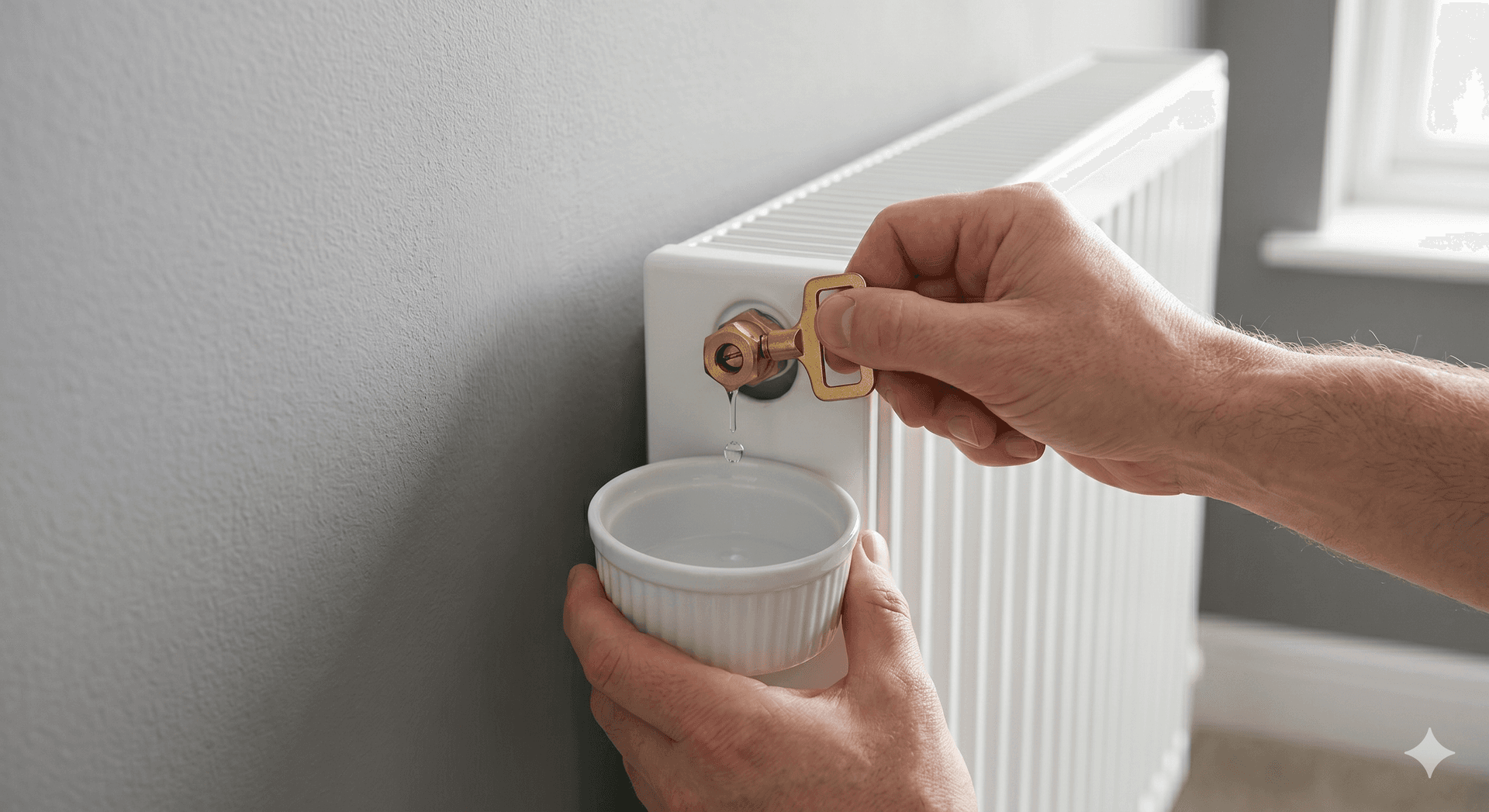
If your radiators feel cold at the top but warm at the bottom, take ages to heat up, or gurgle every time the heating kicks in, the cause is almost always trapped air. Bleeding the radiator releases that air and lets hot water circulate properly again — and it's one of the few jobs you can safely do yourself, no Gas Safe ticket required.
This guide walks you through the process step by step the way we'd do it on a callout in Milton Keynes. We'll cover what you need, the right order to bleed radiators in different system types, what to watch out for, and when to stop and call an engineer.
Signs Your Radiators Need Bleeding
Trapped air rises to the top of each radiator and stops hot water reaching that section. You'll usually notice one or more of the following:
- Cold patch at the top of the radiator while the bottom feels normal or warm
- Gurgling, bubbling or trickling noises from the radiator when the heating fires up
- Slow warm-up times — rooms that used to be cosy in 20 minutes now take an hour
- Some radiators stone cold while others on the same floor get hot
- Boiler short-cycling or running for longer than usual to reach temperature
Bleeding is a 10 minute job per radiator. If you've never done it before, don't worry — it's genuinely one of the easier home maintenance tasks, and you only need a couple of pounds' worth of kit.
What You'll Need
- Radiator bleed key — about £2 from Wickes, B&Q, Screwfix or any DIY shop in MK. Some modern radiators use a flat-head screwdriver instead — check the bleed valve before you start.
- Old cloth or rag — to catch drips and grip the key.
- Small container or jug — to catch water once the air is out. A mug or a takeaway tub works fine.
- Towel — to lay underneath the radiator and protect carpet or flooring.
- Pair of pliers (optional) — only if the bleed nipple is stiff. Be gentle.
Step-by-Step: How to Bleed a Radiator
- Turn off the heating. Switch the boiler off at the thermostat or programmer and let the system cool for at least 20-30 minutes. Bleeding a hot, pressurised radiator risks scalding — the water inside can be 70°C or hotter.
- Lay your towel under the radiator. Put it directly beneath the bleed valve (top corner of the radiator, either left or right) to catch any drips.
- Find the bleed valve. It's a small square nipple at one of the top corners of the radiator. On older radiators it'll need a bleed key; on newer ones it might take a flat-head screwdriver.
- Hold the cloth around the valve. Wrap your cloth around the key so any water that escapes runs down into your container, not over the wall or carpet.
- Turn the key a quarter turn anticlockwise. You should hear a hiss as air starts escaping. Don't open it any further — a quarter turn is plenty.
- Wait for the hiss to stop. This usually takes 20-60 seconds. The air will be replaced by a steady trickle of water.
- Close the valve as soon as water appears. Turn the key clockwise until it's hand-tight. Don't overtighten — you'll damage the valve.
- Wipe up any drips. Move on to the next radiator and repeat.
- Check the boiler pressure. Once you've bled all the radiators that needed it, look at the pressure gauge on the front of your boiler. If it's dropped below 1 bar, you'll need to repressurise the boiler using the filling loop.
- Turn the heating back on. Wait for the radiators to come up to temperature and check each one — top and bottom should be evenly warm.
What Order Should You Bleed Multiple Radiators?
This is the bit most online guides get wrong, and it does matter — especially if you've got air in several radiators or you've recently had work done on the system.
| System Type | Bleed Order | Why |
|---|---|---|
| Combi boiler (pressurised) | Downstairs first, then upstairs | Pressure pushes air upwards. Bleeding downstairs first forces remaining air up to upstairs radiators where it's easier to release. |
| Vented system (header tank in loft) | Upstairs first, then downstairs | The header tank refills the system by gravity. Bleeding upstairs first lets the tank top up downstairs as you work. |
| System boiler (unvented cylinder) | Downstairs first, then upstairs | Treat like a combi — the system is pressurised, so air collects at the highest points. |
| Single radiator only | Just that one | If only one radiator is affected, no need to do the rest. Bleed it on its own and recheck the next day. |
Not sure what system you have? Look at your boiler. If there's a pressure gauge on the front and no tank in the loft, you've got a combi or system boiler. If there's a small water tank in the loft and no gauge on the boiler, you've got a vented system. Most Milton Keynes homes built after 2000 — and a lot of older ones that have been upgraded — run combi boilers.
What If No Water Comes Out?
You've opened the bleed valve, you can hear hissing or you can't hear anything at all, and water never appears. There are a few possible causes:
- System pressure is too low. Check the boiler gauge — if it's below 0.5 bar, there's not enough water in the system to push out of the bleed valve. Top up via the filling loop first, then try bleeding again.
- Bleed valve blocked with corrosion. Older radiators in hard water areas of MK can get scale or sludge clogging the bleed nipple. A gentle prod with a pin can sometimes clear it — but if it won't budge, call an engineer rather than forcing it.
- Radiator valve closed. Check the lockshield valve and TRV at the bottom of the radiator are both open.
- Frozen pipe — rare, but possible in a cold snap if the pipe runs through an unheated loft or garage.
If you've checked pressure and valves and you still can't bleed the radiator, that's the point to stop and call a professional. Forcing a stuck bleed nipple risks snapping it off, which means the whole valve has to be replaced. Our boiler and heating repair service covers exactly this kind of thing across all Milton Keynes postcodes.
What If the Water Comes Out Dirty or Black?
Clean system water should look pale yellow or clear, possibly with a slight pink tinge from corrosion inhibitor. If what comes out of your bleed valve is jet black, brown, or full of grit, you've got a sludge problem.
Sludge is iron oxide — rust — that builds up over time as the metal inside radiators and pipework corrodes. It settles at the bottom of radiators, blocks pipes, damages pumps, and reduces heating efficiency dramatically. A few of the MK areas with harder water — parts of Bletchley, Wolverton and Newport Pagnell — see this more frequently because limescale and sludge compound each other.
You can't fix sludge by bleeding. The solution is a power flush — a chemical cleanse of the entire heating system, typically £450-£800 in Milton Keynes depending on the number of radiators. We cover this in detail in our guide to common central heating problems in MK.
What If the Pressure Drops After Bleeding?
This is normal. When you release air from radiators, the system needs to replace that volume with water, so pressure on the boiler gauge will drop — sometimes from 1.5 bar down to 0.5 bar after bleeding several radiators.
Top the system back up to between 1 and 1.5 bar using the filling loop. If you don't know how, our full repressurise your boiler guide covers all the main brands.
If pressure keeps dropping over the days that follow — and you're sure you've fully closed all bleed valves — you may have a leak somewhere. See our guide to boiler losing pressure in Milton Keynes for diagnostic steps.
When to Call a Gas Safe Engineer Instead
Bleeding radiators is safe DIY because it only involves the water side of the heating system. You're not touching the gas supply, the boiler casing, or any electrical components. However, certain situations need a professional:
- Bleed nipple stuck, stripped, or snapped
- Water coming out black, brown or full of grit
- Radiators that fill with air again within days of bleeding
- Boiler losing pressure repeatedly even after you've stopped bleeding
- Visible leaks from valves, joints or the radiator body
- You smell gas at any point — leave the property and call 0800 111 999
Plumbline MK are Gas Safe registered (number available on request) and cover the whole of Milton Keynes, including Bletchley, Newport Pagnell, Wolverton, Stony Stratford, Bradwell and the new-build estates out towards Tattenhoe and Broughton. We do same-day callouts for heating faults and offer fixed-price quotes before any work begins.
Need expert help? Contact Plumbline MK for a free, no-obligation quote. Call 07805 844 016 for same-day response across Milton Keynes and surrounding areas.
Frequently Asked Questions
How often should I bleed my radiators?
Most households need to bleed radiators once a year, usually at the start of the heating season in October or November. If you find yourself bleeding the same radiator every few weeks, that's a sign air is being drawn into the system somehow — common causes include an auto-air vent stuck open, a failing expansion vessel, or a leak. Get a Gas Safe engineer to investigate rather than just keep bleeding it.
Can bleeding a radiator damage my boiler?
No — bleeding itself is safe. The risk is forgetting to repressurise the boiler afterwards. If you bleed several radiators and the system pressure drops below 0.5 bar, the boiler will lock out and may show a low-pressure fault code. Always check the pressure gauge after bleeding and top up to 1.2 bar via the filling loop if needed.
What if there's no air in my radiator but it's still cold at the top?
If you've bled the radiator, no air came out, and it's still cold at the top, the next likely cause is poor circulation — either a partially closed valve, a failing pump, or the radiator being last in the line and not getting enough flow. The system may need balancing, which a heating engineer can do quickly.
Will my boiler pressure drop after bleeding?
Yes, usually. Releasing air from radiators reduces the total volume of water and gas in a sealed system, so pressure drops. After bleeding, check the boiler pressure gauge and use the filling loop to top up to between 1 and 1.5 bar when the system is cold. If you've bled several radiators in one session, expect a noticeable drop.
The water that came out is black — what should I do?
Black water means sludge — iron oxide build-up from internal corrosion. Bleeding won't fix this. You need a power flush to chemically clean the system, typically £450-£800 in Milton Keynes. Left untreated, sludge will damage the pump, block radiators, and shorten the life of your boiler. Book a heating system inspection to confirm the diagnosis.
Need Professional Advice?
Our Gas Safe registered engineers are ready to help with all your heating needs. Get a free, no-obligation quote today.