Radiator Not Heating Up? Eight Causes and Fixes
TL;DR
Where the radiator is cold tells you why. Cold at the top is air: bleed it. Cold along the bottom is sludge: it needs flushing. One radiator cold while the rest are hot is nearly always a stuck thermostatic valve pin. All upstairs cold is air plus balancing. All downstairs cold points to the pump. Every radiator cold is a boiler-side fault. Bleeding, opening valves and freeing a pin are safe DIY; pumps, valves and flushing are engineer jobs.
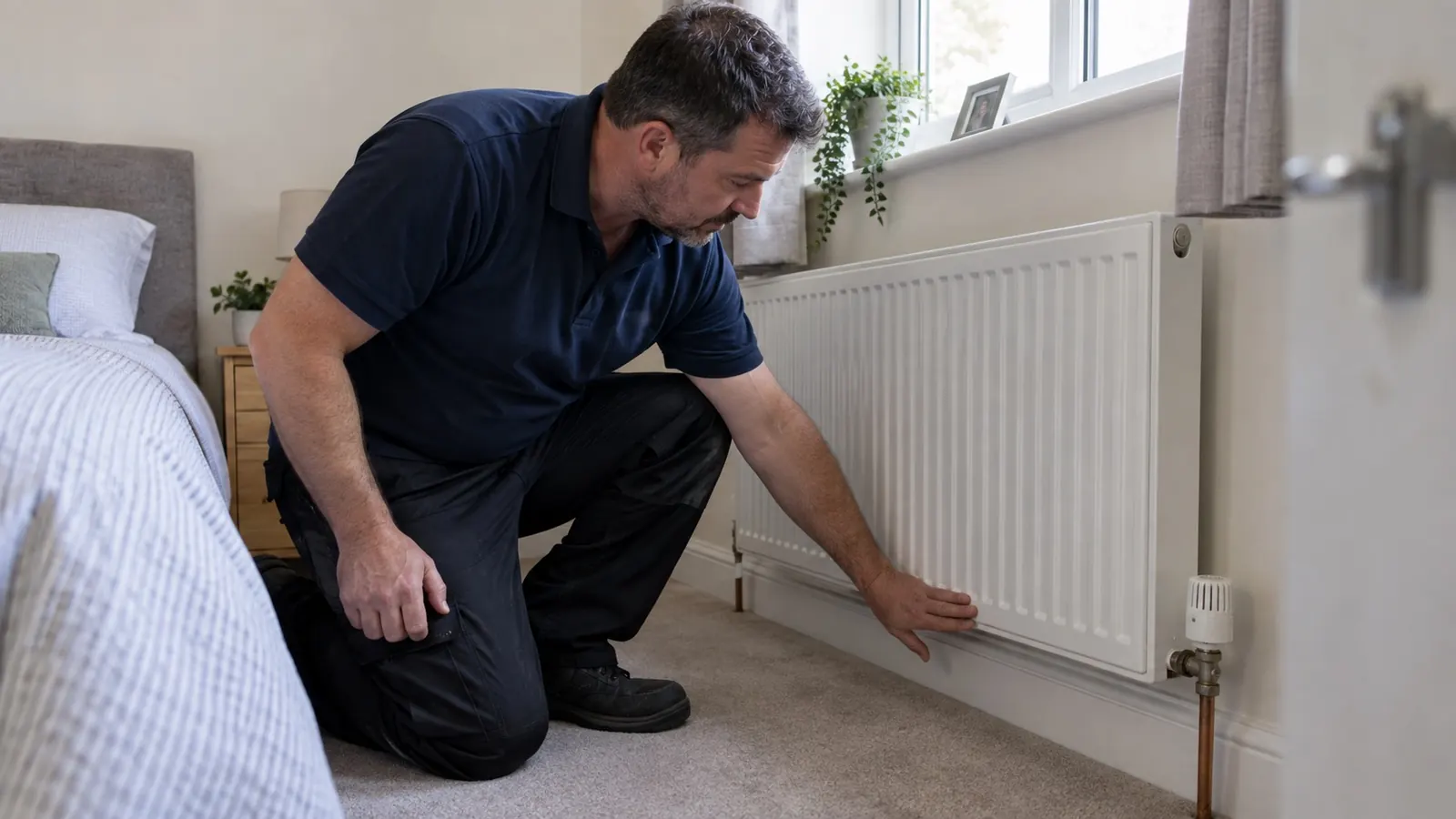
"My radiator isn't heating up" is one of the most common heating calls there is, and the cause depends on two things: where on the radiator it is cold, and whether it is one radiator or several. Get those two answers and you are most of the way to the fix. Most of the eight scenarios below are things you can sort yourself. A few need an engineer, and we say which.
Match the symptom to the cause
- Cold all over, one radiator only: valve closed or a stuck thermostatic valve pin. DIY.
- Cold at the top, warm at the bottom: trapped air. Bleed it. DIY.
- Warm at the top, cold along the bottom: sludge. Needs flushing. Engineer.
- Cold in the middle, warm at the edges: limescale or sludge sitting across the base. Engineer.
- One cold, all the others hot: stuck pin. DIY.
- All upstairs cold, downstairs fine: air plus poor balancing. Part DIY.
- All downstairs cold, upstairs fine: weak or failing pump. Engineer.
- Every radiator cold: boiler-side fault. Engineer, after the basic checks.
1. One radiator cold all over
Stone cold top to bottom while the rest of the house is fine. Two likely causes.
The thermostatic valve is closed or stuck. Turn the dial fully to off, then fully to maximum, and wait ten minutes. If it warms up, it was simply set low or the pin was on the edge of sticking. If not, see scenario 5.
The lockshield is closed. The valve at the other end has a plain plastic cap. Pull the cap off and turn the spindle anticlockwise a couple of turns with a small spanner or adjustable. It was probably closed during decorating or a floor job and never reopened.
2. Cold at the top, warm at the bottom
Air. It collects at the top of the radiator and stops the water reaching it. Bleeding takes five minutes and a radiator key. Full walkthrough in our guide to bleeding a radiator. Afterwards check the boiler pressure and top up if it has dropped; our guide to what the pressure should be covers it.
3. Warm at the top, cold along the bottom
Sludge. Years of internal corrosion make a black iron oxide sediment that settles at the lowest point and blocks the flow across the bottom of the panel. Bleeding will not shift it. Tapping will not shift it. The radiator needs flushing.
Two levels of fix. If it is one radiator, it can be taken off the wall, carried outside and hosed through until the water runs clear. If it is several radiators, and especially if the water that comes out when you bleed is black, the whole system needs a powerflush and fresh inhibitor. An engineer should tell you which by looking at the water, not default to the bigger job.
4. Cold in the middle, warm at the edges
Less common and mostly a hard water area problem. Limescale and sludge build up across the base and create a cold zone in the middle while water still finds its way round the edges. The fix is the same family as scenario 3: flush the radiator or the system, then protect it with inhibitor and, ideally, a magnetic filter on the return to the boiler.
5. One radiator cold, all the others hot
The most common scenario of all, and the fix is free. Inside every thermostatic radiator valve is a small spring-loaded pin. It rises to let water through and drops to shut it. Over summer, with the heating off, the pin can stick in the down position. When the heating comes back on in October, that radiator stays cold.
To free it:
- Turn the dial to off, then unscrew or unclip the head. It comes off in your hand and leaves a small brass pin sticking out of the valve body.
- Press the pin down with a finger. It should spring straight back up.
- If it is stuck down, tap it gently sideways with a small spanner or the handle of a screwdriver, and wiggle it. Do not hammer it. Do not use pliers to pull it, because the pin can come out and the valve will pour water.
- Once it springs freely, refit the head, set the dial to 3 or 4 and give it twenty minutes.
If the pin will not free, the valve needs replacing. That means isolating or draining, so it is a job for a plumber. Our guide to radiator valve types helps if you want to choose the replacement yourself.
6. All upstairs radiators cold, downstairs fine
Usually two things at once. Air rises to the highest radiators, so bleed all the upstairs ones first, starting with the one furthest from the boiler, then top up the pressure. Second, the system is out of balance: the downstairs radiators nearest the boiler are grabbing all the flow. Balancing means adjusting each lockshield so the flow is shared fairly. You can attempt it yourself with a pair of pipe thermometers and patience; an engineer does it in about an hour.
7. All downstairs radiators cold, upstairs fine
The opposite pattern usually means the circulating pump is weak or partly seized. It cannot push water round the longer ground-floor runs, while upstairs still gets warm. Pump replacement is an engineer job. Some pumps have a slot on the head that can free a stuck impeller, but the pump is often inside the boiler casing, and inside the casing is Gas Safe registered work only.
8. Every radiator in the house cold
If nothing is getting warm, the problem is upstream at the boiler. Check:
- The thermostat is calling for heat and the programmer is on.
- The boiler display for a fault code.
- The pressure gauge reads between 1 and 1.5 bar cold.
- Whether the boiler fires at all when heat is called.
- In freezing weather, the condensate pipe outside for ice.
If hot water from the taps still works but no radiators heat, it is a heating-side fault: usually the diverter valve, a motorised valve, the pump or the circuit board. Our guide to central heating not working takes you through it.
Quick flowchart
- Is more than one radiator affected? No: scenarios 1 to 5. Yes: carry on.
- Are all of them cold? Yes: scenario 8. No: carry on.
- Only upstairs? Scenario 6. Only downstairs? Scenario 7.
- Mixed pattern: bleed every affected radiator, top up, and re-check. Still cold, call.
What not to do
- Do not take a radiator off the wall unless you know how to close both valves, count the lockshield turns and catch the water. It holds more than you think.
- Do not pour leak sealer or "radiator silencer" liquids in without advice. They can gum up the boiler.
- Do not keep topping up the pressure if it keeps dropping. See our guide to a boiler losing pressure.
- Do not open the boiler casing or touch anything on the gas side. Gas Safe registered work only.
One honest point that a lot of heating firms would rather not print: a powerflush is not always the answer to cold radiators. One sludged radiator on an otherwise clean system can be taken off and hosed out. A system that has never had inhibitor and runs black water does need flushing, and fitting a new boiler onto it without doing so is how a ten-year warranty gets refused. Ask to see the water before you agree to either.
When to call an engineer
- You have bled the radiator and it is still cold.
- Black or brown water came out when you bled it.
- Several radiators are cold in a pattern that does not match 2, 5 or 6.
- You suspect the pump or the boiler.
- The pin will not free with a gentle tap.
- The whole house is cold and the basic checks have not fixed it.
- You smell gas: leave the property and call 0800 111 999.
If you are in Milton Keynes or the surrounding towns and it has gone beyond bleeding and valves, Plumbline MK is Gas Safe registered (957816). Our heating repair visits cover valve replacement, balancing, pumps and flushing, and we quote before we start rather than after. Get in touch and tell us which of the eight it looks like; it saves time on the day.
Frequently asked questions
Why is one radiator cold when the others are fine?
Nearly always a stuck pin in the thermostatic valve after a summer off. Take the head off, tap the pin gently sideways until it springs, refit the head. If it will not move, the valve needs replacing.
Why are my upstairs radiators cold but downstairs is fine?
Air at the top of the system plus poor balancing. Bleed every upstairs radiator, top up the pressure, then have the system balanced if they are still slow.
Do I really need a powerflush?
If the bottoms of several radiators are cold and the water runs black when you bleed, yes. If it is one radiator, taking it off and hosing it through may be all it needs. Judge it on the water.
Can I fix a cold radiator myself?
Bleeding, opening a closed valve and freeing a stuck pin are safe. Anything inside the boiler, replacing a pump or valve, or flushing the system is for a Gas Safe registered engineer or plumber.
Need Professional Advice?
Our Gas Safe registered engineers are ready to help with all your heating needs. Get a free, no-obligation quote today.