Central Heating Not Working? How to Find the Fault
TL;DR
Most central heating faults come down to a short list: trapped air, sludge, low pressure, a stuck valve, a tired pump or a thermostat not calling for heat. Start with the simple checks: power, thermostat, programmer, pressure gauge and the condensate pipe in cold weather. Bleed a radiator that is cold at the top. Cold at the bottom means sludge and needs a professional flush. Anything inside the boiler or on the gas side is a Gas Safe engineer's job.
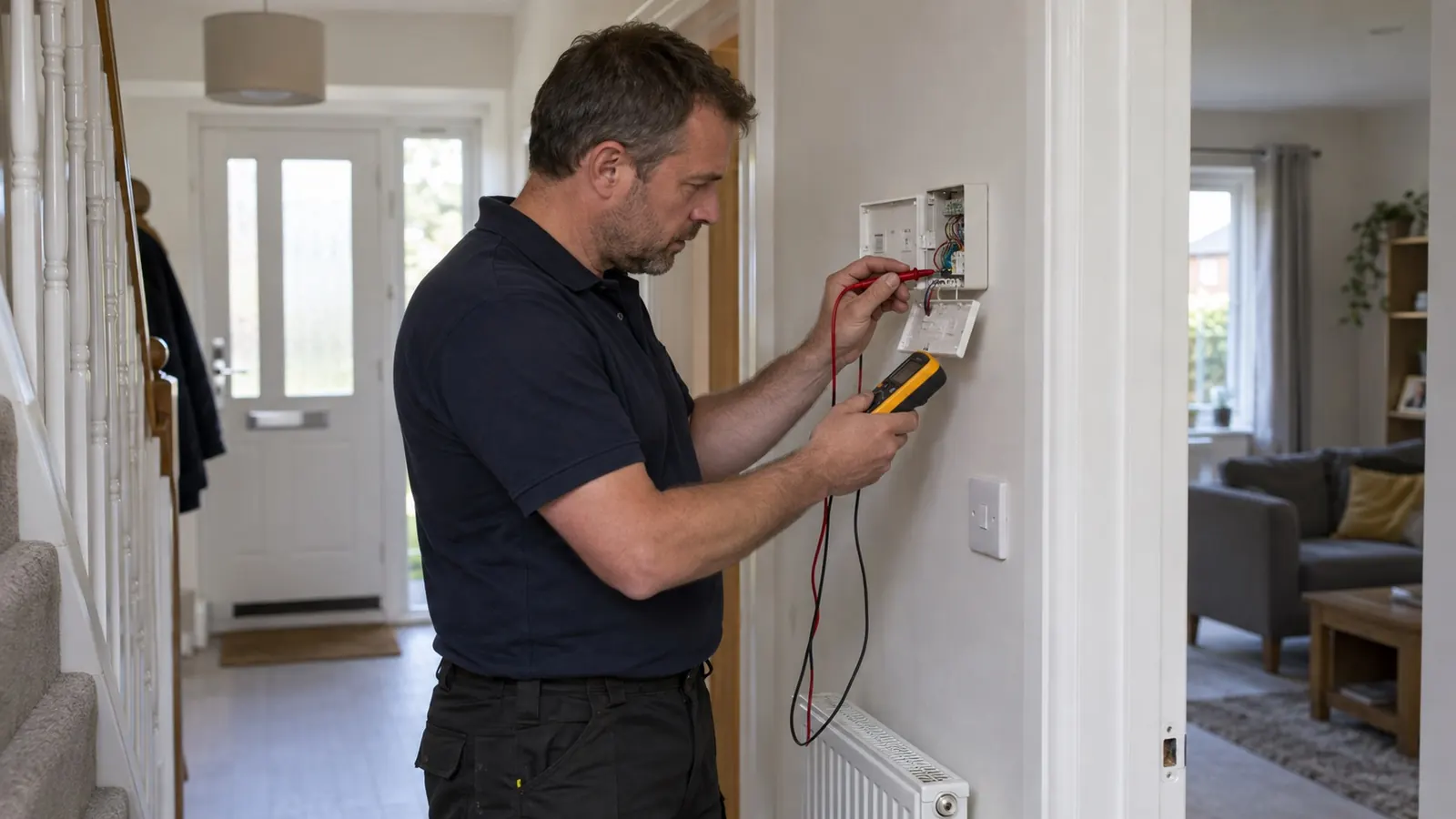
Coming home to a cold house when the heating should be on is miserable, and the boiler is not always the culprit. A central heating system is simple in principle: the boiler heats water, a pump pushes it round the pipes, radiators give the heat off, and a thermostat and programmer tell the boiler when to run. When it stops working, the fault is in one of those parts, and the pattern of what is cold and what is warm usually tells you which.
This guide walks through the faults in the order we would check them, says which ones you can safely sort yourself, and is clear about where the line is. Anything on the gas side or inside the boiler casing is a Gas Safe registered engineer's job by law. Bleeding radiators, topping up pressure, checking the thermostat and the condensate pipe are all fine for a homeowner.
Start here: what is the pattern?
- Everything cold, boiler silent. Power, controls, pressure or a lockout. Work through the basic checks below.
- Boiler runs but every radiator stays cold. Pump, diverter valve or a serious air lock. Engineer.
- One radiator cold, the rest fine. Stuck thermostatic valve or the valve is shut. Usually a homeowner fix.
- Radiators cold at the top. Trapped air. Bleed them.
- Radiators cold along the bottom. Sludge. Needs a flush.
- Upstairs hot, downstairs cool, or the far end of the house never warms. Balancing, or a pump that is losing its strength.
- Heating fine but no hot water, or the other way round. Diverter valve on a combi. Engineer.
- Banging or rumbling from the boiler. Kettling from scale. Engineer.
The five-minute checks before you ring anyone
A surprising number of call-outs end with the engineer pressing a button.
- Power. Is the boiler display lit? Check the fused spur next to the boiler and the consumer unit. A power cut can also wipe a programmer's schedule.
- Thermostat and programmer. Is the room thermostat set above the current room temperature, and is the programmer actually in an on period? Wireless and smart thermostats run on batteries or lose their connection. Change the batteries before you assume the worst.
- Pressure gauge. On a sealed system the gauge should read between 1 and 1.5 bar when cold. Below about 0.5 bar most boilers refuse to fire. Top up through the filling loop following the boiler manual, slowly, and stop at 1.5. Our guide to a boiler losing pressure explains what it means if it keeps dropping.
- Condensate pipe. In a cold snap, a boiler that has stopped overnight with a fault code has very often got a frozen condensate pipe. Pour warm, not boiling, water along the frozen section, then reset the boiler. If it happens every winter, the pipe needs re-routing or lagging.
- Reset once. If the display shows a fault code, write it down, then press reset once. If it locks out again, stop. Repeated resets do not fix anything and can make a real fault worse.
Cold radiators
Cold at the top, warm at the bottom. Air. Bleeding it takes a minute per radiator with a radiator key and a cloth. Start furthest from the boiler and work back, then check the pressure gauge because bleeding drops it. Full steps are in our how to bleed a radiator guide. If you are bleeding the same radiators every few weeks, air is getting in somewhere, which usually means a small leak or a pump pulling air, and that needs looking at.
Warm at the top, cold at the bottom. Sludge. Black iron oxide, called magnetite, settles in the bottom of radiators and blocks the flow. Bleeding does nothing for it. The fix is a proper system clean with a pump and chemicals, a magnetic filter to stop it coming back, and inhibitor. In hard water areas sludge and scale build faster, which is why we see so much of it in Milton Keynes. Our guide on whether you need a powerflush helps you decide.
One radiator stone cold, the rest fine. Check the thermostatic radiator valve. Take the plastic head off (it unscrews or unclips, no tools on most) and you will see a small pin. If it is stuck down, press it gently a few times until it springs up. Also check the lockshield valve on the other end has not been closed. If the pin will not free, the valve needs replacing, which is a quick plumbing job.
Some rooms hot, some never quite warm. The system needs balancing. Each radiator has a lockshield valve that sets how much water flows through it. Radiators near the boiler hog the flow unless the lockshields are adjusted so everything heats at a similar rate. It is safe to do yourself but fiddly, and most people are happier having it done during a service. If balancing does not solve it the pump may be on too low a speed, or partially blocked with sludge.
Noises
Gentle ticking as pipes warm up and cool down is normal. Gurgling is air, so bleed. A deep rumble or bang from the boiler itself is kettling: scale on the heat exchanger making water boil in pockets. It is common in hard water areas and it shortens the boiler's life, so book an engineer rather than living with it. Our separate guide to a boiler making a banging noise goes into detail. A loud thump from pipes under the floor when a valve closes is usually water hammer or a loose clip.
The boiler runs but nothing gets warm
If you can hear the boiler fire and the pipes near it get hot but the radiators stay cold, the water is not being moved. Possible causes are a seized or failed pump, a motorised or diverter valve that is stuck, or an air lock in the pump after the system has been drained. Put a hand near the pump: it should be warm with a faint vibration. None of these are homeowner jobs. Replacing a pump or valve means draining part of the system and working on the heating circuit, and on a combi these parts are inside the casing.
Leaks
A damp patch under a radiator valve, green or white crust on a fitting, or a pressure gauge that keeps falling all point to a leak. Do not tighten fittings at random; over-tightening a compression joint makes it worse. Turn the heating off, put a bowl under it and get it looked at. If water is running rather than dripping, turn the water off at the stopcock and call an emergency plumber.
Is it an emergency or can it wait?
Call straight away if you smell gas (ring the National Gas Emergency Service on 0800 111 999 first, then leave the boiler alone), if water is leaking and you cannot stop it, if there is no heating at all in freezing weather and someone in the house is elderly, very young or unwell, or if the boiler is banging loudly and locking out repeatedly.
A single radiator cold at the top, a thermostat that needs batteries, a one-off pressure top-up or slightly uneven heating can wait for a normal appointment. Sort them soon, but not at an out-of-hours rate.
What you can do and what you should not
Fine to do yourself: bleed radiators, top up pressure through the filling loop, change thermostat batteries and check the schedule, free a stuck TRV pin, adjust lockshields to balance, thaw a condensate pipe, reset the boiler once.
Leave to a Gas Safe registered engineer: anything inside the boiler casing, the gas supply or the flue, replacing a pump or motorised valve, tracing and fixing leaks, powerflushing, adding inhibitor to a sealed system, adding a radiator.
Before you call, note the boiler make and model, any fault code, the pressure reading and which radiators are affected. It often means the right part is on the van.
Why the type of house matters
The same symptom can have different causes in different homes. In Milton Keynes, the 1970s and 1980s grid-square estates often have microbore pipework: narrow pipes that clog with sludge sooner than standard 15mm and are harder to flush. Newer estates were mostly built with combis, but a system fitted without a magnetic filter can still sludge up within a few years in this water. The older stone villages and the Victorian terraces in Wolverton and Stony Stratford sometimes still run open-vented systems with a tank in the loft, which behave differently: pressure is set by the tank height, air locks are more common, and the pressure gauge advice above does not apply.
One honest point: a lot of the heating problems we are called to were caused by the last person who worked on the system topping up the pressure and leaving, without asking why it dropped. Topping up is fine. Topping up every fortnight is a leak, and every top-up brings in fresh hard water that feeds scale and corrosion. If your heating has been unreliable for a while, ask for the cause, not just the quick fix.
When it is beyond DIY
If you have worked through the checks and the heating is still not right, it needs someone with the tools to test the pump, the valves and the flow and return temperatures properly. Plumbline MK is Gas Safe registered (957816) and covers central heating and boiler repairs across Milton Keynes, Newport Pagnell, Bletchley, Wolverton, Stony Stratford and the surrounding towns. Get in touch and tell us what you have found so far; it usually gets you a faster answer.
Frequently asked questions
Why is my heating on but the radiators are cold?
If the boiler is firing, the water is not circulating. The usual causes are a failed pump, a stuck diverter or zone valve, or an air lock. If only some radiators are cold, it is more likely air, sludge or balancing. Check the pattern first, then decide whether it is a bleed job or an engineer's visit.
Can I bleed my radiators myself?
Yes. It is safe and needs nothing more than a radiator key and a cloth. Turn the heating off first, open the bleed valve a quarter turn until water appears, close it, and check the boiler pressure afterwards.
How often should the pressure need topping up?
Rarely. Once or twice a year after bleeding is normal. Monthly or more means water is escaping somewhere, even if you cannot see it, and the leak needs finding rather than the gauge being topped up indefinitely.
When should I think about replacing the system rather than repairing it?
When the boiler is well past ten years old, repairs are becoming frequent, and a single repair quote is approaching half the cost of a replacement. Our guide to the repair or replace rule sets out how to weigh it up.
Need Professional Advice?
Our Gas Safe registered engineers are ready to help with all your heating needs. Get a free, no-obligation quote today.