Boiler Repair or Replace? The 50 Percent Rule in Milton Keynes
TL;DR
The 50 percent rule is simple: if the repair quote is more than half of what a new boiler would cost you installed, replacement is usually the better buy. Age tips the balance too. Under seven years old, repair nearly always wins. Over ten, and especially over fifteen or on a non-condensing boiler, a major part such as the heat exchanger or circuit board usually means it is time to replace. Ask for both quotes and compare them.
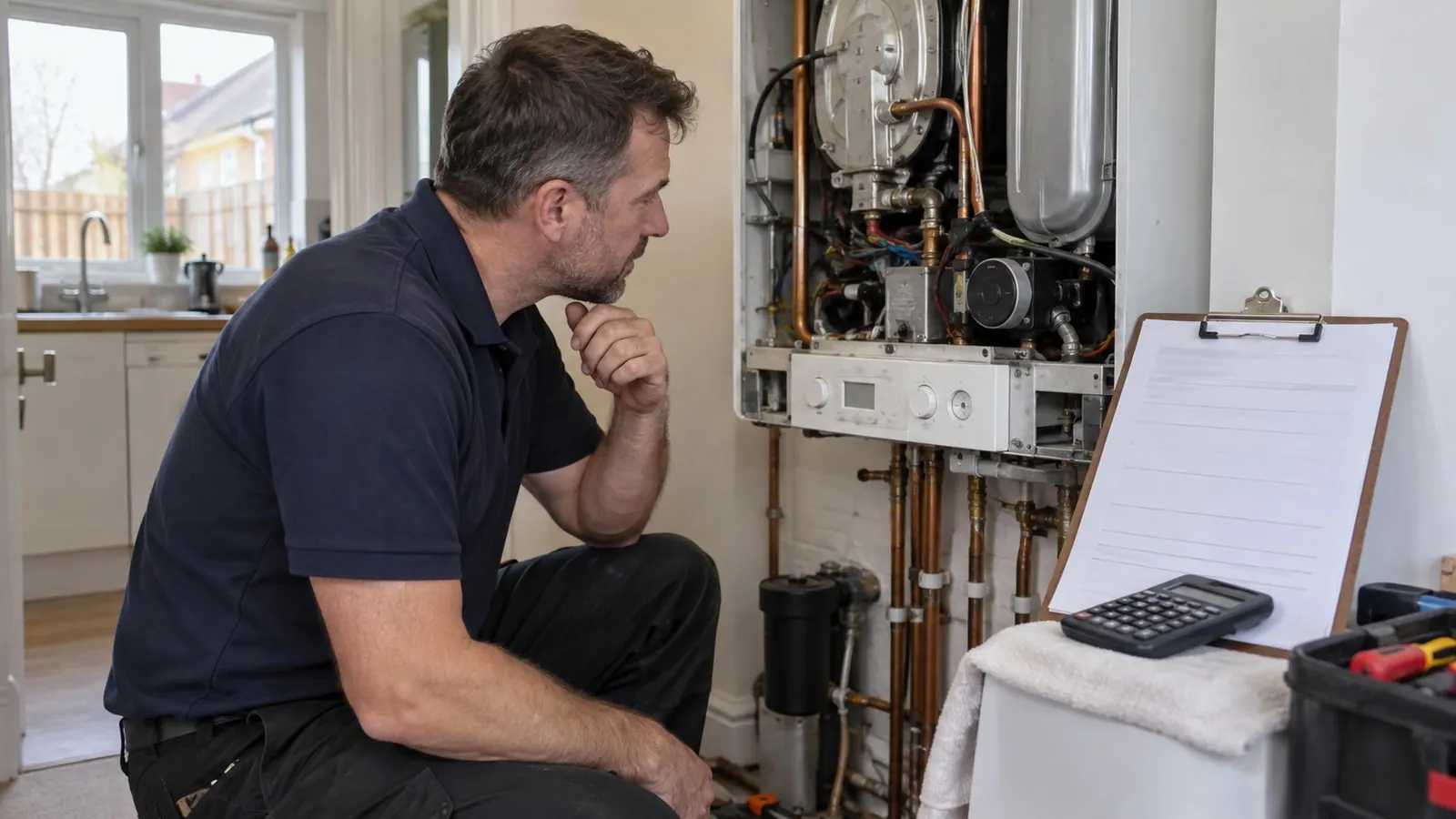
It is the question we get asked more than any other in Milton Keynes: should I repair this boiler or replace it? It usually lands on a cold morning with no hot water, which is the worst time to make a decision that costs real money. People get it wrong in both directions. Some keep paying to patch up a boiler that is on its last legs. Others scrap a perfectly good unit over a cheap part because someone told them it was "old".
There is a simple way to keep the decision honest, and it does not need you to know anything about boilers. Here is how we work it out with customers across MK, from the grid-square semis of the 1970s to the newer estates.
The 50 percent rule
Get two numbers: what the repair will cost, and what a new boiler would cost you fitted. If the repair is more than half the price of the replacement, replacing is usually the smarter buy. If it is well under half, repair it.
The reasoning is straightforward. When you spend half the price of a new boiler on an old one, you get one part renewed and everything else stays the same age. The pump, the fan, the valves and the heat exchanger are all still worn, still out of warranty, and still burning gas the way an old boiler does. Spend a little more and you get a whole new appliance with a long manufacturer warranty and a fresh start.
The rule is not a law. It is a sanity check. It stops you spending big on a boiler that is one cold snap from the scrapheap, and it stops you binning a young boiler over a minor part.
Age moves the line
A repair that makes sense on a five-year-old boiler can be a waste of money on a fifteen-year-old one, even if the quote is the same. A useful refinement is to think about the repair as a proportion of a new boiler, then weigh it against the age. A small proportion on a young boiler is an easy yes. A large proportion on an old boiler is an easy no. Most real cases sit in between, and this is how we break them down:
- Under seven years old: repair, almost without exception. The boiler may still be under manufacturer warranty, in which case the part may cost you nothing at all. Check the paperwork before anyone quotes.
- Seven to ten years: it depends on the part and the service history. A well-serviced boiler with one failed component is worth fixing. A neglected one with its second fault in a year is telling you something.
- Ten to fifteen years: lean towards replacement for any major component. Minor parts are still worth doing if the rest of the boiler is sound.
- Over fifteen years, or any non-condensing boiler: replacement is nearly always the sensible choice, even when a repair is technically possible. Parts get scarce and the running costs are much higher than a modern condensing boiler.
What a repair quote is made of
To use the rule you need a proper repair figure, and that means understanding what goes into one. A repair quote is the part, the labour to fit it, and any work needed to get at it. Three things move it:
- Which part has failed. Cheap and quick: an expansion vessel recharge, a pressure sensor, a fan, a diverter valve. Middling: a pump, a gas valve. Expensive: the printed circuit board, and above all the main heat exchanger, which on many boilers costs a large share of a new appliance on its own.
- Brand and age. Premium brands cost more for parts. Older models may have parts on back order or discontinued altogether, and an obsolete part can end the conversation.
- What the fault has done to the rest of the system. A heat exchanger that has failed because the system is full of sludge will fail again unless the system is cleaned. A proper quote says so and includes a powerflush or a filter, which is not padding. It is the difference between a repair that lasts and one that does not.
The general pattern in Milton Keynes is this. An expansion vessel, fan or diverter valve is a small proportion of a new boiler and worth fixing on almost anything that is otherwise sound. A heat exchanger on a boiler past ten years is usually over the line. A circuit board on the same boiler is borderline, and we would look at the service history before advising either way. Our boiler repair page explains how we diagnose before we quote.
The running cost you are not being quoted
Here is the part people forget. The repair bill is a one-off. The old boiler's gas bill is not. A modern A-rated condensing boiler recovers heat from the flue gases that an older boiler simply throws out of the wall. If your boiler is non-condensing, and anything fitted before the mid-2000s in MK usually is, then every bill you pay includes heat you never got. A well-set-up condensing boiler running at a lower flow temperature recovers more still.
So when you are comparing a repair against a replacement, the honest comparison is not repair versus new boiler. It is repair plus a few more years of high gas bills plus the strong chance of another repair, against a new boiler that then keeps running cheaper for a decade. On an old non-condensing boiler that sum usually favours replacement even when the repair looks cheap on its own.
The honest flip side, which sales-led firms do not print: if your boiler is already a condensing model in decent condition, the gas saving from a new one is small. The Energy Saving Trust figures on boiler upgrades are mostly about replacing old non-condensing boilers. Nobody should replace a ten-year-old condensing boiler "to save on gas". Replace it because it is unreliable or a major part has failed, not because of the bills.
Signs a boiler is beyond economic repair
One of these on its own may not decide it. Three or more together and replacement is almost always the better-value route.
- Two or more repairs in the last couple of years on a boiler past ten years old. The pattern does not improve. It accelerates.
- The failed part is the heat exchanger or the circuit board on a boiler already past ten years.
- Parts are discontinued or on long back order, so even a willing repair means weeks without heating.
- It is a non-condensing model. Anything that old is so far behind on efficiency that the replacement pays for itself in running costs.
- It is noisy, slow to fire, or the radiators take an age to warm, all signs of an ageing system working harder than it should.
- Repeated lockouts, or an engineer has previously flagged combustion readings that are drifting. That points to deeper, costlier trouble.
The warranty factor
A repaired boiler carries a guarantee on the part that was fitted and nothing else. A new boiler fitted by an accredited installer carries a manufacturer warranty on the whole appliance. As a Worcester Bosch Accredited Installer and Vaillant Advance installer we can register up to 12 years on Worcester Bosch and up to 10 on Vaillant, on top of our own 12-month workmanship guarantee. Over that period, repair costs are off the table. That is worth something when you run the sum, and it is why a borderline case often tips towards replacement.
How to get a straight recommendation
The rule only protects you if the engineer giving the advice is honest. A minority of fitters default to selling a new boiler because it is the bigger ticket. Here is how to tell the difference.
- They diagnose first. A trustworthy engineer names the failed part before the word "replacement" comes up.
- They give you both numbers. A repair price and a replacement price, so you can apply the rule yourself.
- They answer the three questions. What exactly has failed? What does the repair cost? What is the realistic remaining life if we fix it?
- They let you go away and think. Be wary of anyone who will not quote for a repair, cannot explain the fault in plain words, or wants a decision on the doorstep.
We will always tell you when a repair is the sensible choice, even though a replacement would earn us more. Our reputation in Milton Keynes is worth more than one oversized job.
If the answer is replace
A new boiler is a survey job, not a phone quote. What it costs depends on the boiler you choose, whether it goes back in the same place, the flue route, the state of the existing system and what controls are already there. Our boiler installation page sets out what is included as standard, including the flush, the filter, a Hive thermostat and the Building Regulations notification. Anything quoted without those is not cheaper. It is incomplete.
Talk it through
If your boiler has packed up or is showing its age, we can give you an honest diagnosis, a clear repair price and a replacement price, and then a straight answer on which one is better value using the same rule set out here. We cover Milton Keynes, Newport Pagnell, Bletchley, Wolverton, Stony Stratford, Buckingham, Leighton Buzzard and the villages around. Get in touch and tell us the make, the age and what it is doing. No pressure either way.
Frequently asked questions
At what age should I replace a boiler rather than repair it? There is no fixed age. Under seven, repair. Seven to ten, apply the 50 percent rule and look at the service history. Over ten, lean towards replacement for any major part. Over fifteen, or on a non-condensing boiler, replace.
Is it worth repairing a boiler that is out of warranty? Often yes, if it is under ten years old and the part is minor. Out of warranty just means you pay for the part. It does not mean the boiler is finished.
Will a new boiler cut my gas bill? Noticeably if you are replacing a non-condensing boiler. Only a little if your current boiler is already a condensing model. Do not replace a working condensing boiler for the bills alone.
Can I do the 50 percent rule without a replacement quote? Not really. Ask for both. Any engineer who will give you a repair price can give you a rough replacement figure at the same time.
Need Professional Advice?
Our Gas Safe registered engineers are ready to help with all your heating needs. Get a free, no-obligation quote today.