Oil Boiler Repairs in Milton Keynes: Costs, Common Faults & When to Replace in 2026
TL;DR
Oil boilers need different care to gas, and the most common faults are blocked nozzles, pump failures, electrode trouble and dirty filters. We are Gas Safe engineers, so we refer oil repairs to OFTEC-registered specialists, but we can help you weigh up switching from oil to mains gas or LPG where it makes sense.
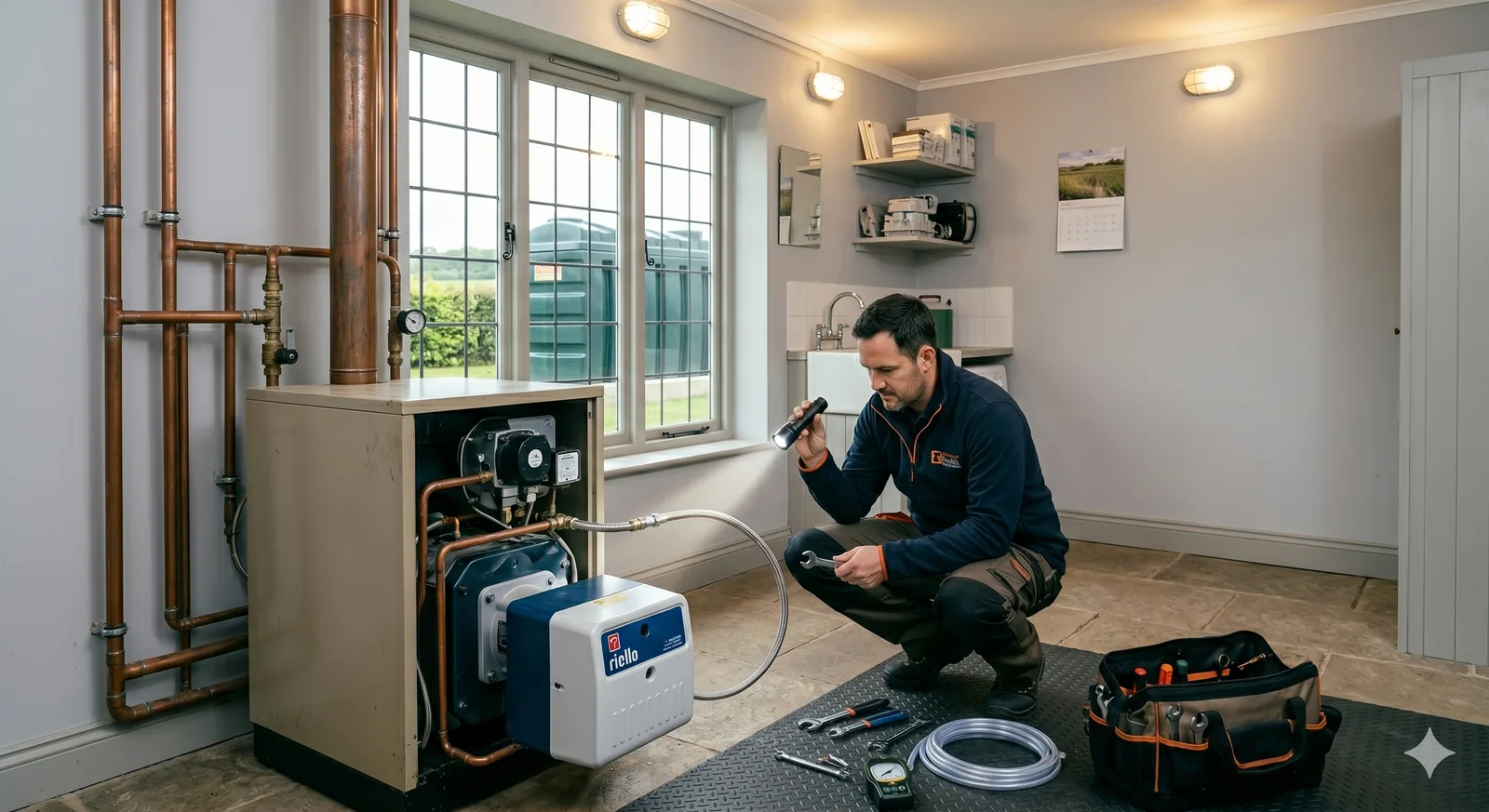
If you live in one of the villages around Milton Keynes, there is a good chance your home is heated by oil rather than mains gas. Properties in places such as Hanslope, Sherington, Woburn Sands, Newport Pagnell's outskirts and the many hamlets beyond the urban grid often sit off the gas network, and oil-fired central heating has long been the practical answer. Oil boilers are dependable workhorses, but they have their own quirks, their own maintenance needs, and their own faults that catch homeowners out, usually on the coldest morning of the year.
This guide is written to be genuinely useful rather than salesy. We should be upfront from the start: Plumb Line MK are Gas Safe registered engineers specialising in mains gas and LPG heating. We do not carry out oil-boiler repairs ourselves, because oil work legally requires a different qualification. What we can do is explain how oil systems behave, give you realistic 2026 repair costs for the MK area, point you towards the right kind of engineer, and help you decide whether sticking with oil still makes sense or whether converting to gas or a heat pump is the smarter long-term move.
How oil boilers differ from gas boilers
The fundamental difference is the fuel and how it is burned. A gas boiler draws a clean, pressurised supply straight from the mains (or from an LPG tank) and ignites it with a spark. An oil boiler relies on heating oil, usually kerosene, that is stored in a tank in your garden, pumped to the burner, atomised through a fine nozzle and ignited. That extra mechanical complexity, the pump, the nozzle, the filters and the tank, is where most oil-specific problems begin.
Because oil is a liquid that is sprayed and burned, the system produces more soot and residue than gas. Components clog more readily, combustion needs more frequent fine-tuning, and the quality and cleanliness of the oil in your tank matters enormously. A gas boiler that is left unserviced will usually keep going; an oil boiler that misses its annual service is far more likely to let you down. In short, oil heating asks a little more attention in return for keeping off-grid homes warm.
The most common oil boiler faults
Most oil boiler breakdowns come back to a handful of culprits. Knowing them helps you describe the problem accurately when you call an engineer, and sometimes spot trouble before it leaves you cold.
- Blocked or worn nozzle. The nozzle atomises oil into a fine mist for clean combustion. Over a year it wears and clogs, causing poor ignition, sooting, lockouts or a smoky flame. Nozzles are routinely replaced at every service.
- Pump failure. The fuel pump pushes oil from the tank to the burner at the right pressure. A failing pump means no firing, erratic firing or a boiler that locks out. Pumps can sometimes be reconditioned, but often need replacing.
- Electrode problems. Ignition electrodes create the spark that lights the oil. If they crack, foul with carbon or fall out of alignment, the boiler will not ignite and goes to lockout.
- Blocked filters. There is usually a filter at the tank and another at the burner. As they trap sludge and water, fuel flow drops and the boiler struggles or cuts out. Cheap to clean or replace, easy to neglect.
- Air in the fuel line. If air gets drawn into the supply, often after the tank has run low, the burner cannot maintain a steady flame. The line needs bleeding and the cause traced.
- Tank sludge and water contamination. Condensation and ageing oil produce sludge and a layer of water at the bottom of the tank. This breeds bacteria, clogs filters and corrodes the tank itself. It is one of the most under-appreciated causes of repeat breakdowns.
Many of these issues snowball: a neglected tank leads to dirty filters, which strain the pump, which fouls the nozzle. That is why regular servicing is so much more than a box-ticking exercise for oil systems.
Average oil boiler repair costs around Milton Keynes in 2026
Prices vary with the engineer, the boiler model, parts availability and how far they travel into the rural areas around MK. The figures below are realistic 2026 ranges for the Milton Keynes area and are meant as a guide, not a quote.
| Job | Typical 2026 cost (MK area) |
|---|---|
| Diagnostic call-out / first hour | £70 to £110 |
| Nozzle replacement | £90 to £150 |
| Fuel pump replacement | £180 to £350 |
| Electrode replacement | £90 to £160 |
| Filter clean / replacement | £60 to £120 |
| Bleeding air from the fuel line | £70 to £130 |
| Tank clean / de-sludge | £150 to £400 |
| Control box (relay) replacement | £150 to £300 |
| Emergency / out-of-hours call-out | £120 to £200+ |
As a rough rule, a straightforward repair on an oil boiler tends to land somewhere between £100 and £350 all-in. Where costs climb sharply, multiple failed components, a corroded tank, or a heat exchanger problem, you are entering replacement territory, which we cover further down.
What is OFTEC, and how do you find a qualified engineer?
For gas appliances in the UK, the law requires a Gas Safe registered engineer. Oil has its own equivalent: OFTEC, the Oil Firing Technical Association. An OFTEC-registered technician has been trained and assessed to install, service and repair oil-fired appliances and oil storage tanks safely and to current building regulations. Using an OFTEC engineer is the oil-world equivalent of insisting on Gas Safe for gas, it is how you know the person working on your boiler is genuinely competent and insured for it.
To find one near Milton Keynes, you can search the official OFTEC register by postcode, which lists registered businesses in your area. When you call, it is reasonable to ask for their OFTEC registration number, confirm they are insured, and get a clear idea of call-out charges before they travel. A good oil engineer will happily provide all three. Plumb Line MK are Gas Safe rather than OFTEC, so for any oil repair or oil boiler service we will always refer you to a registered oil specialist rather than attempt work we are not certified to do.
What an annual oil boiler service involves
Oil boilers genuinely need servicing every year, and skipping it is a false economy. A proper OFTEC service is more involved than a typical gas service and usually includes:
- Replacing the nozzle as standard.
- Cleaning or replacing the oil filters at the tank and burner.
- Inspecting and cleaning the electrodes, and checking ignition.
- Cleaning the combustion chamber, baffles and heat exchanger of soot.
- Checking the fuel pump pressure and the photocell that detects the flame.
- Running a flue gas analysis to tune combustion for efficiency and safety.
- Inspecting the tank, supply line and fittings for leaks, water and sludge.
A well-serviced oil boiler burns cleaner, uses less oil and is far less likely to break down mid-winter. It also protects any manufacturer warranty and keeps you compliant if you let the property, where an annual service and safety check are expected of landlords.
Signs your oil boiler is beyond economic repair
Every boiler reaches a point where repairs stop making sense. Watch for these signals:
- Age. Most oil boilers last 15 to 20 years. Beyond that, parts get scarce and efficiency drops.
- Repeat breakdowns. Two or three call-outs in a single heating season is a clear warning.
- Rising oil bills. An old, sooted-up boiler can run well below its rated efficiency, quietly costing you more each year.
- Expensive parts. A failed heat exchanger or a cracked combustion chamber often costs more than the boiler is worth.
- Corroded tank. A leaking or rusting tank is an environmental and safety risk and a major replacement cost in its own right.
A sensible benchmark: if a single repair approaches half the cost of a replacement boiler, or you are facing repeated repairs on a unit over 15 years old, it is usually time to plan a replacement rather than keep patching.
Should you switch from oil to mains gas or a heat pump?
This is the question we are best placed to help with, because it is where our gas expertise meets your off-grid reality. There are three broad paths once an oil boiler is on its way out.
Stay on oil. If there is no gas connection near your property and a heat pump is not yet viable, a modern condensing oil boiler is still a valid choice. An OFTEC engineer can advise and install.
Convert to mains gas. If a gas main runs along or near your road, switching from oil to gas is often well worth investigating. Gas is typically cheaper and cleaner to run, gas boilers need less intensive servicing, and you lose the hassle of ordering and storing oil. Where a connection is available, we can help you plan and carry out the conversion, from the new boiler to the pipework. Our boiler installation page explains how we approach this. Where there is no gas main, LPG can be an excellent middle ground, similar convenience to gas but supplied by tank; see our guide to LPG boiler installation in Milton Keynes.
Move to a heat pump. For well-insulated rural homes, an air source heat pump can be a strong long-term option, with grant funding sometimes available. It is not right for every property, so it pays to weigh it honestly against gas or LPG. Our heat pump vs gas boiler honest guide walks through the trade-offs without the hype.
The right answer depends on your property, your road's access to the gas network, your budget and how long you plan to stay. There is rarely a one-size-fits-all choice, which is exactly why an honest conversation beats a sales pitch.
Talk to Plumb Line MK about your options
If your oil boiler needs repairing, the right call is an OFTEC-registered engineer, and we will gladly point you towards one rather than pretend otherwise. But if you are weighing up whether to stay on oil or convert to mains gas or LPG, that is exactly where we can help. We will give you a straight assessment of whether a connection is realistic for your property near Milton Keynes, and a clear, no-pressure idea of the costs.
Call us on 07805 844 016 or 01908 229 560, or send us a message through our contact page. Honest advice, whichever way you decide to go.
Need Professional Advice?
Our Gas Safe registered engineers are ready to help with all your heating needs. Get a free, no-obligation quote today.