LPG Boiler Installation in Milton Keynes: What to Know
TL;DR
Many villages around Milton Keynes are off the mains gas grid and heat with LPG instead. An LPG boiler is a normal condensing boiler set up to burn propane, fed from a bulk tank or cylinders through a regulator. The install differs from mains gas in the tank siting, the supply pipework, the boiler set-up and the safety clearances. The engineer must hold the LPG category on their Gas Safe ID card, not just a natural gas registration.
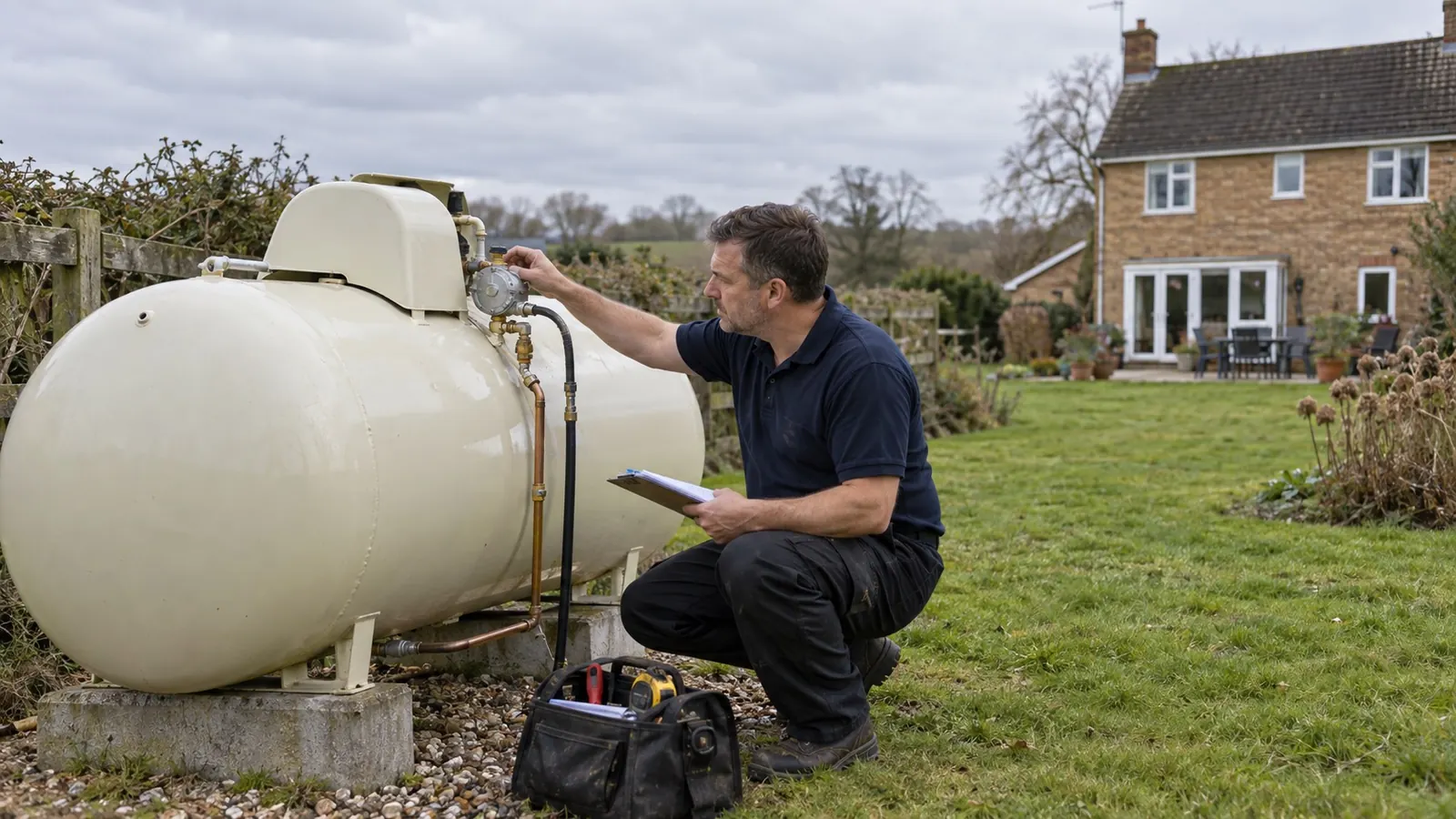
If you live in one of the villages ringing Milton Keynes, there is a fair chance the gas main never reached your door. Plenty of homes on the Buckinghamshire and Bedfordshire borders are off the gas grid altogether, so the usual combi-or-system decision comes with an extra question: where does the gas come from? For a lot of these homes, the answer is LPG.
LPG work is a slightly different world from mains gas and not every heating firm is qualified for it. This guide covers what LPG is, which areas around MK rely on it, how the installation differs, the tank options, what makes up the price, which boilers suit it, and the qualification your engineer has to hold.
What is LPG and why do some homes use it?
LPG is liquefied petroleum gas. For home heating it is almost always propane, stored as a liquid under modest pressure in a tank and turned back into gas as it leaves. It burns cleanly and gives plenty of heat, which makes it a good fuel for a modern condensing boiler: the same sort of boiler you would fit in a house in Bletchley, just set up to burn propane instead of the methane that comes through a gas main.
Homes use LPG for one reason: there is no mains gas available. Extending the network to a remote property is rarely worth the cost, so a supplier puts a tank in the garden, delivers by tanker, and the house runs its heating, hot water and often the hob from it. For an off-grid family it is the nearest thing to the convenience of mains gas without going to oil or relying entirely on electricity.
Which areas around Milton Keynes rely on LPG?
Milton Keynes itself is well served by the gas network, so most homes inside the city are on natural gas. Head out into the countryside and the picture changes quickly. Hanslope, Sherington, North Crawley and Astwood, the hamlets around Woburn Sands, Aspley Guise and Husborne Crawley, and properties out towards Buckingham and Olney are where we see LPG most. Older farmhouses, barn conversions and isolated cottages are the usual candidates. If you are buying a rural property and are not sure what the heating runs on, check before you commit to any work: a tank in the garden or a propane bottle cage by the back door is the giveaway.
How LPG installation differs from mains gas
The boiler on the wall does much the same job either way. The supply behind it is set up differently, and an installer has to get four things right.
- Storage. With mains gas you connect to the network. With LPG the fuel lives on your property, so there is a tank or cylinders, pipework to bring it indoors, and planning around where the tank sits.
- Regulator and supply pipe. LPG leaves the tank at a higher pressure and is stepped down by a regulator before it reaches the boiler. The pipe is sized for the demand of your appliances so the pressure holds steady when the boiler fires.
- The boiler set-up. Natural gas and propane burn differently. The boiler is either supplied as an LPG model or converted with the manufacturer's own conversion kit and set up on a flue gas analyser. Running a natural gas boiler on LPG without conversion is dangerous and illegal.
- Clearances. LPG is heavier than air, so a leak behaves differently from mains gas. There are strict distances between the tank, the flue, drains, openings and boundaries, and getting them right is a core part of a compliant install.
Tank options: above ground, underground or cylinders
Above-ground bulk tank. The most common choice. It sits on a base in the garden and is usually leased from a supplier such as Calor or Flogas, who then deliver the gas. Leasing keeps the upfront cost down, but you are normally tied to that supplier for your fuel. For most rural MK properties it is the practical option.
Underground tank. Does the same job but buried, with only a small green lid visible. Far neater and it frees the garden, which matters on some plots. The trade-off is the excavation, which makes it a noticeably bigger job than an above-ground tank.
47 kg cylinders. Bottled LPG suits smaller or lower-demand homes. Bottles are paired through an automatic changeover valve so the supply does not run dry, and you swap empties for fulls. No tank siting to worry about, but it costs more per unit of heat and needs more managing, so it suits modest properties or a stepping stone.
The tank is normally supplied and sited by the LPG supplier under your fuel contract; the boiler and the pipework from the tank are the heating engineer's job. Make sure you know who is doing which bit before either of them turns up.
What makes up the price of an LPG boiler installation
We do not publish figures for this job because the spread between a simple swap and a full new supply is too wide for a number to be honest. What the quote is made of:
- Whether a tank already exists. If it does and the supply is sound, it is a boiler swap plus a check of the regulator and pipework. If it does not, the tank, base and connection are a separate cost, usually through the supplier.
- The boiler. Brand, output, combi or system, and warranty length.
- The supply pipework. Distance from tank to boiler, whether it can be run externally, and whether the existing pipe is the right size.
- Flue and condensate route. As with any boiler.
- System condition. Older rural systems often need a clean or a powerflush, and a magnetic filter is standard on our installs.
- Controls. We include a Hive thermostat with a new boiler install.
For a like-for-like boiler, LPG tends to sit a little above the equivalent mains gas job because of the extra supply and safety work. A proper survey and a written quote is the only way to get a real figure. Our boiler installation page lists what is included as standard.
Running costs: LPG against oil and electric
Straight answer: LPG costs more per kWh than mains gas. If you could connect to the mains, you usually would. But that is not the comparison that matters for an off-grid home. The real question is how LPG compares with the other off-grid options.
Against heating oil, the two are broadly competitive and both move with the wider energy market. LPG burns cleaner, the boilers are compact and efficient, and there is no oil tank to worry about. Oil can be cheaper per unit at times.
Against direct electric heating, LPG is usually much cheaper for whole-house heating. The picture shifts if you are weighing a heat pump, which uses electricity very efficiently and is often a stronger case off-grid precisely because the fuel it replaces is dear. Our gas boiler vs heat pump comparison covers that trade-off honestly. If you are off-grid and the house is reasonably well insulated, a heat pump deserves a proper look before you commit to another LPG boiler. Not every installer will tell you that.
Which boilers suit LPG?
Most major manufacturers offer LPG versions of their popular boilers or a factory conversion kit. The ones we fit most on LPG:
- Worcester Bosch Greenstar: widely supported with LPG variants. As a Worcester Bosch Accredited Installer we can register the extended warranty.
- Vaillant ecoTEC: efficient and quiet, with LPG options across the range, and extended warranty through the Vaillant Advance scheme.
- Baxi: solid value with LPG-ready models.
- Ideal: competitively priced with LPG versions and good warranty cover.
The right one depends on the house, the hot water demand and the budget. Whichever it is, it must be configured for LPG, commissioned on an analyser, and serviced every year to keep the warranty and the safety intact. Our boiler servicing page covers the annual check.
The Gas Safe LPG category your engineer must hold
This is the part that catches people out. Being on the Gas Safe Register is not, by itself, enough to work on LPG. The register lists separate categories of work, and LPG is one of them. It has to appear on the back of the engineer's Gas Safe ID card. An engineer registered only for natural gas is not legally allowed to install, convert or service an LPG appliance.
Before any LPG work starts, ask to see the card and check the LPG category is listed for the type of work being done. It takes a moment. Our guide to checking a Gas Safe engineer walks through it. We install and service LPG boilers around Milton Keynes and we will show you our card when we arrive; you should expect the same from anyone.
Talk to a local LPG engineer
If you are in one of the off-grid villages around Milton Keynes and need an LPG boiler installed, replaced or serviced, get in touch. We will survey the property, recommend the right boiler and tank arrangement, give you a written quote, and do the job properly. Happy to answer questions before you commit to anything.
Need Professional Advice?
Our Gas Safe registered engineers are ready to help with all your heating needs. Get a free, no-obligation quote today.