No Hot Water in Milton Keynes? How to Diagnose and Fix It
TL;DR
No hot water is usually one part or one setting, not a dead boiler. Check the display for a fault code, check the pressure gauge reads 1 to 1.5 bar, check the programmer and thermostat, and in a freeze check the condensate pipe outside. On a combi, hot radiators with cold taps almost always means a stuck diverter valve or a scaled plate heat exchanger. On a cylinder system, test the immersion and the motorised valve.
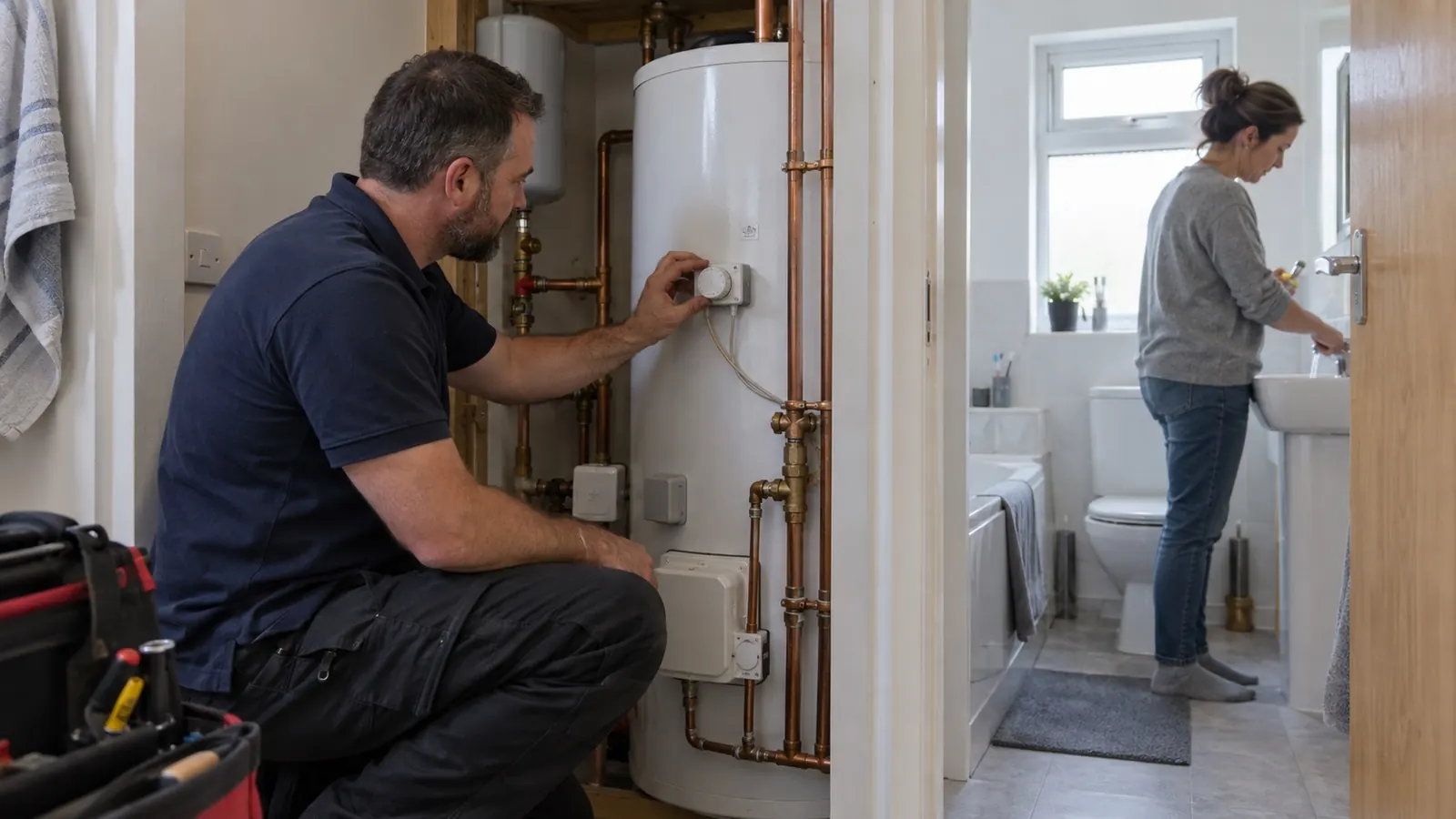
A cold tap when you were expecting a hot shower is one of the most common calls we take in Milton Keynes, and one of the most fixable. No hot water is almost never a sign that the whole system has failed. It is usually a single component, a setting that has drifted, or pressure that has crept too low. Worked through calmly, the cause usually shows itself in a few minutes.
This guide is a fault tree you can follow by hand. It is organised by boiler type, because the likely culprit on a combi is very different from the one on a system boiler with a cylinder. For each step we say whether it is a safe check you can do yourself or an engineer's job.
First, work out what you have lost
- No hot water, but cold water runs fine. A boiler or cylinder fault. Carry on below.
- No water at all, hot or cold. Not the boiler. Ask a neighbour. If they have none either, ring Anglian Water. If they do, your stopcock may be closed or a pipe has frozen. Jump to the frozen pipes section.
- Hot water works, heating does not. The opposite fault. Our central heating not working guide covers it.
- Neither hot water nor heating. Something system-wide: pressure, power, a frozen condensate pipe, or a control board. See the section further down.
Then, know which boiler you have
A combi heats water on demand straight from the mains. One box on the wall, no cylinder. If there is no tall insulated tank in an airing cupboard, you have a combi. A system or regular boiler heats water and stores it in a cylinder, usually with an electric immersion heater fitted as a backup. This changes everything that follows.
Step one: read the display
Most boilers fitted in the last fifteen years show a fault code the moment something goes wrong. Look here first. Codes differ by manufacturer, but the Worcester Bosch, Vaillant, Ideal and Baxi boilers we see most often around MK follow the same patterns:
- Low pressure codes mean the water pressure has dropped below what the boiler needs to run. The single most common cause of losing hot water and heating together.
- Ignition or flame codes mean the boiler is trying to fire and failing. Gas supply, ignition or flame sensing. An engineer's job.
- Fan or flue codes mean the boiler has locked out because it cannot prove the flue is clear. In winter, that is often a frozen condensate pipe.
- Sensor or temperature codes often point to a failed thermistor, which can leave you with heating but no hot water on a combi.
Write the exact code down. Resetting the boiler once is a safe step and clears the occasional glitch. If the same code comes straight back, stop resetting and book an engineer. Repeated resets on a real fault can do damage. Our boiler repair page explains how we diagnose from the code.
Step two: older boilers with a pilot light
If the boiler has no display but a small permanent flame visible through a window near the base, it has a standing pilot. It should be steady and blue. If it has gone out, the boiler cannot heat anything. The boiler's own printed instructions cover relighting it. If it will not stay lit, keeps going out, or burns lazy and yellow, stop there and call a Gas Safe registered engineer. That points to a failing thermocouple or a combustion problem, and it is not something to keep trying.
Step three: check the pressure
Find the gauge on the front or underside of the boiler. Cold, with the heating off, it should read between 1 and 1.5 bar. Below 1 bar, or in the red, and the boiler may refuse to make hot water as a protection.
Topping up via the filling loop (the braided silver hose under the boiler) is a job most people can do. Open the valves slowly, watch the gauge climb to about 1.2 bar, close them. Our boiler pressure guide has the full walkthrough. If the pressure holds, you are done. If it drops again within days, there is a leak somewhere or the expansion vessel has failed, and that needs an engineer.
Step four: the combi classic, heating works but taps run cold
If the radiators are hot and the taps are not, the prime suspect on a combi is the diverter valve. A combi has one heat exchanger and two jobs. The diverter valve decides whether heat goes to the radiators or to the water you are drawing at the tap. When you open a hot tap it should swing across; when you close it, swing back. After years of constant movement it can stick, usually because of scale and grit. Stuck in the heating position, you get brilliant radiators and cold taps.
The second suspect, and in Milton Keynes it is nearly as common, is the plate heat exchanger. This is the small stack of plates that transfers heat into your tap water. MK has very hard water, which Anglian Water's hardness data confirms, and scale builds up inside the plates until the water comes through lukewarm and the flow drops. Here is the point a lot of firms would rather not print: replacing a diverter valve on a combi that has a scaled plate exchanger fixes nothing. A good engineer checks both before ordering parts, and fits a scale reducer afterwards so it does not come back.
Less common causes of the same symptom: a failed flow sensor, which never tells the boiler a tap has opened, a worn thermistor giving false readings, or an airlock in the hot pipework after plumbing work or a mains interruption. Try other hot taps. If only one is cold, it is that tap or a local airlock, not the boiler.
Every one of these is inside the boiler casing and is a Gas Safe registered engineer's job. They are routine repairs, done in one visit when the parts are on the van, and rarely a reason to replace the boiler.
Step five: thermostat, programmer and batteries
Rule out the simplest explanation: the boiler has been told not to heat water. It happens after a power cut, when a wireless thermostat battery dies, or when someone nudges the programmer. Check the room thermostat is set above the current temperature. On a system boiler, check the hot water programme is actually on and not in a holiday or off period. On a combi the hot water is on demand, so check the hot water temperature dial on the boiler has not been turned down. New batteries and a corrected timer cost nothing.
Cylinder homes: cylinder, immersion and motorised valve
Feel the cylinder
Stone cold while the boiler runs means heat is not reaching it, which points at the motorised valve or a control. Warm cylinder but no hot water at the tap points downstream, to a mixer or a blockage.
Test the immersion
Switch on the immersion heater, usually a switch with a red light in the airing cupboard. If you get hot water that way and not from the boiler, you have confirmed the boiler side is at fault and kept the household in hot water while you wait. If the immersion does nothing either, the element or its thermostat has failed, which is an electrician's job.
Check the cylinder thermostat
The thermostat strapped to the cylinder should be set around 60 degrees. Knocked down, or failed, and the tank stays cold.
The motorised valve
This sends heated water to the radiators or the cylinder, much like a combi's diverter. When its motor fails or it sticks, the cylinder never heats even though the boiler fires. You may hear it buzzing. Replacing the valve or its head is an engineer's job, usually an hour or two.
No hot water and no heating together
A stuck diverter cannot explain a total loss, because one side or the other would still work. Check, in order: the pressure gauge, the electrical supply to the boiler (a tripped switch or fuse), and in a cold snap the condensate pipe. A fault on the main circuit board is the remaining suspect, and that is an engineer's diagnosis and one of the dearer repairs. On an older boiler we will give you a straight view on whether it is worth it. Our breakdown checklist covers the wider picture.
Winter: frozen condensate pipes and frozen pipes
The condensate pipe is the narrow plastic pipe, white or grey, that runs from the boiler to an outside drain. When it freezes, the boiler shuts down as a safety measure and usually shows a fault code. Pouring warm, not boiling, water along the frozen section, or holding a hot water bottle against it, clears it. Then reset the boiler. If it freezes every winter, ask us to insulate or reroute it.
For frozen supply pipes, the usual freeze points in MK are external wall pipes, uninsulated lofts, and garage or utility pipework. Older houses in Wolverton and Stony Stratford suffer more than the new estates at Tattenhoe and Brooklands. Thaw gently with a hot water bottle, warm cloths or a hair dryer, working from the tap end back towards the frozen section. Never use a blowtorch, boiling water or an open flame. Then lag the pipe so it does not happen again, and keep the heating ticking over on a low setting overnight in a hard frost. If a pipe has split, turn the water off at the stopcock and follow our burst pipe guide.
When it is an emergency
Most no-hot-water calls can wait for a booked visit. Stop fault-finding and call straight away if you smell gas (turn off the supply at the meter, open windows, avoid switches, and ring the National Gas Emergency line on 0800 111 999), if water is leaking from the boiler or cylinder, if the boiler is making banging noises or the casing is very hot, or if someone vulnerable is without heat in cold weather. Our emergency plumbing page explains how to reach us out of hours.
Getting it fixed
We carry diverter valves, plate heat exchangers, thermistors and motorised valves for the common brands on the van, so most of these faults are fixed in one visit. We diagnose first and then give a fixed price, so you pay for the part you actually need. Plumbline MK is Robert and Sam, Gas Safe registered (957816), covering Milton Keynes, Newport Pagnell, Bletchley, Wolverton and the surrounding towns and villages. If you have worked through the checks and it needs an engineer, get in touch with the boiler make and the fault code and we will take it from there.
Need Professional Advice?
Our Gas Safe registered engineers are ready to help with all your heating needs. Get a free, no-obligation quote today.