Boiler Pressure Too High or Too Low? A Milton Keynes Homeowner's Complete Fix Guide for 2026
TL;DR
Most combi boilers run best at 1 to 1.5 bar when cold. Low pressure usually means a small leak or recently bled radiators, while high pressure points to overfilling or a tired expansion vessel. This guide shows you how to safely top up or release pressure yourself, and when to call a Gas Safe engineer.
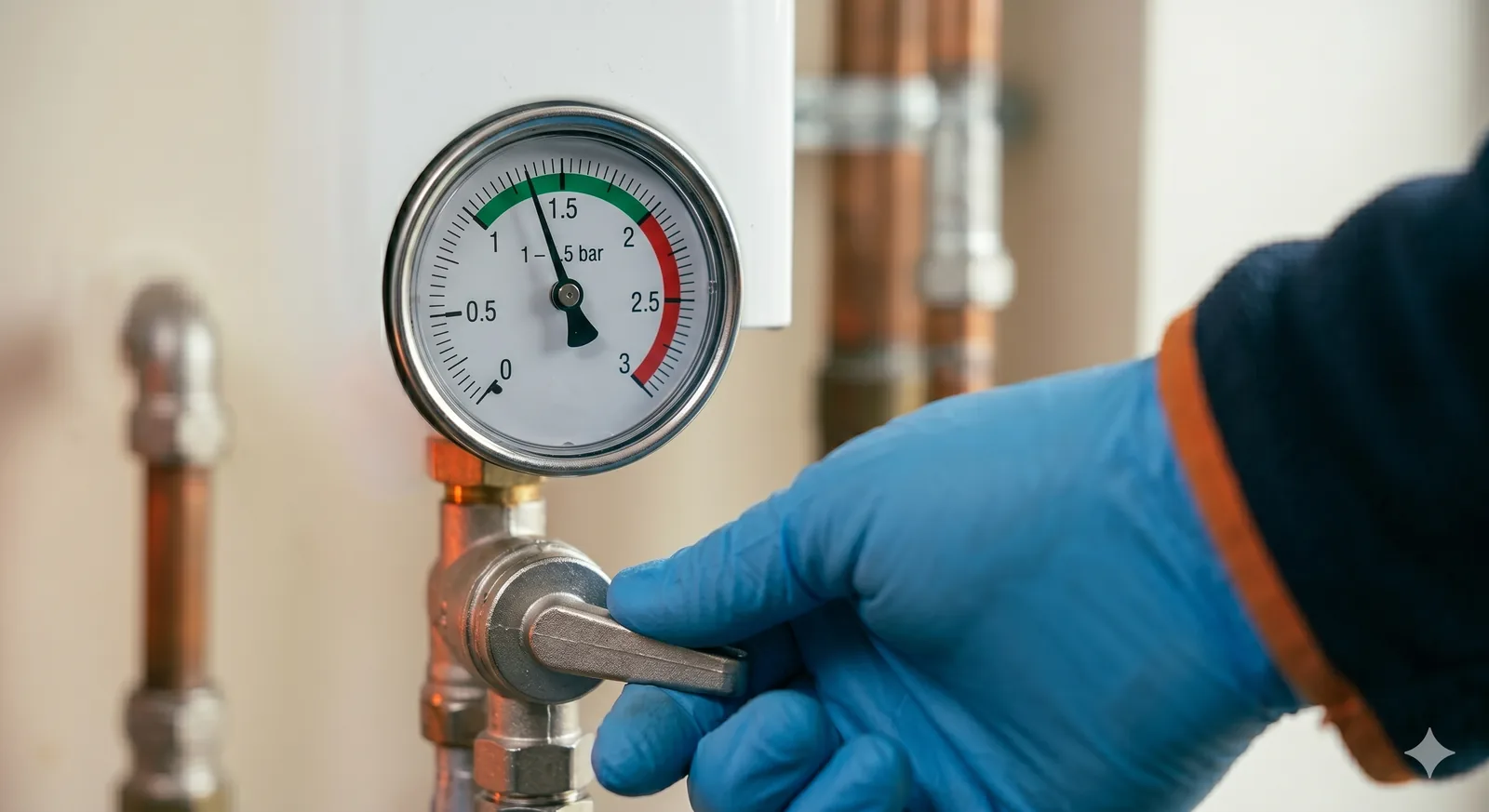
If the pressure gauge on your boiler has crept into the red or dropped close to zero, you are not alone. It is one of the most common reasons Milton Keynes homeowners pick up the phone to us, and the good news is that many pressure problems are straightforward to understand and, in some cases, safe to fix yourself. The tricky part is knowing which situations you can handle and which ones are warning signs of a fault that needs a qualified engineer.
This guide brings both sides together in one place: too high and too low. We will explain what boiler pressure actually is, what the correct range should be, the most common causes in each direction, and clear step-by-step instructions for putting things right safely. We will also be honest about where you should stop and call us, because some pressure faults hide a leak or a failing part that only gets worse if it is ignored.
What boiler pressure is and why it matters
Your central heating is a sealed system. Water is pumped around a closed loop of pipes and radiators, and that water needs to be held at a steady pressure so it can circulate properly to every room. Boiler pressure is simply a measure of how much water is in that sealed loop, shown in bar on the gauge at the front or underneath your boiler.
When the pressure is correct, your heating warms up evenly and your hot water flows as it should. When it drifts too low, the boiler may struggle to push water around the system and many modern models will simply lock out and show a fault code to protect themselves. When it climbs too high, the extra strain can stress seals, joints and the safety valve, eventually leading to leaks or a dripping pipe outside the house.
The correct pressure range
For most combi boilers, the sweet spot is between 1 and 1.5 bar when the system is cold. As the heating fires up and the water warms, the pressure naturally rises, often to around 1.5 to 2 bar. This is completely normal — water expands as it heats. A healthy system settles back down again once it cools.
As a rough guide, treat anything below 1 bar as low and anything above 2.5 bar when hot as high. If your gauge has a green band, the manufacturer is showing you the safe zone; the red sections at either end are the warnings. Worcester Bosch, Vaillant, Ideal and Baxi boilers are the brands we see most often in MK homes, and while gauges vary slightly, this 1 to 1.5 bar cold target applies to nearly all of them.
What causes low boiler pressure
Low pressure means water has left the sealed system somehow. The usual culprits are:
- A small leak. Even a tiny weep at a radiator valve, pipe joint or the boiler itself slowly bleeds pressure away. You may not see standing water — it can evaporate as fast as it escapes.
- Recently bled radiators. Letting air out of radiators releases water too, so the pressure drops a little afterwards. This is the one harmless cause and is easily topped back up.
- A faulty pressure relief valve (PRV). This safety valve releases water if pressure ever climbs too high. If it sticks open or fails, it can let water dribble out continuously, usually from a pipe poking through an outside wall.
- A leaking automatic air vent. This component clears air from the system, but if its seal fails it can release small amounts of water and air over time.
If you top your boiler up and it loses pressure again within days or weeks, that is a strong sign of a hidden leak rather than a one-off. For wider symptoms such as cold radiators alongside the pressure issue, our central heating problems diagnosis guide walks through the likely causes.
What causes high boiler pressure
High pressure means there is too much water in the system, or the system has lost its ability to absorb the natural expansion of hot water. Common causes are:
- Overfilling via the filling loop. By far the most frequent cause. If the filling loop was opened too far or left slightly open after a top-up, extra water keeps entering and the pressure climbs.
- A failed or waterlogged expansion vessel. This sealed vessel contains a cushion of air that absorbs expansion as the water heats. When it fails or fills with water, the pressure has nowhere to go and shoots up sharply whenever the heating runs, then drops when it cools.
- A faulty PRV. If the relief valve sticks shut, it cannot release pressure when it should, allowing the reading to climb beyond safe limits.
A telltale sign of an expansion vessel problem is pressure that sits fine when cold but jumps high every time the boiler heats up. That pattern almost always needs an engineer to recharge or replace the vessel.
How to safely repressurise a boiler that is too low
If your pressure has simply dropped after bleeding radiators or sits a little under 1 bar, you can usually top it up yourself using the filling loop — a small silver braided hose with a valve at each end, found beneath most combi boilers. Work calmly and follow these steps:
- Turn the boiler off and let it cool fully. Topping up cold gives the most accurate reading.
- Locate the filling loop and check both ends are firmly attached.
- Open both valves slowly, a quarter turn at a time. You should hear water flowing into the system.
- Watch the pressure gauge closely as it rises towards 1.5 bar.
- As soon as it reaches the correct level, close both valves firmly. Do not overshoot.
- Switch the boiler back on and check it fires up normally. If your model needs a reset, press the reset button once.
If your boiler has a built-in keyed or lever filling system rather than a loose hose, the principle is the same: add water gently and stop at 1.5 bar. If you cannot find the filling loop or are unsure which valve is which, it is always safer to call us than to guess.
How to reduce pressure that is too high
If the gauge has crept above the safe range, the simplest way to release a little pressure is to bleed a radiator. This lets a small amount of water and air out and brings the reading down. Here is how:
- Switch the heating off and let the radiators cool so you do not risk scalding.
- Have a cloth and a small container ready to catch drips.
- Use a radiator bleed key to open the valve at the top of one radiator a little.
- Let a small amount of water escape while you watch the boiler pressure gauge.
- As soon as the pressure returns to around 1.5 bar, close the bleed valve firmly.
First, double-check the filling loop is fully closed — if it has been left slightly open, that is often the real reason pressure keeps rising, and shutting it solves the problem. If bleeding a radiator brings the pressure down but it climbs straight back up next time the heating runs, stop and call an engineer; that points to the expansion vessel rather than simple overfilling.
Safety warning: what you must not attempt yourself
Topping up or gently bleeding a system is fine for a confident homeowner, but there are firm limits. For your safety, never attempt any of the following yourself:
- Do not touch the gas side of the boiler. Anything involving the gas supply, burner or combustion is illegal to work on unless you are Gas Safe registered, and getting it wrong can be deadly.
- Do not open, dismantle or adjust sealed components. The expansion vessel, pump and internal valves are not user-serviceable.
- Do not tamper with the pressure relief valve (PRV). It is a critical safety device. If it is leaking or stuck, it needs an engineer, not a screwdriver.
- Do not keep repressurising a boiler that loses pressure repeatedly. Constant topping up masks a leak and can introduce fresh oxygen that corrodes the system from the inside.
- Do not ignore visible water, scorching, or a smell of gas. If you ever smell gas, turn off the supply at the meter, open windows, do not use switches, and call the National Gas Emergency line on 0800 111 999.
When to call a Gas Safe engineer
Some pressure problems are clear signals that a professional needs to step in. Call us if you notice any of these:
- Pressure that drops repeatedly no matter how often you top it up — almost always a hidden leak that needs tracing.
- Pressure that climbs high every time the boiler heats and falls when it cools — typically a waterlogged or failed expansion vessel.
- Water dripping from a pipe outside the house, which usually indicates a PRV releasing pressure.
- A boiler that keeps locking out on a pressure fault code despite correct topping up.
- Any damp patches, staining or corrosion around pipework, valves or the boiler itself.
A regular service is the best way to catch these issues early, before they leave you without heating. Our boiler servicing checks pressure, the expansion vessel and the safety valve as standard, and if something has already failed, our boiler repair team can diagnose and fix it quickly. If your pressure problem has left you without hot water, our no hot water diagnosis guide may help you narrow things down while you wait.
Need help with your boiler pressure? Call Plumb Line MK
If your pressure will not settle, keeps dropping, or has climbed into the red and you would rather not risk it, our friendly Gas Safe registered engineers are here to help across Milton Keynes and the surrounding area. We will find the real cause, fix it properly, and get your heating running safely again.
Call us today on 07805 844 016 or 01908 229 560, or send us a message through our contact page and we will get back to you promptly. Whether it is a quick top-up question or a stubborn leak, we are always happy to help.
Need Professional Advice?
Our Gas Safe registered engineers are ready to help with all your heating needs. Get a free, no-obligation quote today.