How to Bleed and Balance Radiators in Your Milton Keynes Home (Step-by-Step 2026 Guide)
TL;DR
Bleeding removes trapped air; balancing adjusts the lockshield valves so every radiator in your home heats evenly. Most Milton Keynes homeowners bleed first, then balance using two thermometers to set a roughly 12 degrees Celsius drop across each radiator. If rooms stay cold after both, hard-water sludge may be the culprit and a power flush is the fix.
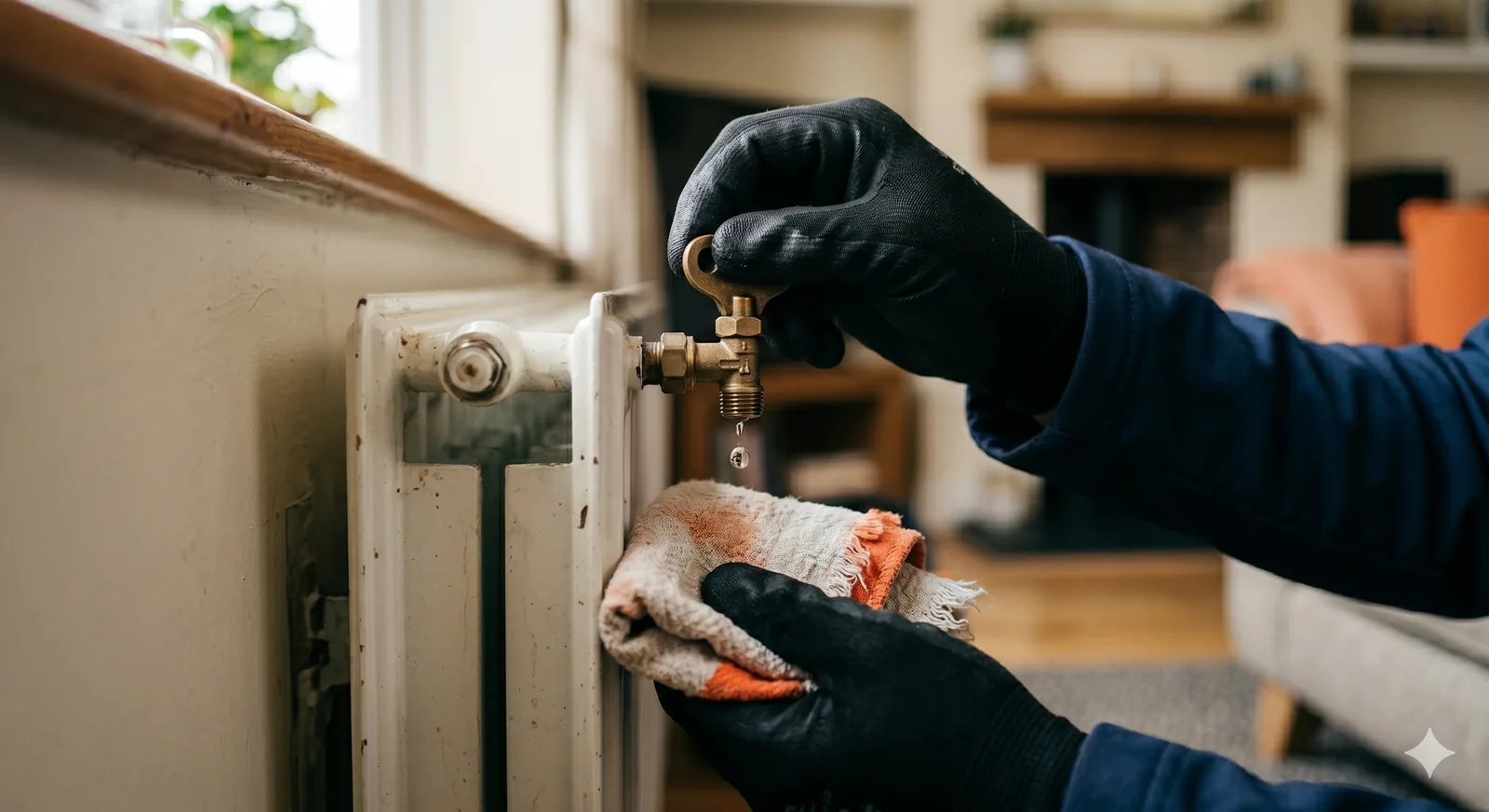
If your bedroom radiator is roasting while the one in the lounge stays lukewarm, you are not alone. It is one of the most common heating complaints we hear from homeowners across Milton Keynes, and the good news is that you can often fix it yourself in an afternoon. The trick is knowing the difference between two jobs that sound similar but do very different things: bleeding and balancing.
This 2026 guide walks you through both, in plain English, with the order that actually works: bleed first, then balance. We will cover the tools you need, clear numbered steps for each job, how to tell trapped air apart from sludge, and the point at which it stops being a DIY task and becomes a job for a Gas Safe engineer. Living in a hard-water area like MK adds a twist too, which we explain near the end.
Bleeding vs balancing: what is the difference?
Bleeding means letting trapped air escape from a radiator. Air rises to the top, so an air-locked radiator feels cold at the top and warm at the bottom. Bleeding is quick, costs nothing, and you may need to do it a few times a year.
Balancing is a one-off tuning job. Every radiator on your system competes for the same hot water from the boiler. Radiators nearest the boiler tend to grab the heat first, leaving distant rooms cold. Balancing adjusts the lockshield valve on each radiator so the flow is shared fairly and every room warms up at a similar pace.
Put simply: bleeding fixes air, balancing fixes unfair flow. If a cold radiator does not improve after bleeding, balancing is usually the next step. You bleed first because trapped air will throw off your balancing measurements.
Tools you will need
- A radiator bleed key — a few pounds from any DIY shop in Milton Keynes, or you may already have one taped inside the boiler cupboard.
- Two thermometers — a pair of clip-on pipe thermometers, or a single digital probe used twice. These let you measure the temperature drop across a radiator for balancing.
- An adjustable spanner — to turn the lockshield valve, which usually needs a spanner rather than a hand.
- A cloth and a small bowl — to catch the dribble of water when bleeding.
- Optional: a flat-head screwdriver — some modern lockshield caps take a screwdriver instead of a key.
How to bleed a radiator: step by step
- Turn the heating on fully and let it run for 15 to 20 minutes so every radiator gets hot. This builds the pressure that pushes trapped air out.
- Find the cold spots. Carefully feel each radiator. Cold patches at the top mean trapped air and a radiator that needs bleeding.
- Turn the heating off and let the radiators cool for around 20 minutes. Bleeding a hot, pressurised radiator risks a spray of scalding water.
- Hold the cloth under the bleed valve at the top corner of the radiator, then fit the bleed key onto the square nipple.
- Turn the key slowly anticlockwise, no more than a quarter to half a turn. You will hear a hiss as air escapes. Keep the cloth in place.
- Wait for water. When a steady dribble of water appears with no more hissing, the air is gone. Close the valve clockwise, snug but not overtightened.
- Repeat for every radiator, working from the radiator nearest the boiler outward, and from downstairs to upstairs.
- Check the boiler pressure. Bleeding lowers system pressure. If the gauge reads below roughly 1 bar when cold, top it up using the filling loop until it sits between 1 and 1.5 bar.
How to balance your radiators: step by step
Balancing takes a little patience, but you only do it once. Set aside an hour and work calmly through these steps.
- Turn the whole system off and let it go cold. You want to start from cold so you can watch which radiators heat up first.
- Open everything up. Turn every thermostatic radiator valve (the dial end) to its highest setting. At the other end of each radiator, remove the lockshield cap and open the lockshield valve fully by turning it anticlockwise with your spanner. Count and note the turns so you can find your way back.
- Fire up the heating and watch closely. The radiator that heats up first is almost always the one nearest the boiler. Make a list of your radiators in the order they warm up, fastest to slowest.
- Start with the fastest radiator. Nearly close its lockshield valve, then open it just a quarter to half a turn. This throttles the radiator that is hogging the heat, freeing flow for the rest.
- Use the two-thermometer method. Clip one thermometer to the pipe at the valve where water enters the radiator, and the other to the pipe where water leaves. Let the readings settle.
- Aim for a 12 degrees Celsius drop. Adjust the lockshield slowly until the outgoing pipe reads about 12 degrees cooler than the incoming pipe. Open the valve a touch for a smaller drop, close it slightly for a larger one. Give it a few minutes to settle after each tweak.
- Work outward to the coldest. Move to the next radiator on your list and repeat the 12 degree measurement. As you go further from the boiler, you will open each lockshield a little wider, because those radiators need more help to draw flow.
- Leave the last, coldest radiator fully open. The radiator furthest from the boiler usually performs best with its lockshield wide open, since it struggles most for flow.
- Recheck the whole house. Refit the lockshield caps, run the system for half an hour, and feel every radiator. They should now warm up far more evenly.
Why some rooms stay cold even after bleeding
Bleeding only removes air. If a radiator still runs cold once the air is gone, the cause is usually one of three things. First, poor balancing, where a nearer radiator is stealing all the hot water, which the steps above will solve. Second, a stuck thermostatic radiator valve, where the internal pin seizes and the valve stays shut even when the dial is turned up. A gentle tap or wiggling the pin often frees it. Third, sludge build-up inside the radiator, which no amount of bleeding or balancing will shift. That last one is common in older Milton Keynes homes and we cover it next.
Sludgy radiator vs air-locked radiator: how to tell
The position of the cold patch is the giveaway. Here is the quick test:
| Symptom | Likely cause | The fix |
|---|---|---|
| Cold at the top, warm at the bottom | Trapped air | Bleed the radiator |
| Cold at the bottom, warm at the top | Sludge (magnetite) settling at the base | Power flush or radiator removal and clean |
| Cold all over, others fine | Closed valve or poor balancing | Open the valve, then balance |
| Several radiators cold at the bottom | System-wide sludge | Professional power flush |
Sludge, properly called magnetite, is a black, gritty mud made of corroded metal that collects in the coldest, lowest parts of the system. A few cold bottoms across the house is a strong sign the whole system needs cleaning. Our boiler repair team sees this regularly, and our guide to diagnosing central heating problems walks through more symptoms.
When it needs a professional power flush, not DIY
DIY bleeding and balancing handle air and flow. They do nothing for sludge, which has to be physically cleaned out of the pipework and radiators. A power flush pumps a cleaning solution through the whole system at high velocity to break up and remove magnetite, then adds a corrosion inhibitor to slow it coming back.
It is time to call a professional rather than reach for the bleed key when you notice cold patches at the bottom of several radiators, dirty or rusty-looking water when you bleed, banging or gurgling from the boiler, radiators that take far too long to heat, or repeated breakdowns. If you are unsure whether you genuinely need one, our honest explainer on whether you need a power flush in Milton Keynes helps you decide before you spend a penny.
How often should Milton Keynes homeowners bleed radiators, and what hard water does to MK radiators
As a rule, bleed your radiators once a year, ideally in early autumn before the heating goes on properly. It is also worth a quick check after any plumbing work or if you spot a cold top developing mid-winter. Balancing, by contrast, is usually a one-off unless you add or move radiators.
Milton Keynes sits in a notably hard-water area, and that matters more than most homeowners realise. Hard water is rich in dissolved minerals, so over the years limescale builds up inside boilers, pipework and radiators. Scale narrows pipes, reduces flow and makes your boiler work harder, which is part of why MK systems can fall out of balance and run noisily sooner than systems in soft-water regions.
Hard water also speeds up the formation of magnetite sludge, because scale and corrosion feed off each other inside the system. That is why we strongly recommend a magnetic filter and a fresh dose of corrosion inhibitor for MK homes, both of which catch debris before it settles and protect against scale. Pairing that with an annual boiler service keeps the whole system healthy and is the single best way to avoid costly breakdowns in a hard-water town like ours.
Talk to Plumbline MK
If you have bled and balanced your radiators and rooms are still cold, or you have spotted dirty water and cold patches at the bottom of your radiators, the friendly team at Plumbline MK is here to help. We are Gas Safe registered, local to Milton Keynes, and we will give you an honest answer about whether you need a simple fix or a full power flush.
Call us on 07805 844 016 or 01908 229 560, or send a message through our contact page and we will get back to you quickly. Whether it is a quick balancing job, a power flush, or an annual service, we will keep your Milton Keynes home warm and your heating running efficiently through 2026 and beyond.
Need Professional Advice?
Our Gas Safe registered engineers are ready to help with all your heating needs. Get a free, no-obligation quote today.