How to Bleed a Radiator: Step by Step
TL;DR
Turn the heating off and let it cool. Put a cloth and a small pot under the bleed valve at the top corner of the radiator, fit the radiator key and turn it a quarter turn anticlockwise. Air hisses out. When a steady trickle of water appears, close the valve. Afterwards check the boiler pressure gauge and top up to around 1.2 bar if it has dropped. Black water means sludge, which bleeding will not fix.
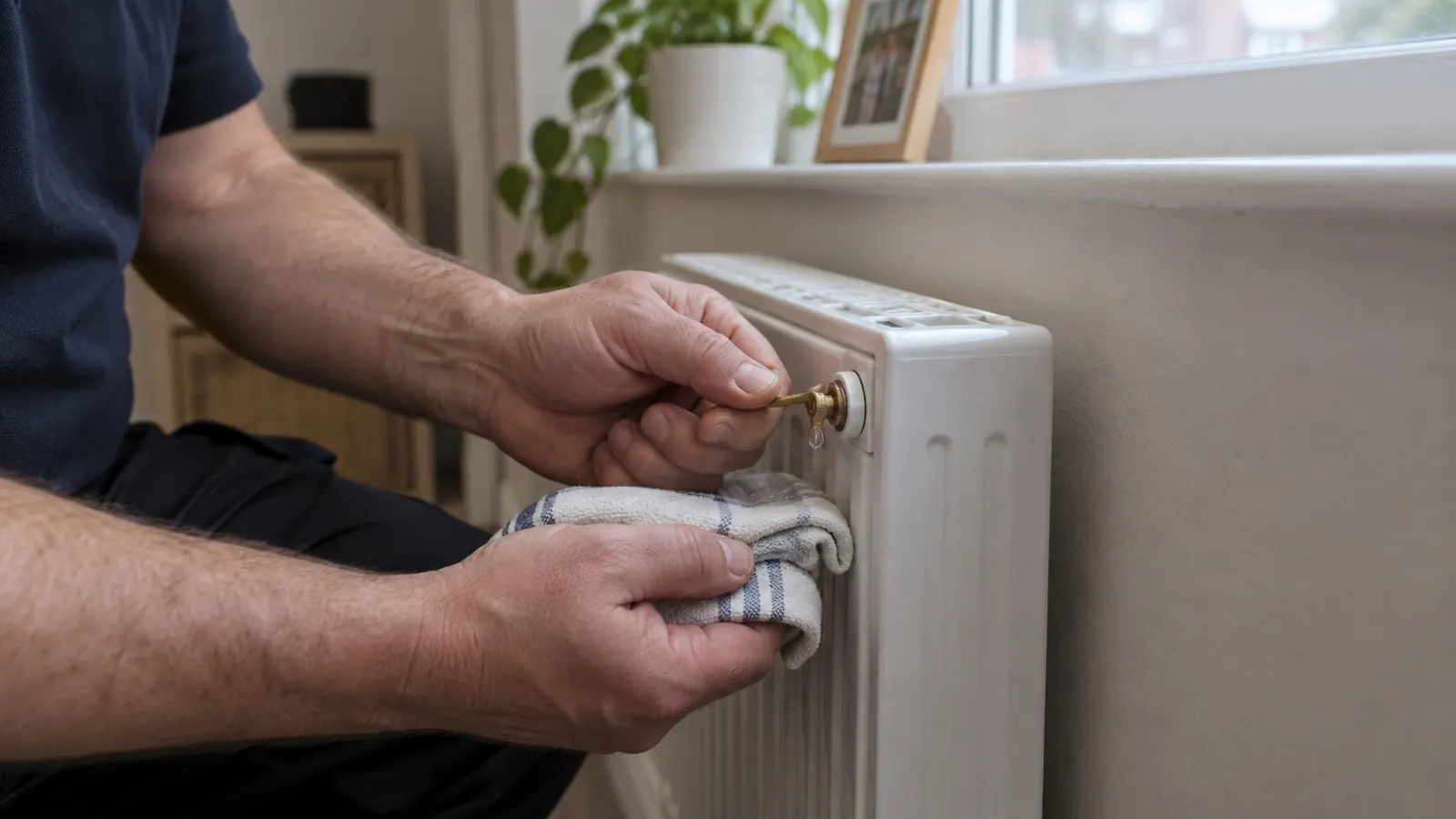
If a radiator is cold at the top but warm at the bottom, takes ages to heat up, or gurgles when the heating comes on, the cause is almost always trapped air. Bleeding releases that air so hot water can fill the whole panel again. It is one of the few heating jobs you can safely do yourself, because it only involves the water side of the system. No Gas Safe registration needed.
This is how we would do it on a visit, including the order to do multiple radiators in and the two checks people usually skip: the pressure gauge afterwards, and the colour of the water.
Signs a radiator needs bleeding
- Cold patch at the top while the bottom is warm. Air rises, so it collects at the top and stops water reaching that section.
- Gurgling or trickling noises from the radiator when the heating fires up.
- Slow warm-up in one room compared with the rest of the house.
- One radiator stone cold while others on the same floor are hot.
If the radiator is cold at the bottom and hot at the top, that is not air. That pattern means sludge sitting in the base of the panel, and bleeding will not shift it. More on that below.
What you need
- A radiator bleed key. Any DIY shop or hardware counter sells them. Some newer radiators take a flat-head screwdriver instead. Look at the valve before you start.
- An old cloth to hold around the valve and catch drips.
- A small pot or mug to catch the water once the air is out.
- An old towel on the floor under the valve, especially on carpet. System water stains.
You do not need pliers. If the valve will not turn with the key, forcing it with pliers is how bleed screws get snapped off.
How to bleed a radiator
- Turn the heating off and let it cool. Give it at least half an hour. A hot system spits scalding water and gives a false pressure reading.
- Find the bleed valve. A small square-headed screw inside a round nut at one of the top corners of the radiator.
- Put the towel down and hold the cloth around the valve. Position the pot underneath.
- Turn the key a quarter turn anticlockwise. You should hear a hiss. Do not open it further. A quarter turn is plenty and any more risks the screw coming out completely.
- Wait for the hiss to stop. Usually well under a minute. The air is replaced by a steady trickle of water.
- Close the valve as soon as water appears. Turn clockwise until it is snug. Hand-tight is enough. Over-tightening damages the seat.
- Wipe up and move to the next radiator.
- Check the boiler pressure. Once you have done all the radiators that needed it, look at the gauge on the boiler. If it has dropped below 1 bar, top it up to around 1.2 bar using the filling loop. This is the step most people forget, and it is why the boiler sometimes refuses to fire the morning after a bleeding session.
- Turn the heating back on and feel each radiator once it is warm. Top and bottom should be evenly hot.
What order to bleed multiple radiators
This is where most online guides go wrong. It matters if you have air in several radiators or you have recently had work done on the system.
- Combi boiler or system boiler (sealed system, pressure gauge on the boiler, no tank in the loft). Start downstairs and work up. The remaining air gets pushed to the highest radiators where it is easiest to release. Then bleed upstairs.
- Vented system (small feed tank in the loft, no gauge on the boiler). Start upstairs and work down. The tank refills the system by gravity as you go.
- Only one radiator affected. Just do that one. Check it again the next day.
Not sure which you have? If there is a pressure gauge on the boiler and no tank in the loft, it is a sealed system. Most homes built since the late 1990s, and most older homes that have had a new boiler, are sealed systems.
If no water comes out
You have opened the valve, the hissing has stopped or never started, and no water appears. Work through these:
- System pressure too low. Look at the boiler gauge. Below about 0.5 bar there is not enough water in the system to reach the valve. Top up at the filling loop first, then try again.
- Radiator valves closed. Check both valves at the bottom of the radiator, the thermostatic one and the lockshield under its plastic cap, are open.
- Bleed valve blocked. On older radiators in a hard-water area like Milton Keynes, scale and sludge can block the tiny hole. A gentle prod with a pin sometimes clears it. If it will not budge, stop. Forcing it snaps the screw and then the whole valve has to be replaced.
- Frozen pipe. Rare, but possible in a cold snap where the pipe runs through an unheated loft or garage.
If the water comes out black or dirty
This is the check most guides miss, and it tells you more about your heating system than anything else you can do without tools. Healthy system water is clear or faintly coloured, sometimes with a pinkish tint from inhibitor. If what trickles out is black, brown or gritty, the system has sludge in it.
Sludge is iron oxide from the inside of the radiators and pipework corroding. It settles in the bottom of radiators, clogs the boiler's heat exchanger, wears out the pump and makes the whole system slow and expensive to run. Hard water makes it worse because limescale and sludge compound each other, and Milton Keynes water is very hard.
You cannot fix sludge by bleeding. The fix is cleaning the system, either a chemical cleanse or a full power flush depending on how bad it is, followed by a magnetic filter and fresh inhibitor. Our guide to whether you need a power flush explains how to tell the difference, and what an honest engineer will check before recommending one.
If the pressure drops after bleeding
Normal. Letting air out means the system needs more water to replace it, so the gauge falls. After several radiators it can drop from 1.5 bar to well under 1. Top it back up to between 1 and 1.5 bar cold using the filling loop.
If the pressure keeps falling over the following days, and you are sure every bleed valve is closed, the system is losing water somewhere. See our guide to why a boiler loses pressure for what to check.
If you keep having to bleed the same radiator
Bleeding once a year at the start of the heating season is normal. Bleeding the same radiator every few weeks is not. Air is getting into the system somehow, and the common causes are a leak drawing air in as the pressure drops, an automatic air vent that has stuck, a tired expansion vessel, or corrosion inside the system generating gas. Each top-up of fresh water brings more oxygen in and makes the corrosion worse. That is a diagnosis for a heating engineer rather than something to keep living with.
When to stop and call an engineer
Bleeding is safe DIY because you are not touching gas, electrics or anything inside the boiler casing. Call a Gas Safe registered engineer if:
- The bleed screw is stuck, stripped or has snapped.
- The water is black or gritty.
- A radiator fills with air again within days.
- The boiler keeps losing pressure once you have stopped bleeding.
- You can see water leaking from a valve, joint or the radiator body.
- You have bled the radiator, no air came out, and it is still cold. That is a circulation or balancing issue, not air.
If you smell gas at any point, leave the property and call the National Gas Emergency Service on 0800 111 999.
Frequently asked questions
How often should I bleed my radiators?
Once a year, before the heating season, is enough for most homes. Do it any time you notice a cold top on a radiator.
Can bleeding a radiator damage my boiler?
Bleeding itself cannot. Forgetting to check the pressure afterwards can leave the boiler locked out on a low-pressure fault. Always look at the gauge when you have finished.
Can I bleed a radiator with the heating on?
Do not. The water inside can be hot enough to scald, and the pressure reading you take afterwards will be wrong. Wait for it to cool.
The radiator is cold at the bottom, not the top. Should I still bleed it?
You can, but it will not help. Cold at the bottom is sludge, not air. The system needs cleaning.
If it is beyond a bleed
When a radiator will not come right, the water is dirty, or the pressure will not hold, a Gas Safe registered engineer in Milton Keynes can sort it. We cover MK and the surrounding towns, and our boiler and heating repair visits start with a proper diagnosis rather than a guess. Get in touch if you would like us to take a look.
Need Professional Advice?
Our Gas Safe registered engineers are ready to help with all your heating needs. Get a free, no-obligation quote today.