Boiler Losing Pressure? 7 Causes and How to Fix Each
TL;DR
A boiler losing pressure means water is getting out of the sealed heating circuit somewhere. The seven usual causes are a failing expansion vessel, a dripping pressure relief valve, a leak in the pipework, a weep at a joint, a faulty pressure sensor, a stuck auto air vent, and radiators you have just bled. Only the last one is fixed by topping up. If you are topping up more than two or three times a year, get the cause found.
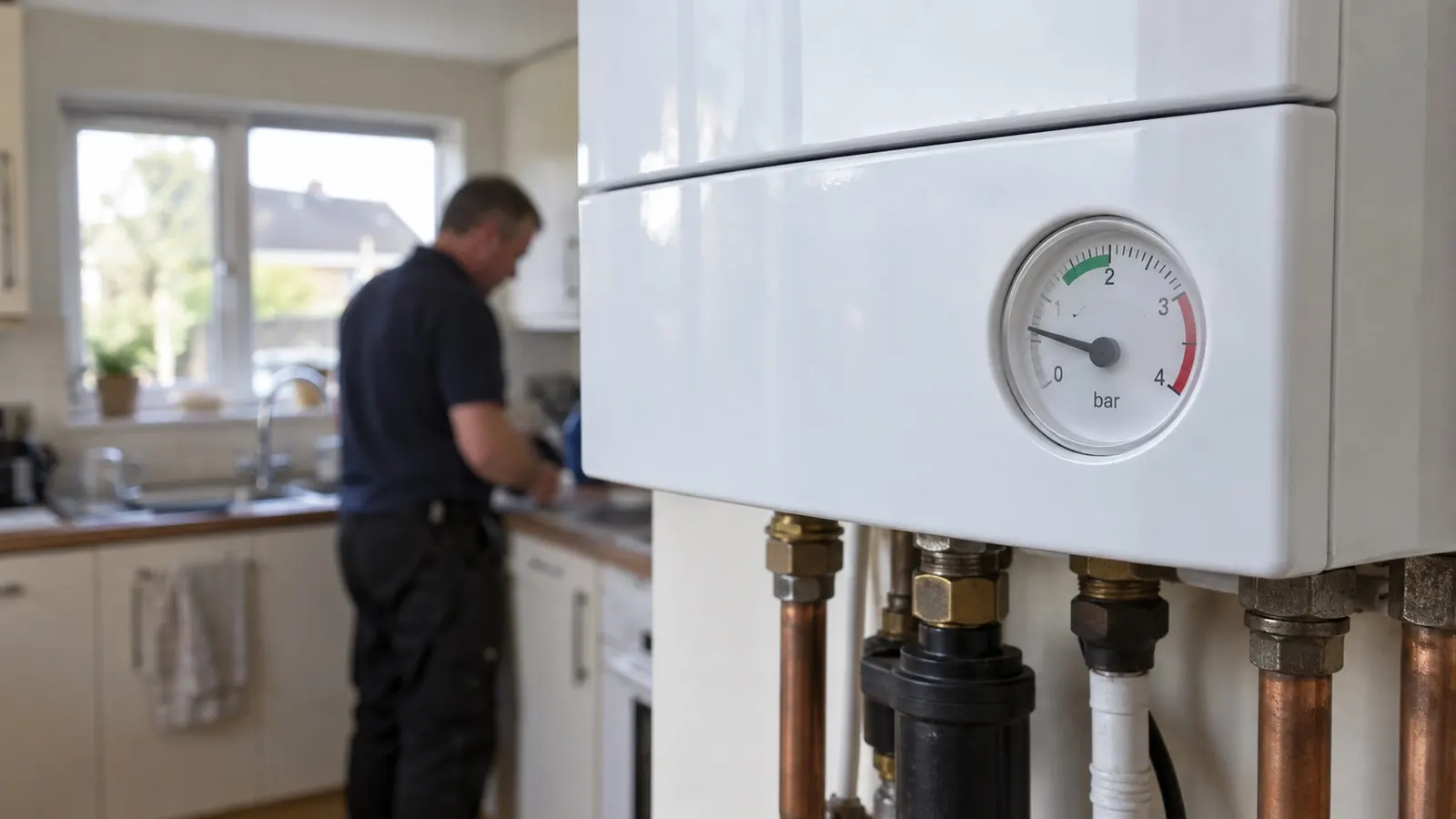
"My pressure keeps dropping" is one of the most common calls we get, especially in autumn when heating comes back on after months off. It can mean a five-minute top-up you do yourself, or a leak under the floor that has been quietly feeding a joist for a year. The difference is in the pattern, and this guide shows you how to read it.
How much pressure loss is normal?
Very little. A healthy sealed system holds its pressure within a tenth or two of a bar over a week. A slow drift over months as small amounts of air work their way out is normal. What is not normal:
- Dropping more than about 0.3 bar in a week.
- Dropping every day.
- The boiler locking out on low pressure more than once a year.
- Any drip, damp patch or staining near a radiator, valve or pipe.
If you are not sure what the gauge should read, our guide to what your boiler pressure should be covers it. Here are the seven causes, roughly in the order we find them.
1. Failing expansion vessel (the most common)
The expansion vessel is a small tank inside the boiler with a rubber diaphragm and a charge of air on one side. When the water heats up and expands, the vessel absorbs the extra volume. After seven to ten years the diaphragm perishes, the air charge escapes, and the vessel cannot do its job. Pressure then climbs high when the heating is hot and the boiler dumps water out through the pressure relief valve to protect itself. When everything cools, the pressure is low.
How to spot it: watch the gauge over a full heating cycle. Up towards 2.5 bar or more when the radiators are hot, down to 0.8 bar or less when cold, is the classic pattern.
DIY: none. The vessel is behind the casing. An engineer can either recharge it with air, which is quicker and cheaper but often a short-term fix, or replace it. Ask which they have done. If someone recharges it and it is back to the same pattern within a year, the diaphragm has gone and it needed replacing all along.
2. Pressure relief valve dripping
The pressure relief valve discharges through a copper or plastic pipe that comes out through an outside wall, usually below the boiler and pointing at the ground. If the valve is worn, or the expansion vessel has failed and is forcing it open, water comes out of that pipe.
How to spot it: go outside and look at the end of the pipe. A drip, a wet patch or green staining under it, or an icicle in winter.
DIY: none. The valve is replaced with the boiler drained down. The underlying cause is very often the expansion vessel, and a good engineer will check the vessel before fitting a new valve. A new valve on its own will start dripping again if the vessel is the real problem.
3. A leak in the heating pipework
Actual leaks show up most often at radiator valve unions, at compression joints under floorboards, at towel rail connections in bathrooms, and on older copper runs that have corroded.
How to spot it: check under every radiator and valve for staining, drips or rust marks. Look at ceilings below upstairs radiators for stains or bulging plaster. Lift any loose floorboard near a radiator. Look under and around the boiler itself.
DIY: a weeping radiator valve nut can sometimes be stopped with a quarter turn, holding the valve body with a second spanner. Our guide to why a radiator is leaking covers it properly. Anything under a floor or in a wall needs a plumber.
4. A tiny weep at a joint
A pinhole weep at a compression joint can lose pressure without ever leaving a puddle, because the water evaporates off warm pipe before it can collect. These are the hardest to find and the most common in houses over ten years old.
How to spot it: lay clean, dry kitchen paper under suspect joints for a day and look for marks. Look for a white crusty deposit or a rust ring around a nut. Both are the residue of water that has been evaporating there for months.
DIY: not reliably. Leak sealer liquids from the DIY shop can work as a stopgap on a genuine pinhole, but they mask the cause and they can clog the boiler's heat exchanger and pump. Most boiler manufacturers discourage them. We would rather find the joint.
5. Faulty pressure sensor
On most modern boilers the gauge or digital reading is driven by a sensor inside the boiler. After years, or after limescale has built up in a hard water area, the sensor can read low when the actual pressure is fine.
How to spot it: the boiler locks out on low pressure, but a separate test gauge shows normal pressure. Or the needle is stuck or twitchy and does not respond when you top up.
DIY: none. Engineer replaces the sensor.
6. Auto air vent stuck open
The automatic air vent at the top of the boiler lets air out of the system. If the float sticks or the seal fails, it lets water out too, as a fine mist or slow drip.
How to spot it: damp marks on top of the boiler or running down the back of the casing, and no obvious leak anywhere else.
DIY: none. It is inside the casing.
7. You have just bled the radiators
This is the only cause on the list that is not a fault. Bleeding lets air out, and the pressure drops to make up for it. If you bled three radiators yesterday and the gauge now reads 0.6 bar, that is expected. Top up through the filling loop to around 1.2 bar cold. If it stays there over the next week, you are done.
How to look for a hidden leak yourself
- Walk every radiator. Wipe each valve joint with dry kitchen paper. Any damp transferring is a weep.
- Check ceilings below upstairs radiators for stains or bulges.
- Lift loose floorboards near radiator pipes if you can do it safely.
- Look at the relief pipe outside for drips or staining.
- Look at the boiler casing and the floor under it for water, rust or limescale tracks.
- Leave kitchen paper under suspect joints for a day.
- Still nothing? The leak is under a floor or in a wall, or it is the expansion vessel. Time for an engineer.
Is it dangerous?
Not directly. The boiler locks out on low pressure long before anything serious can happen. Two things do matter, though.
- Hidden water damage. A slow leak under a floor rots joists and brings ceilings down, and the repair to the house costs far more than the repair to the heating.
- Repeated topping up. Every top-up brings in fresh mains water carrying oxygen and, in a hard water area, limescale. Oxygen corrodes radiators from the inside and makes sludge. Limescale coats the heat exchanger. A year of weekly top-ups can leave you needing a powerflush and shorten the boiler's life. This is the part most people are not told: topping up is not free, even though it costs nothing at the time.
You should not need to top up a healthy system more than two or three times a year.
When to call a Gas Safe engineer
- You have topped up more than twice in a month.
- Pressure drops below 0.5 bar repeatedly.
- There is water under or around the boiler.
- The relief pipe outside is dripping.
- You suspect a leak but cannot find it.
- The boiler is over about eight years old and losing pressure daily. That is usually the expansion vessel.
Most expansion vessel and relief valve problems get picked up at an annual service before they leave you cold. If you are in Milton Keynes or nearby and this has gone beyond a top-up, Plumbline MK is Gas Safe registered (957816) and our boiler repair visits start with finding the cause rather than fitting a part. Get in touch and tell us the pattern on the gauge; it usually tells us most of what we need to know before we arrive.
Frequently asked questions
How much pressure loss in a week is normal?
Almost none. A tenth or two of a bar over a week is fine. More than 0.3 bar a week means water is leaving the system. Half a bar a day means an active leak or a failed expansion vessel.
Can I just keep topping up?
You can, but each top-up brings in oxygen and limescale that corrode the system and scale the boiler. Find the cause. It is nearly always cheaper than the damage a year of topping up does.
How long does an expansion vessel last?
Usually seven to ten years. It is the single most common reason for a boiler losing pressure, and it is far cheaper to catch at a service than on a breakdown visit in January.
Why does the pressure go up when the heating is on and down when it is off?
That swing is the signature of a failed expansion vessel. The water has nowhere to expand into, so the pressure spikes, the relief valve lets some out, and the system is short of water when it cools.
Need Professional Advice?
Our Gas Safe registered engineers are ready to help with all your heating needs. Get a free, no-obligation quote today.