Boiler Keeps Turning Off? Short Cycling
TL;DR
Short cycling means the boiler reaches temperature faster than the system can absorb the heat, so it shuts off and restarts repeatedly. The usual causes are an oversized boiler, too many radiator valves closed, sludge restricting flow, or a boiler flow temperature set too high. Each start puts more wear on the boiler than an hour of steady running.
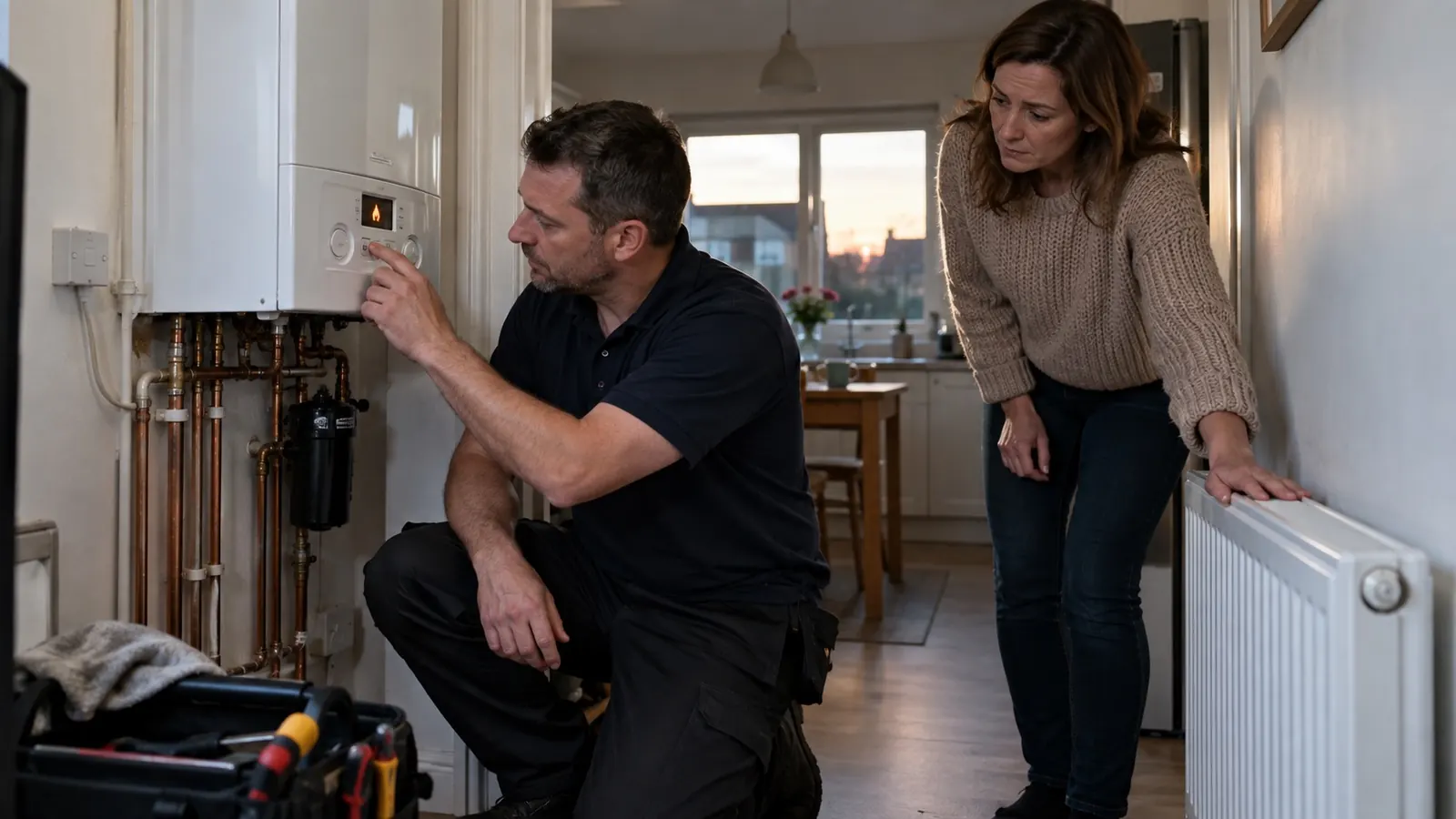
It matters because ignition is the hardest thing a boiler does. A unit cycling six times an hour is doing far more damage to itself than one running steadily for the same period, and it burns more gas doing it.
What Is Actually Happening
The boiler heats water to its set flow temperature. If the system cannot absorb that heat fast enough - because there is not enough radiator surface open, or flow is restricted - the return water comes back hot, the boiler hits its target almost immediately and shuts down.
It then waits, the water cools slightly, and it fires again. Repeatedly.
Cause 1: Too Many Radiators Closed
The most common cause and the easiest to fix.
If most thermostatic valves are turned down or off, there is very little system volume for the boiler to heat. It reaches temperature in seconds.
The fix: leave at least one radiator with no thermostatic control - normally the one in the room with the main house thermostat, on a manual valve. That guarantees somewhere for heat to go.
Our guide to thermostatic radiator valves explains why that radiator should not have a TRV.
Cause 2: Flow Temperature Set Too High
Many boilers leave the factory set at 75 to 80°C, which is higher than a modern condensing boiler needs and higher than is efficient.
At a lower flow temperature the boiler runs longer, gentler cycles and - importantly - actually condenses, which is where its efficiency comes from. A condensing boiler running at 80°C flow is not condensing much at all.
The fix: reduce the heating flow temperature to around 60°C, or lower if the radiators keep the house warm at that setting. The Energy Saving Trust covers the efficiency case for this.
Note this is the heating flow temperature, not the hot water temperature, which should stay at 60°C or above.
Cause 3: Sludge Restricting Flow
Iron oxide sludge narrows pipework and coats heat exchangers. Flow drops, the boiler's return water comes back hot, and it cycles.
Clues: radiators cold at the bottom, cold spots, black water when bled, a noisy pump. Our guide to a radiator not heating up covers the same underlying problem.
The fix: a power flush and a magnetic filter, then correct inhibitor.
Cause 4: An Oversized Boiler
A boiler much larger than the property needs will cycle in mild weather because the heat demand is a fraction of its minimum output.
This is common because combis are often sized on hot water flow rate, which pushes the output up, while the heating demand stays modest. A 35kW combi in a well-insulated two-bedroom house will cycle in autumn.
Mitigations rather than fixes: lower the flow temperature, ensure the boiler modulates properly, and fit weather compensation or load compensation controls where supported. Replacing an oversized boiler purely for this is rarely worth it.
Cause 5: A Pump Problem
A pump running too slowly, or a failing one, moves too little water. Same effect as restricted flow.
Some pumps have a speed setting that has been left too low. Worth checking before assuming anything worse.
Cause 6: Controls Fighting Each Other
A TRV in the same room as the main thermostat is the classic. The TRV closes the radiator, the room cools, the thermostat calls for heat, the boiler fires with nowhere to send it, the room does not warm, and it repeats.
Similarly, a smart TRV system without a compatible room thermostat can leave the boiler firing while every valve is shut.
Why It Matters
- Wear. Ignition and shutdown are the most stressful moments in a boiler's cycle. Frequent cycling shortens its life measurably.
- Efficiency. Each start has a purge and ignition phase that produces no useful heat.
- Comfort. Temperature swings rather than steady warmth.
- Noise. Repeated fan spin-up and ignition, which is noticeable at night.
A Quick Diagnostic Order
- Open more radiators, and ensure one has no TRV.
- Reduce the heating flow temperature to around 60°C.
- Check the pump speed setting.
- Bleed the radiators and check for sludge symptoms.
- If it persists, look at sizing and controls.
Frequently Asked Questions
How often should a boiler cycle?
In steady cold weather, ideally it runs continuously at reduced output. Three to six starts an hour in mild weather is common; more than that repeatedly is worth investigating.
Is short cycling dangerous?
Not dangerous, but it wastes gas and shortens the boiler's life. It is a maintenance issue rather than a safety one.
Will turning the flow temperature down leave the house cold?
Usually not. The radiators run cooler but for longer, and the room reaches the same temperature. If the house genuinely will not warm at 60°C, the radiators may be undersized - see our radiator sizing guide.
Is my boiler broken?
Short cycling is usually a system or settings problem rather than a boiler fault. The boiler is doing what it is being asked to do.
If It Keeps Cycling
Persistent cycling after opening radiators and lowering the flow temperature usually points at sludge or a controls mismatch. We cover Milton Keynes and the surrounding area for boiler repair and power flushing. Get in touch.
Need Professional Advice?
Our Gas Safe registered engineers are ready to help with all your heating needs. Get a free, no-obligation quote today.