What Size Radiator Do I Need? BTU Guide
TL;DR
Start with room volume in cubic metres, multiply by a factor for the room type and insulation, then add for north-facing walls, large windows and external doors. A rough working figure is 5 BTU per cubic foot for a well-insulated living room, more for older properties. Undersizing leaves the room cold; oversizing wastes money and short-cycles the boiler.
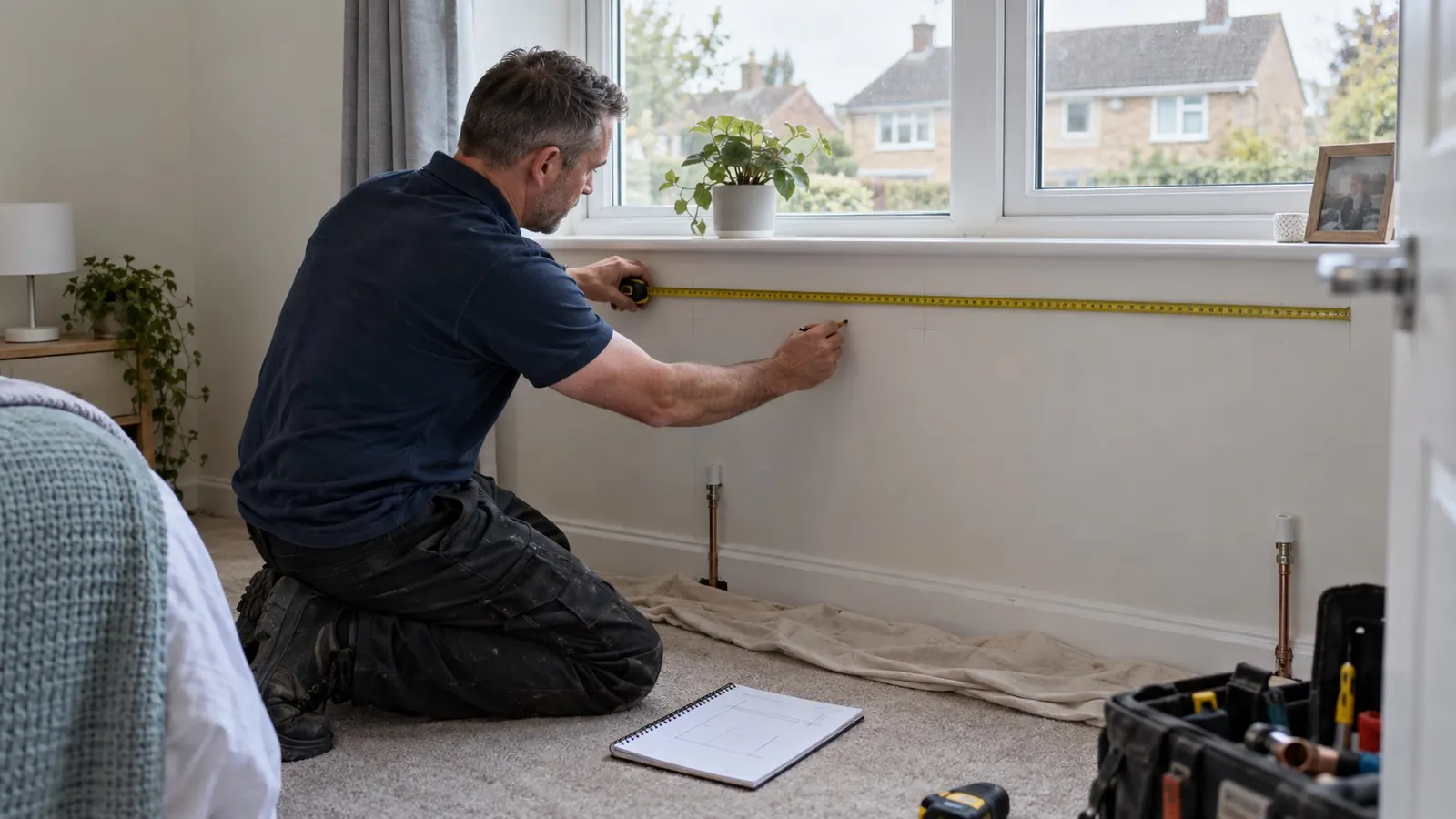
Minimum efficiency standards for heating systems are set out in Approved Document L. Radiator sizing is one of the few heating decisions where getting it wrong is obvious for the next fifteen years. Too small and the room never quite warms. Too large and you have paid more than needed, and the radiator spends its life throttled back.
The calculation is not complicated, but it needs to account for more than floor area.
Start With Volume, Not Floor Area
Heating warms air, and air is measured in three dimensions. A room with a high ceiling needs considerably more output than the same floor plan with a standard ceiling.
Measure length, width and height in metres and multiply them together to get cubic metres.
Apply a Factor for the Room
Different rooms need different target temperatures, and different buildings lose heat at different rates. As a working guide, multiply your cubic metres by roughly:
- Living room, well insulated: 150 to 180 BTU per cubic metre
- Living room, older or poorly insulated: 200 to 240
- Bedroom: 130 to 160 - usually kept cooler
- Kitchen: 100 to 130 - appliances contribute heat
- Bathroom: 180 to 220 - kept warmer, and often has poor insulation on an external wall
- Hallway: 100 to 130
These are starting points, not a specification. A room's actual heat loss depends on construction, glazing and exposure.
Then Adjust for the Room's Weaknesses
Add roughly the following on top:
- North-facing room: add 10 to 15 per cent
- Large or single-glazed windows: add 10 to 20 per cent
- Two or more external walls: add 10 per cent
- External door: add 10 per cent
- Room above an unheated space such as a garage: add 10 to 15 per cent
- Solid walls rather than cavity: add 15 to 20 per cent
- Recent full insulation and modern glazing: deduct 10 per cent
A north-facing lounge with a large bay window in a solid-walled property can need close to double the output of an identically sized room in a well-insulated modern house.
Reading Radiator Specifications
Manufacturers quote output in BTU per hour or in watts. To convert, 1 watt is roughly 3.41 BTU/hr.
The important detail is the temperature the figure is quoted at, usually shown as Delta T. Older figures were quoted at Delta T 60, modern ones at Delta T 50.
A radiator rated 5,000 BTU at Delta T 60 delivers roughly 3,800 BTU at Delta T 50. If you compare a Delta T 60 figure against your requirement without adjusting, you will undersize by about a quarter.
The Energy Saving Trust has detail on sizing emitters for lower flow temperatures. This matters more with a heat pump, which runs at much lower flow temperatures. A radiator sized for a gas boiler will be significantly undersized on a heat pump, which is why heat pump conversions so often involve replacing radiators.Single, Double and Convector Panels
- Type 11 - single panel, single convector fin. Slimmest, lowest output.
- Type 21 - double panel, single convector. Middle ground.
- Type 22 - double panel, double convector. Highest output for a given size, and the usual choice where wall space is tight.
If the calculation gives a radiator too big for the wall, a Type 22 in the same footprint often solves it. A vertical radiator is another option where wall width is the constraint.
Where to Put It
Traditionally under a window, to counter the cold downdraught from the glass. With modern double glazing that matters less, and any wall works - but avoid:
- Behind a sofa or a curtain, which blocks convection
- Anywhere the thermostatic valve sits in a pocket of trapped heat, since it will close early and leave the room cold
Our guide to thermostatic radiator valves covers that trapped-heat problem, which is a common cause of a room that never feels warm despite a correctly sized radiator.
A Worked Example
A living room 5m by 4m with a 2.4m ceiling is 48 cubic metres. Well insulated, at 165 BTU per cubic metre, gives about 7,900 BTU.
It faces north, so add 12 per cent - around 8,850. It has a large window, so add another 15 per cent - around 10,200 BTU.
You would then look for a radiator delivering at least 10,200 BTU at Delta T 50, and round up rather than down.
Frequently Asked Questions
Is it better to oversize or undersize?
Slightly oversize. An oversized radiator simply reaches temperature sooner and the valve throttles it back. An undersized one can never heat the room, whatever you do.
Do I need to recalculate if I add insulation?
The existing radiator will now be oversized, which is fine - it will just work less hard. Recalculating matters when you are replacing radiators or moving to a heat pump.
Can I just match the size of the old radiator?
Only if the old one heated the room properly. Many were sized by eye decades ago, and modern radiators of the same physical size often have quite different output.
How does a heat pump change this?
Heat pumps run at 35 to 45°C rather than 70°C or more, so a radiator delivers far less output. Sizing for a heat pump typically means radiators two to three times larger, which is why a proper room-by-room heat loss survey is essential rather than a rule of thumb.
If You Want It Calculated Properly
Rules of thumb are fine for replacing one radiator. For a whole system, or anything involving a heat pump, a room-by-room heat loss calculation is the right approach. We cover Milton Keynes and the surrounding area for heating design and installation. Get in touch.
Need Professional Advice?
Our Gas Safe registered engineers are ready to help with all your heating needs. Get a free, no-obligation quote today.