How to Bleed a Towel Radiator
TL;DR
Find the bleed valve at the top of the rail - usually a small square or slotted screw on one of the upper corners. Turn the heating off and let it cool, hold a cloth underneath, and open the valve a quarter turn until the hiss stops and water appears. Towel rails trap air more than flat radiators because the top bar sits higher than the pipework feeding it.
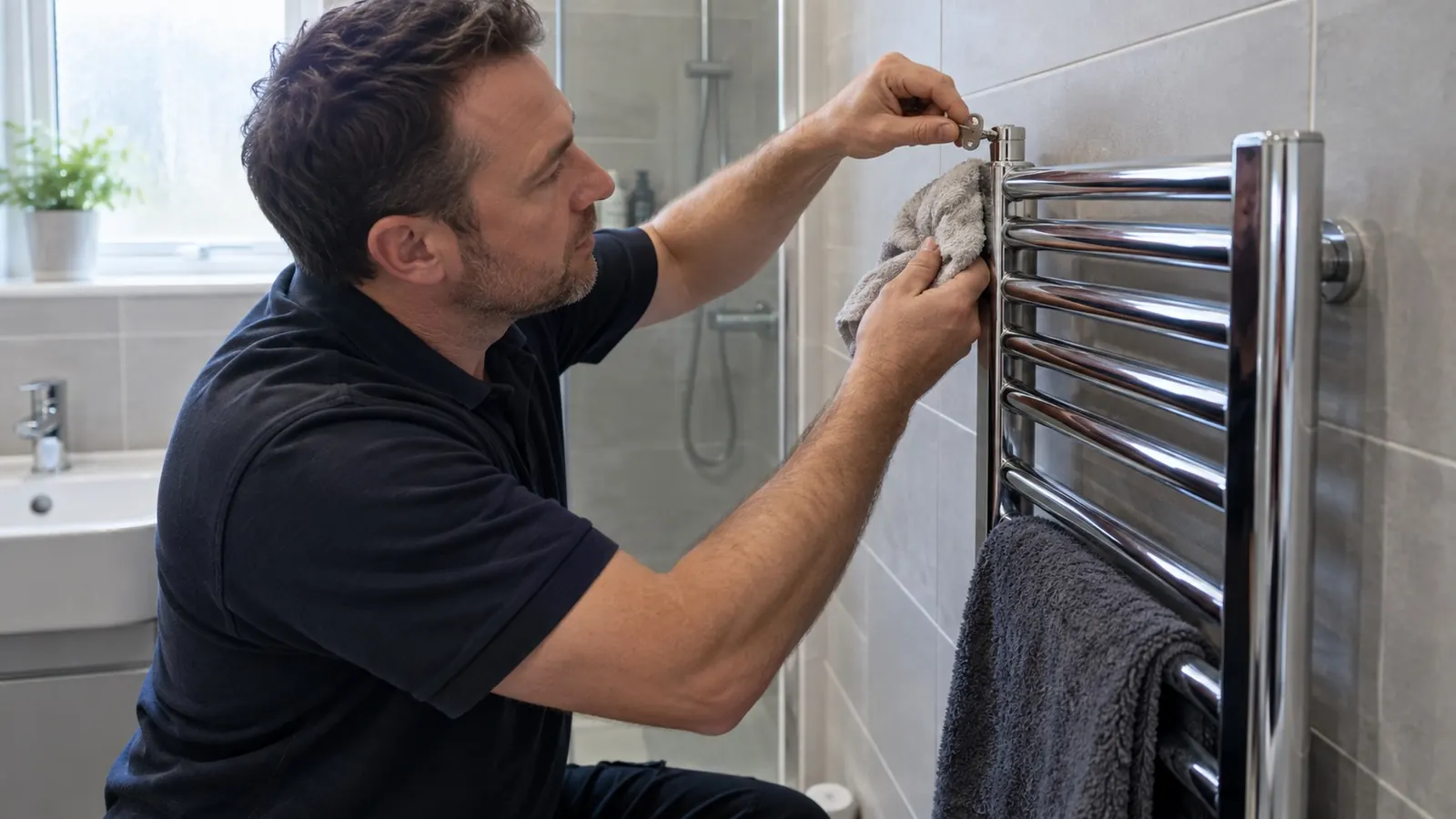
The Chartered Institute of Plumbing and Heating Engineering covers venting and commissioning of domestic heating circuits. In practice, heated towel rails are the most air-prone radiator in most homes, and the reason is their shape. The horizontal bars at the top sit above the flow and return connections, so air collects there and simply stays. A flat panel radiator has one high point; a ladder rail effectively has several.
That is why a towel rail is often cold at the top while every other radiator in the house is fine.
Find the Bleed Valve
On a towel rail it is usually on one of the top corners, at the end of the uppermost bar. Look for:
- A small square spindle inside a round fitting - needs a radiator bleed key
- A slotted screw - a flat screwdriver works
- An automatic air vent - a small cylindrical fitting that releases air on its own
Some designs hide it behind a decorative chrome cap that unscrews or pulls off.
If there is a valve at both top corners, bleed the one on the side that stays coldest.
Bleeding It
- Turn the heating off and let the system cool for at least twenty minutes. Bleeding a hot rail risks a scald and the pump can draw more air in while running.
- Put a cloth or small container under the valve. What comes out is dirty and will mark tiles and grout.
- Fit the key or screwdriver and turn anticlockwise a quarter turn only. You should hear a hiss.
- Let the air out. When the hiss changes to a steady dribble of water, close it.
- Close it firmly but do not overtighten - the brass spindle is soft and strips easily.
- Wipe the area dry and check the valve is not weeping.
Because a ladder rail has multiple high points, it sometimes needs a second bleed a day later once the remaining air has migrated to the top.
Afterwards: Check the Boiler Pressure
The Energy Saving Trust recommends bleeding radiators annually as part of keeping a heating system efficient. Every time you do, you remove volume from a sealed system, and the pressure drops. Check the gauge on the boiler - it should sit between 1 and 1.5 bar when cold.
If it has dropped below 1 bar, top it up. Our guide to repressurising a boiler covers how, brand by brand.
Still Cold After Bleeding?
If no air came out, or it came out and the rail is still cold, the cause is something else.
The valves are closed
Check both ends. The thermostatic head should be open, and the lockshield at the other end should not be fully shut. A towel rail fitted during a bathroom refit is often left with its lockshield closed and never reopened.
It is on the wrong circuit
Some towel rails are plumbed onto the hot water circuit rather than the heating circuit, so they only warm when the hot water runs, not when the heating is on. Some are dual-fuel with an electric element for summer use - check whether the element switch is on.
Sludge in the bottom bar
If the rail is warm at the top and cold at the bottom, that is not air - air rises. Cold at the bottom means sludge has settled in the lower bars and is blocking flow. Bleeding will not touch it.
That needs flushing, and it usually means the wider system has a sludge problem too. Our guide to a radiator that will not heat up goes through the same diagnosis for flat panels.
The whole system needs balancing
Towel rails are often at the far end of a circuit and get starved if the system is unbalanced. See balancing radiators.
Dual-Fuel Rails
Many bathroom rails have both a heating connection and an electric element, so they can be used in summer when the heating is off.
Two things worth knowing:
- The element only heats the water already inside the rail. If the rail has been drained or is full of air, it will not work properly and the element can be damaged by running dry.
- When running on the element, both valves should be closed so the rail is isolated. Leaving them open lets the heat escape into the rest of the system.
Frequently Asked Questions
How often should I bleed a towel rail?
Once a year, at the start of the heating season, along with the rest of the radiators. If yours needs bleeding every few weeks, air is getting in somewhere and that needs investigating rather than repeating.
Nothing comes out when I open the valve.
Either there is no air, or the valve is blocked with scale. Check the valves at both ends are open first - that is the more likely explanation.
Why is my towel rail warm at the top and cold at the bottom?
Sludge, not air. Air rises, so trapped air always makes the top cold. Cold at the bottom is a flow problem caused by debris settling.
Water sprayed out instead of hissing.
The valve was opened too far. Close it immediately, then reopen a quarter turn only. Check the boiler pressure afterwards.
If Bleeding Does Not Help
A towel rail that stays cold after bleeding, with both valves open, usually has sludge in the lower bars or a balancing problem across the system. We cover Milton Keynes and the surrounding area for power flushing and heating repairs. Get in touch and tell us which parts of the rail get warm.
Need Professional Advice?
Our Gas Safe registered engineers are ready to help with all your heating needs. Get a free, no-obligation quote today.