Radiator Valve Types Explained: TRV, Lockshield, Manual, Smart
TL;DR
Every radiator has two valves. The control valve at one end is what you adjust, and on most radiators it is a thermostatic valve (TRV) whose numbers are target room temperatures, not heat settings. The lockshield at the other end has a plain cap and sets how much flow that radiator gets compared with the rest. It is set once during balancing and left alone. The commonest TRV fault is a pin seized shut after a summer closed.
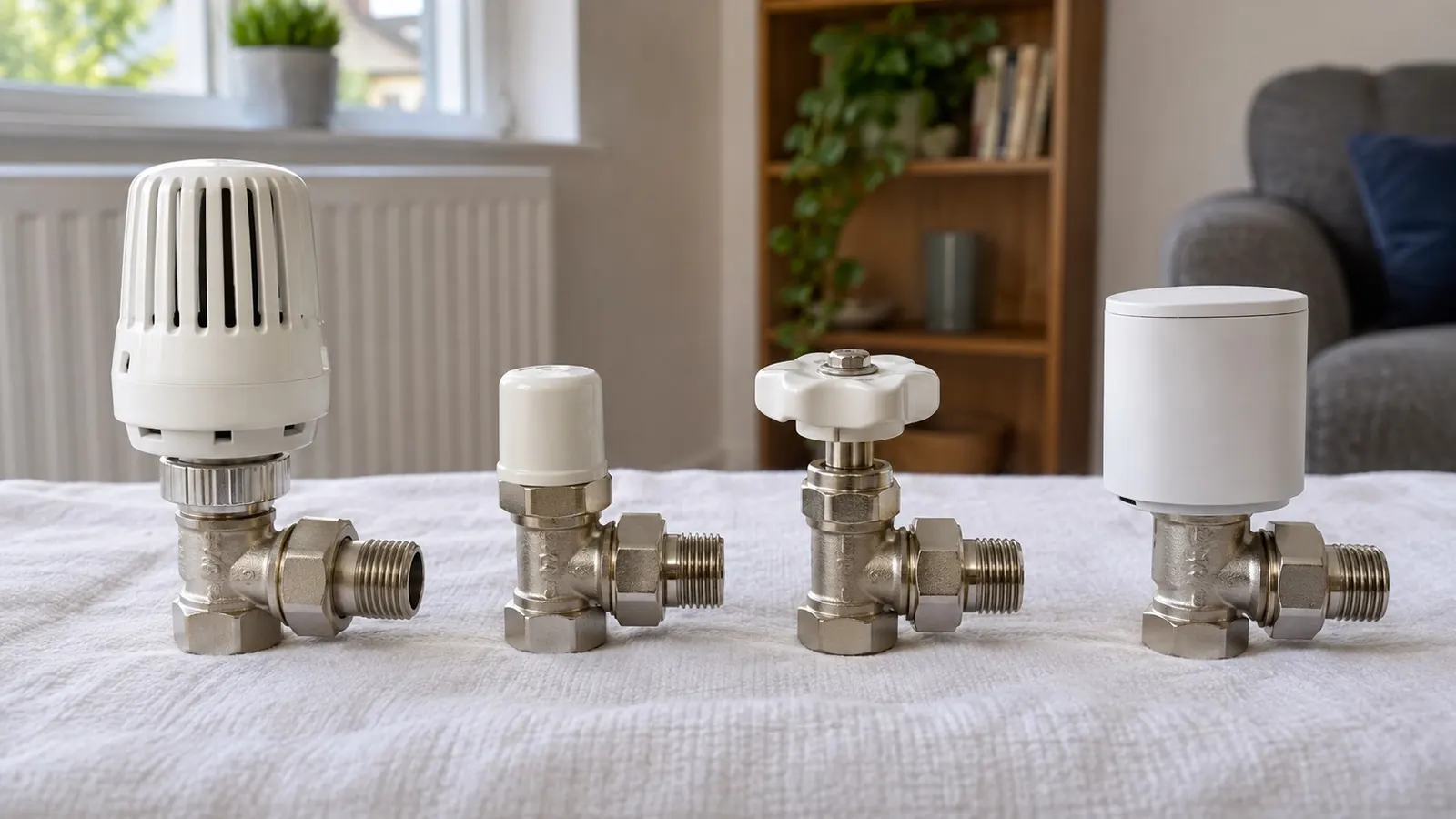
Most radiators have two valves that look much the same and do completely different jobs. Mixing them up is behind a surprising number of heating complaints, because turning the wrong one unbalances the whole house. Approved Document L of the Building Regulations is why modern installations put thermostatic control on most radiators, so it is worth knowing what each valve is for, what the numbers mean, and how to tell when one has failed.
The two ends of a radiator
- The control valve. At one end, with something you are meant to turn: a numbered head, a wheel head, or a smart head. This is the one you adjust day to day. It decides how warm that room gets.
- The lockshield valve. At the other end, with a plain plastic cap over a small square spindle. It is not a user control. It sets how much flow that radiator takes compared with every other radiator in the house. It is set once during balancing and then left. The cap is there specifically to stop people fiddling with it.
Thermostatic radiator valves (TRVs)
The most common control valve in modern homes. Inside the numbered head is a capsule of wax or liquid that expands as the air around it warms. The expansion pushes a pin down into the valve body and throttles the flow. As the room cools, the capsule contracts, the pin rises and flow resumes. It is a small mechanical thermostat powered by the room's own heat, and it senses the air immediately around the head. That last detail explains most TRV problems.
The numbers are target temperatures, not power settings. Turning a TRV to 5 does not make the radiator hotter. It keeps the valve open until the room is warmer than you probably want. Roughly, on most valves:
- Snowflake or star: frost protection only, around 7 degrees. Keeps pipes from freezing without heating the room.
- 1: about 10 degrees.
- 2: about 15 degrees.
- 3: about 20 degrees. The right setting for most living rooms.
- 4: about 25 degrees.
- 5: effectively always open.
Sensible settings: 3 for living rooms, 2 to 3 for bedrooms, 2 for hallways, 3 to 4 for bathrooms, and 1 or the frost setting for rooms you rarely use. Set unused rooms low rather than fully off. Fully off risks damp in an unheated room and lets the pin seize.
Getting the best from a TRV
- Keep the head clear. A TRV behind a curtain or a sofa sits in a hot pocket, reads 25 degrees and shuts while the room is at 16. Same for a head in direct sun or next to a television. If the head cannot be moved, a remote-sensor TRV puts the sensing element on a capillary tube away from the radiator.
- Do not put a TRV in the room with the main thermostat. The two controls fight. The TRV closes the radiator, the room cools, the wall thermostat calls for heat, and the boiler fires with nowhere to send it. That short-cycling wastes gas and shortens the boiler's life. That radiator should have a manual valve, left open, so there is always somewhere for heat to go.
- Open every TRV fully in summer. It costs nothing, because the boiler is off, and it is the single best way to stop the pin seizing.
- Heads point sideways, not up. A head pointing upward is warmed by the radiator's own rising heat and closes early.
The seized pin: the commonest TRV fault
If one radiator is stone cold while the rest are fine, and bleeding produced water rather than air, check this before anything else. Over a summer with the valve closed, the pin under the head sticks down with limescale and corrosion. In autumn the head opens but the pin does not rise, so the valve stays shut. In a hard water area like Milton Keynes it happens more than most.
- Unscrew the collar and pull the head off. Underneath is a small metal pin.
- Press it with a thumb. It should move a millimetre or two and spring back.
- If it is stuck, tap it gently with the handle of a screwdriver. If that fails, grip it with pliers and work it up and down carefully. Gently, because bending or snapping it means replacing the valve body. A little penetrating oil helps, but keep it off the rubber seal.
- Once it springs freely, refit the head.
If the pin moves freely but the valve still will not control temperature, the capsule in the head has failed. A new head fixes it, no draining needed. Heads typically last ten to fifteen years; bodies longer.
Manual valves
A simple wheel head that opens and closes flow with no temperature sensing. Whatever you set stays set until you change it. Still the right choice in the room with the main thermostat, and sometimes on a towel rail where you want constant output.
Lockshield valves
The plain-capped one, and the most misunderstood valve in the house. Its job is balancing. Radiators nearest the boiler naturally get more flow than those furthest away, so the near ones are throttled slightly with the lockshield until every radiator warms at a similar rate. If a system is unbalanced, the far radiators are always lukewarm, the near ones roast, and the boiler runs hotter than it needs to.
If you ever take a radiator off, count the turns as you close the lockshield and reopen it by the same number. That keeps the balance. If several radiators are unevenly warm, the system needs balancing properly with thermometers on the flow and return of each radiator, which is a job worth having done rather than guessed at.
Smart radiator valves
A smart TRV is a thermostatic valve with a motorised head, controlled from an app or a hub. Different schedules and temperatures per room are genuinely useful in a house where rooms are used at different times. The Energy Saving Trust has comparisons of smart heating controls if you are weighing them up. Before buying:
- They need batteries, which need changing.
- They are bulkier, and can foul skirting or a windowsill in a tight spot.
- They control the radiator, not the boiler. Unless the system also has a compatible room thermostat, the boiler may keep firing while every valve is shut.
- They fit standard valve bodies, so usually only the head is replaced, not the whole valve.
Angled, straight, corner and H-block
This is about where your pipes come from, not what the valve does.
- Angled: a 90-degree bend. Standard where pipes come up out of the floor.
- Straight: in line. For pipes coming horizontally out of the wall or skirting.
- Corner: turns 90 degrees in a different plane, keeping the head facing outward. Neater in tight spaces.
- H-block: a single fitting for both flow and return on radiators with a central bottom connection.
Measure and photograph your existing setup before buying. Angled instead of straight is the commonest ordering mistake.
Flow and return
Older thermostatic valves were directional and had to go on a specific side, marked with an arrow. Most modern ones work either way, but check for an arrow. Fitted backwards, a directional valve chatters, whistles and closes unpredictably. A whistling TRV that is fitted the right way round is usually flow noise through a nearly closed valve, and points to a system that needs balancing.
Do TRVs save money?
Yes, when used properly, which means keeping rarely used rooms cooler rather than heating the whole house to the same temperature. What does not work is turning every TRV down and expecting savings. The boiler still fires, it just has fewer radiators to feed, and it may short-cycle. The saving comes from not heating rooms you are not in, alongside a correctly set room thermostat and timer. One honest point: a house full of TRVs with no working room thermostat is worse than a plain system with a good one, and we see plenty of them.
Frequently asked questions
Which end does the TRV go on? Traditionally the flow side, though most modern valves work either way. What matters more is that the head is not blocked by furniture or curtains.
Can I put a TRV on every radiator? Not on the one in the room with the main thermostat. Building regulations require some circulation to remain available, and that radiator on a manual valve provides it.
Why is my lockshield capped? On purpose. It is a commissioning setting, not a user control, and adjusting it unbalances the system.
Do I need to drain the system to change a valve? To change the body, usually yes, unless there are isolation valves nearby. To change just the head, including a smart head, no. The head unscrews and the body stays put.
If a valve needs replacing
Freeing a pin and swapping a head are ten-minute jobs. Changing a valve body means draining down, and a seized or weeping valve on old pipework can turn awkward quickly. If that is where you have got to, or the whole system needs balancing, a heating engineer in Milton Keynes can sort it. We cover MK and the surrounding towns for heating repairs and system cleaning and balancing. Get in touch.
Need Professional Advice?
Our Gas Safe registered engineers are ready to help with all your heating needs. Get a free, no-obligation quote today.