How to Drain a Central Heating System
TL;DR
Turn the boiler off and let the system cool completely, then close the water supply to it. Attach a hose to the lowest drain-off valve, run it outside, and open it. Open the bleed valves starting from the top floor down to let air in. Refill in reverse - bottom-up - and add inhibitor before you finish, or the fresh water will start corroding the system immediately.
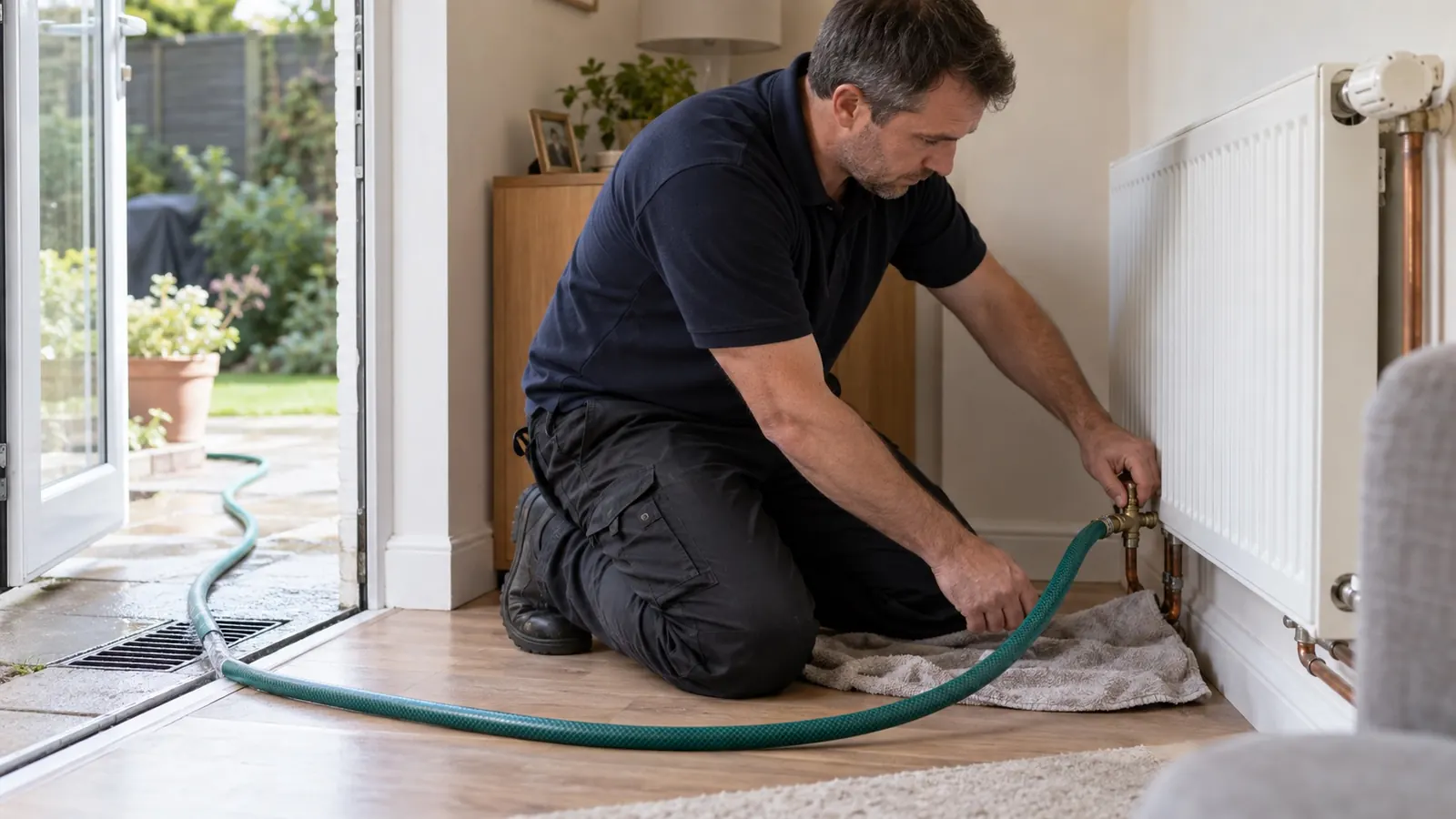
Draining a heating system is not difficult, but the order matters at both ends: you drain top-down and refill bottom-up. Do it the other way and you will spend an afternoon chasing airlocks around the house.
You only need to do this for work on the pipework, replacing a radiator valve, or fitting a new radiator where there is no valve to isolate. To take a radiator off temporarily you do not need to drain anything - see our guide to removing a radiator.
Before You Start
- Turn the boiler off and let the system cool completely. Any work on the gas side is for a Gas Safe Register engineer only. Several hours if it has been running. Hot system water causes serious scalds.
- Switch off at the programmer as well, so nothing fires while the system is empty. A boiler that fires dry can be damaged.
- Have inhibitor ready to add on refill. This is not optional - fresh water plus air plus steel begins corroding immediately.
What you need
- A garden hose that fits the drain-off valve
- A jubilee clip to secure it
- A radiator bleed key and an adjustable spanner
- Central heating inhibitor
- Towels and a bowl
Step 1: Isolate the Water Supply
How depends on your system.
Sealed system - most modern homes with a combi or an unvented cylinder. Close the valves on the filling loop, the flexible braided hose near the boiler.
Open vented system - with a small feed and expansion tank in the loft, separate from the big cold water tank. Tie the float arm up to a batten across the tank so the valve stays shut, or close the isolation valve on its supply. If you skip this, the tank keeps refilling the system while you drain it.
Step 2: Find the Drain-Off Valve
A small brass fitting with a square spindle and a hose nozzle, at the lowest point of the system. Usually:
- At the bottom of a downstairs radiator, on one of the valve bodies
- On the pipework near the boiler
- Under the floor near an external wall
Use the lowest one you can find. A higher one leaves water sitting in the pipes below it.
Step 3: Drain It
- Push the hose onto the nozzle and secure it with the jubilee clip. These blow off under flow and it is not a mistake you want to make indoors.
- Run the hose outside to a drain, or to a lower point than the valve. It works by gravity.
- Open the drain-off with a spanner, turning anticlockwise.
- Water starts flowing. It will be black.
- Now open the bleed valves, starting upstairs and working down. That lets air in behind the water so it drains properly. Opening downstairs first can airlock the upper floors and stall the drain.
- Once flow stops, open any remaining bleed valves to clear the last of it.
Expect this to take twenty minutes to an hour depending on system size.
Step 4: Refilling - Reverse the Order
- Close every bleed valve you opened.
- Close the drain-off valve firmly and remove the hose.
- Add inhibitor now, before the system is full. Either through a radiator with the top connection removed, or via a dosing point if the system has one.
- Open the filling loop slowly, or untie the float valve on an open vented system.
- Bleed from the bottom up - downstairs radiators first, then upstairs. Air is pushed ahead of the rising water, so working upward follows it out.
- Watch the pressure gauge on a sealed system. Stop filling at 1 to 1.5 bar cold. Our guide to repressurising a boiler covers the detail.
- Close the filling loop and disconnect it once full.
- Fire the boiler, run the heating up to temperature, then let it cool and bleed again. Dissolved air comes out of solution on the first heat cycle, so a second bleed is always needed.
- Recheck the pressure and top up if it has dropped.
Do Not Skip the Inhibitor
The Chartered Institute of Plumbing and Heating Engineering treats correct dosing as part of a competent refill. Inhibitor stops the chemical reaction between fresh oxygenated water, steel radiators, copper pipe and aluminium heat exchangers. Without it, sludge starts forming within weeks.
The sludge is what causes cold spots at the bottom of radiators, blocked heat exchangers and premature pump failure. Refilling without inhibitor is the single most expensive shortcut in domestic heating.
If the water that came out was thick and black, the system already has a sludge problem, and a power flush is worth considering while it is empty rather than simply refilling it.
Common Problems
- Draining stalls. Air cannot get in. Open more bleed valves, highest first.
- The drain-off will not close afterwards. Debris caught on the seat. Open it briefly to flush it through, then close again.
- A radiator stays cold after refilling. Trapped air - bleed again once hot, then again once cool.
- Pressure keeps dropping over the next few days. A joint disturbed during the work is weeping, or air is still coming out of solution. Check every joint you touched.
- Banging when the heating first runs. Usually residual air, which clears after a couple of cycles and a bleed.
Frequently Asked Questions
How long does draining take?
Twenty minutes to an hour to empty, and a similar time to refill and bleed properly. Allow a half day including the cool-down beforehand.
Can I drain just part of the system?
Yes, if there are isolation valves on that section. For a single radiator, close both its valves instead - no draining needed.
How much inhibitor do I need?
Typically one litre for a system of up to about ten radiators. Follow the container's dosing, and it is better to be slightly over than under.
Why is the water black?
Iron oxide - the product of steel corroding inside the system. Some is normal after years of service. Thick, gritty black water means the inhibitor has been depleted for a long time.
If It Is Not Refilling Cleanly
Persistent airlocks after a refill, or pressure that will not hold, usually mean something disturbed during the work needs attention. We cover Milton Keynes and the surrounding area for heating repairs and power flushing. Get in touch.
Need Professional Advice?
Our Gas Safe registered engineers are ready to help with all your heating needs. Get a free, no-obligation quote today.