Boiler Kettling: Why It Rumbles
TL;DR
Kettling happens when scale or sludge insulates part of the heat exchanger, so water trapped against the hot metal boils and flashes to steam. The rumble is that steam collapsing. It is a symptom of water quality, not a boiler defect, and the fix is a power flush plus a magnetic filter and inhibitor - descaler alone rarely holds.
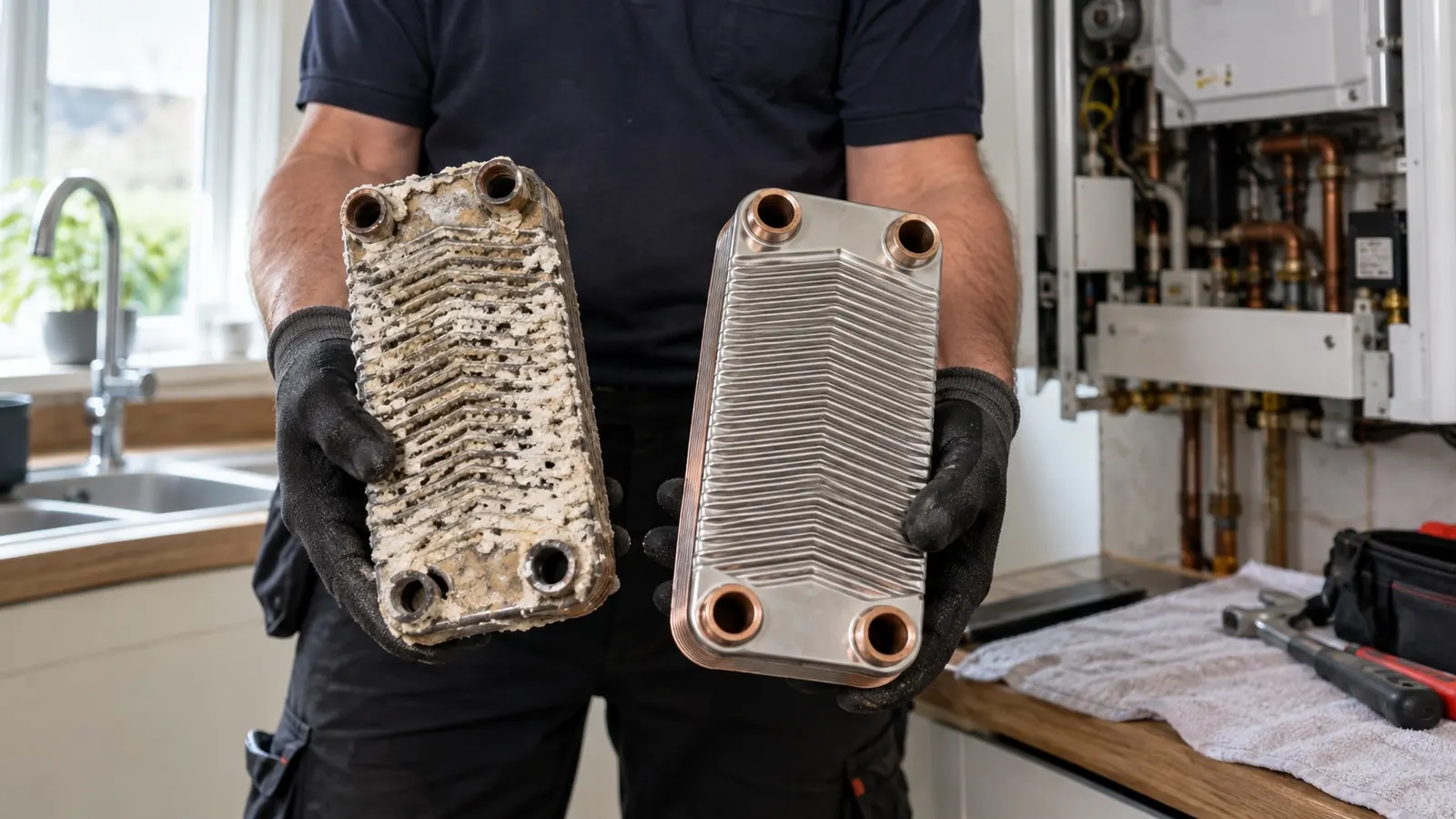
The Mechanism
Water in a heating system carries two things that cause trouble: dissolved minerals from hard water, and iron oxide from steel corroding internally.
Both settle on the hottest surface available, which is the heat exchanger. Once a layer forms, it acts as insulation. The metal underneath still receives full heat from the burner, but the water above the deposit does not carry it away.
So the metal gets hotter than designed. Water trapped in the deposit reaches boiling point, flashes to steam, and that steam bubble then collapses violently as it meets cooler water. That collapse is the bang.
It is the same physics as a kettle, hence the name.
Why This Region Is Prone To It
Hard water. Every time water is heated, some dissolved calcium and magnesium comes out of solution as scale, and it does so preferentially on the hottest surface.
Anglian Water publishes hardness figures by postcode, and this area sits firmly at the hard end. A boiler here scales faster than the same boiler would in a soft water region - which is why kettling is a routine callout locally and rarer elsewhere.
Add the black iron oxide sludge that forms in any system where inhibitor has been depleted, and the two compound each other.
Why It Is Worth Fixing
It is tempting to live with a noisy boiler that still produces heat. There are three reasons not to.
- It damages the heat exchanger. Repeated localised overheating stresses the metal, and eventually warps or cracks it. That is among the most expensive parts on a boiler, and on many units it is the point where replacement becomes the sensible option.
- It wastes gas. An insulated heat exchanger transfers heat poorly, so the boiler burns longer for the same output.
- It is a system-wide signal. The same deposits are settling in radiators and wearing the pump. Kettling is the audible symptom of a problem that is also doing silent damage elsewhere.
What Actually Fixes It
A power flush
The real fix. A high-flow pump and chemical cleanser circulate through the system, lifting scale and sludge and carrying it out. Done properly it addresses the cause rather than the symptom.
It is not a quick job - typically most of a day for an average system - and it is worth asking what the process includes before agreeing to it.
A magnetic filter
Fitted on the return pipe to the boiler, it catches circulating iron oxide before it reaches the heat exchanger. It does not remove existing deposits, so it is a companion to a flush rather than a replacement for one.
Emptied at each annual service, it also gives a useful read on how much debris the system is still producing.
Inhibitor
Chemical treatment that stops the corrosion reaction restarting. It depletes over time and after any drain-down, which is why it should be checked at every service. Our guide to draining and refilling a system covers dosing.
A scale reducer
On the incoming mains, it slows scale formation. Worth having in a hard water area, particularly to protect the hot water side of a combi.
What Does Not Fix It
- Descaler alone. It may quieten the noise briefly. Without removing the sludge and restoring inhibitor, it returns.
- Turning the boiler down. Reduces the noise by reducing the temperature difference. The deposits are still there and still growing.
- Bleeding radiators. That addresses trapped air, which is a different noise entirely - a gurgle rather than a bang.
- Ignoring it. The heat exchanger is the part at risk, and it is the expensive one.
Distinguishing the Noises
- Banging or rumbling on start-up: kettling.
- Gurgling: trapped air, or low pressure. Bleed and check the gauge.
- Whistling: often flow through a nearly closed valve, or a system needing balancing.
- Vibration or humming: usually the pump, or something loose.
- Banging in the pipes when a tap closes: not the boiler at all - see water hammer.
Frequently Asked Questions
Is a kettling boiler dangerous?
Not immediately. It is a reliability and efficiency problem rather than a safety one, though a heat exchanger that eventually cracks becomes a bigger issue.
How much does a power flush cost?
It varies with system size and how bad the contamination is. Ask what it includes - a proper flush with a magnetic filter fitted afterwards is a different job from a chemical circulation.
Will a power flush definitely stop the noise?
Usually, if the deposits are the cause and the heat exchanger has not already been damaged. If the exchanger is scaled internally beyond what a flush reaches, it may need replacing.
How often should a system be flushed?
Not routinely. With a filter and correct inhibitor it should not need it again for many years. Needing one every few years means the underlying water treatment is not being maintained.
If Yours Is Rumbling
Kettling is worth acting on before it reaches the heat exchanger rather than after. We cover Milton Keynes and the surrounding area for power flushing and boiler repair. Get in touch and tell us when the noise happens - on start-up, mid-cycle, or throughout.
Need Professional Advice?
Our Gas Safe registered engineers are ready to help with all your heating needs. Get a free, no-obligation quote today.