Why Is My Radiator Leaking? Causes and Fixes
TL;DR
Dry everything, wrap dry kitchen paper around each valve union, each spindle, the bleed point and the panel seams, and run the heating. Whichever darkens first is the leak. A weeping union usually stops with a quarter turn, holding the valve body with a second spanner, and no more than two. A spindle leak needs the gland nut nipped or a new O-ring. A pinhole in the panel means a new radiator.
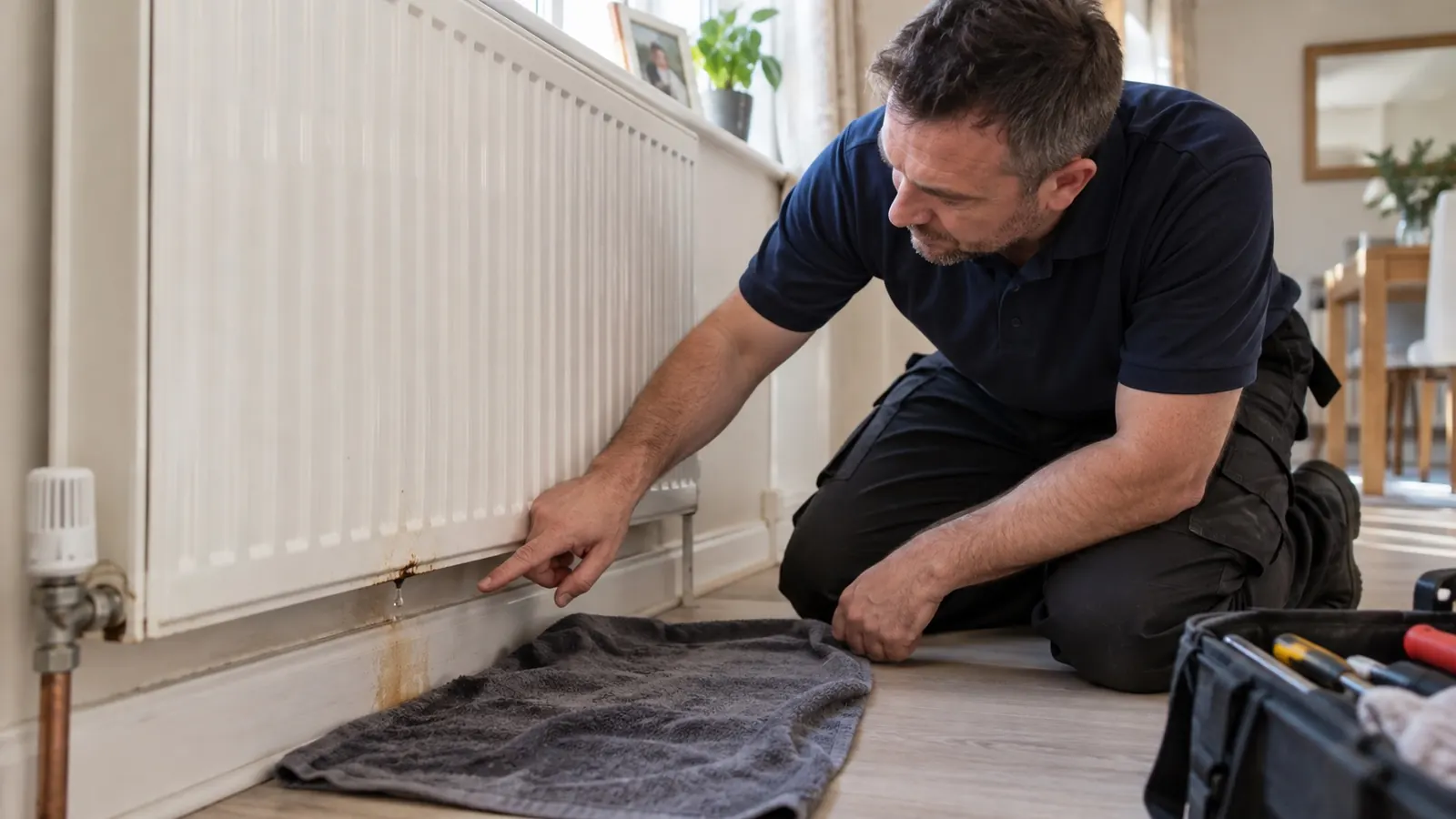
Radiator leaks are nearly always small and slow, which is exactly why they do damage. A weep that takes a week to show on the carpet has been feeding the floor underneath the whole time. Finding the source takes about ten minutes with a roll of kitchen paper, and it matters, because the four possible causes have four different fixes and the wrong one makes it worse.
Find the source first
- Dry the radiator, both valves and the pipework completely.
- Wrap or tuck dry kitchen paper separately around: the union nut where each valve meets the radiator, the union where each valve meets the pipe, the spindle under each valve head, the bleed valve, and along the bottom seam of the panel.
- Run the heating for twenty minutes.
- Check which paper darkens first. That is your leak.
Water runs down and along before it drips, so where the puddle is tells you very little. Where the paper darkens tells you everything.
Cause 1: a weeping valve union
The large nut where the valve joins the radiator, or where it joins the pipe below. The most common leak and usually the easiest fix.
- Fit one spanner to the valve body and hold it still. This is the step people skip, and without it you twist the whole valve and disturb the joint under the floor.
- Fit a second spanner to the union nut and tighten a quarter turn. No more.
- Wipe dry, run the heating ten minutes, check.
- If it still weeps, one more quarter turn. That is the limit.
Compression joints seal by squeezing a soft brass olive onto the pipe. Once the olive is crushed past its seat, more force makes the leak permanently worse. If two quarter turns have not stopped it, the olive needs replacing. That means closing both valves (count the lockshield turns so you can put it back), releasing the pressure at the bleed valve, cracking the union with a bowl underneath, pulling the valve back and looking at the olive. Deformed, scored or oval means replace it. An olive puller is cheap and safer than a hacksaw. Fit the new olive with a smear of jointing compound and reassemble hand-tight plus about a turn. If the pipe itself is scored where the old olive sat, the joint will never seal and that section needs cutting back and remaking, which is where this stops being a DIY job.
Cause 2: a leaking spindle
Water appearing from under the valve head, around the spindle, often only when the valve is turned or just after. The O-ring or gland packing has perished. The good news is the valve body stays in place, so on most valves this is fixable without draining anything.
- Nip the gland nut. Some valves have a small hexagonal nut just under the head. An eighth to a quarter turn compresses the packing and often stops it outright.
- Replace the O-ring. Close the valve fully so the spindle seals on its seat. Remove the head and the gland nut, lift the old O-ring off the spindle, fit the new one with a smear of silicone grease, reassemble, and test through a full heat cycle. Have towels ready in case the valve does not seat fully.
Our guide to radiator valve types shows which design you have, which matters for the spare.
Cause 3: the bleed valve
A drip from the small square-headed screw at the top corner usually means it was not closed properly after bleeding, or it has been overtightened at some point and no longer seats. Close it firmly first. If it still weeps, the bleed plug can be replaced. Isolate the radiator by closing both valves, have a bowl ready, and be quick. Our guide to bleeding a radiator covers the right way to close it.
Cause 4: a pinhole in the panel
The one with no cheap fix. Radiators corrode from the inside out and eventually a hole appears, usually along the bottom seam or a weld where sludge has been sitting. The signs are a rust-coloured stain running down the panel and a drip from the metal itself rather than any fitting.
The radiator needs replacing. Leak sealer additives and external repair putties buy days, not months, and a panel that has holed in one place will hole somewhere else. More importantly, it is a message about the whole system: corrosion that bad means the inhibitor ran out years ago and the other radiators are heading the same way. In Milton Keynes, where Anglian Water classes the supply as hard, scale and corrosion move faster still. The honest point that not every firm will print: an engineer who replaces one holed radiator and says nothing about inhibitor, a magnetic filter or the state of the system water has done half a job, and you will see them again next winter for the next one.
What to do right now
- Catch it. A container under the drip and towels around the base.
- Isolate the radiator. Thermostatic valve clockwise to off. Lockshield cap off, then clockwise with a spanner until it stops, counting the turns and writing the number down so it can be reset to the same place later.
- Keep the floor dry. Chipboard and laminate swell and do not recover.
- Check the boiler pressure. A leak drops it, and a combi will lock out below about 0.5 bar. Top up through the filling loop if needed.
Once isolated, a leaking radiator is rarely an emergency. It becomes one if it is dripping onto electrics or through a ceiling.
After any repair
- Reopen the lockshield by exactly the number of turns you counted, so the system stays balanced.
- Bleed the radiator once the heating is running again.
- Check the boiler pressure and top up to between 1 and 1.5 bar cold.
- Check the joint after a full heat cycle, and again the next day. Expansion and contraction is what finds a marginal joint.
When the valve itself needs replacing
- The body is cracked or the leak comes from the casting rather than a joint.
- The spindle is seized solid.
- The threads are stripped from past overtightening.
- The body is pitted with corrosion.
Replacing a valve body means draining that part of the system, or freezing the pipe, and is a plumber's job for most people. It is also the moment to swap a manual valve for a thermostatic one if you have been meaning to.
Why your boiler pressure keeps dropping
If you are topping up the boiler more than once or twice a year, there is a leak on the heating circuit somewhere, and a radiator weep is the most common culprit because it evaporates off a warm panel without ever forming a puddle. Look for rust rings or a white crusty deposit around unions. Both are the residue of water that has been evaporating there for months. Our guide to a boiler losing pressure covers the other causes.
Frequently asked questions
Can I use a leak sealer additive?
On a genuine pinhole it may buy time, but it can clog the boiler heat exchanger and pump, and most manufacturers advise against it. On a valve leak it does nothing at all.
Can I use PTFE tape on a radiator valve?
Not on the compression union. That seals on the olive, and tape on the thread stops the nut pulling up square. Tape belongs on tapered threads, such as the valve tail screwed into the radiator.
Why did tightening make it worse?
The olive has been crushed past its seat. It needs replacing now rather than tightening. This is why the two-quarter-turn limit matters.
Why does it only leak when the heating is on?
Heat expands the metal and raises the pressure, so a marginal joint opens slightly. It is still a real leak. Fix it before it becomes a constant one.
Can a leaking radiator be repaired rather than replaced?
Valve, spindle and bleed point leaks, yes. A holed panel, no. The corrosion is throughout the radiator, not just at the hole.
If it is beyond a quarter turn
A union that still leaks on a new olive, a scored pipe, a seized valve or a holed panel are all jobs for a plumber, and it is worth having the inhibitor checked at the same visit so the replacement does not go the same way. We cover Milton Keynes and the surrounding towns for heating repairs and radiator replacement. Get in touch with a photo of the leak and we will tell you what it is likely to need.
Need Professional Advice?
Our Gas Safe registered engineers are ready to help with all your heating needs. Get a free, no-obligation quote today.