What Should My Boiler Pressure Be? Too High, Too Low, Fixed
TL;DR
Boiler pressure should sit between 1 and 1.5 bar when the system is cold, rising to around 1.5 to 2 bar when hot. Below 1 bar is too low and the boiler may lock out: top up at the filling loop. Above 2.5 to 3 bar cold is too high: check the filling loop is shut and bleed a radiator. Pressure that keeps dropping means a leak; pressure that spikes when hot means a tired expansion vessel.
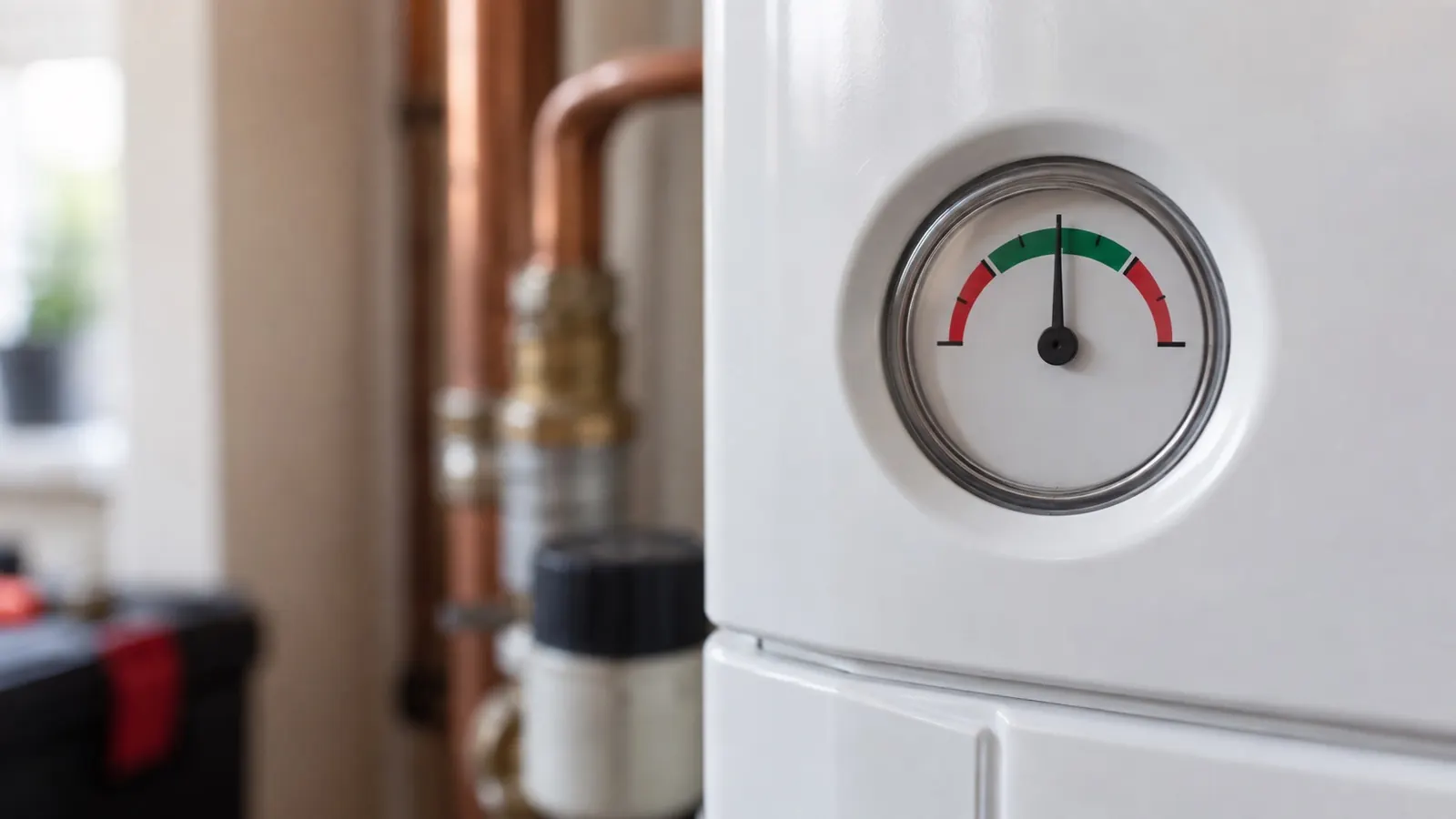
If you have looked at the dial on the front of your boiler and wondered whether the needle is in the right place, this is the answer. Boiler pressure is one of the things we are asked about most, and it is one of the easiest to understand once you know what the gauge is telling you. This guide covers the correct reading, why it moves during the day, what to do when it is too low, what to do when it is too high, and the point at which it stops being a DIY job.
The correct boiler pressure
For almost every modern combi or system boiler:
- 1 to 1.5 bar when cold (heating off, radiators cool). This is the number to set and check.
- 1.5 to 2 bar when hot (heating running, radiators up to temperature). A rise of a few tenths of a bar as the water heats is normal.
Below 1 bar is low, and below about 0.5 bar most boilers lock out and show a fault code. Above 2.5 to 3 bar is high, and at around 3 bar the pressure relief valve opens and dumps water through a copper pipe outside. Worcester Bosch, Vaillant, Ideal and Baxi are the brands we see most in Milton Keynes and the 1 to 1.5 bar cold target applies to all of them. If your boiler manual says something different, follow the manual.
Where the gauge is and how to read it
The gauge is on the front or the underside of the boiler. There are two types:
- Analogue dial. A needle over a scale, usually with a green zone for the normal range and red at either end. Some have a second, movable needle you can set to the correct cold pressure as a reminder.
- Digital. A number on the display, for example 1.3 bar. On some Worcester Bosch and Vaillant models it only shows when you press a button or scroll a menu.
If you cannot find it, the manual will show you, or send us a photo of the boiler and we will point it out.
What the reading means
- Below 0.5 bar (cold): critically low. The boiler has probably locked out. Top up at the filling loop. If it drops again within days, there is a leak.
- 0.5 to 1 bar: low. Top up to around 1.2 bar.
- 1 to 1.5 bar: correct. Nothing to do.
- 1.5 to 2.5 bar: fine when hot. If it reads this high when stone cold, it has been slightly overfilled and is worth bringing down.
- 2.5 to 3 bar: too high. Check the filling loop is shut and bleed a radiator to release some water.
- Above 3 bar: the relief valve will be discharging. Reduce the pressure and if it climbs back, book an engineer.
Why pressure changes between hot and cold
Your heating is a sealed loop of water. Water expands when it heats and cannot be compressed, so the pressure rises when the boiler runs and falls back as it cools. A component called the expansion vessel, a sealed can with a cushion of air inside, absorbs that expansion and keeps the swing small.
That is why you set and check the pressure cold. It gives you a consistent baseline. If the pressure jumps dramatically when the heating comes on, say from 1.2 bar straight to 2.8, the expansion vessel has probably lost its air charge. Re-charging or replacing it is an engineer's job because it sits inside the casing.
Pressure too low: what causes it and how to top up
Low pressure means water has left the system. The usual reasons:
- Bleeding radiators. Letting air out lets water out too. Harmless, and one top-up fixes it.
- A small leak. A weep at a radiator valve, a pipe joint under the floor, or the boiler itself. It can evaporate as fast as it escapes, so you may never see a puddle.
- A passing pressure relief valve. If it does not seat properly it dribbles from the pipe outside. Look for a wet patch on the wall under it.
- A leaking automatic air vent. A small brass component in the boiler that lets air out and, when its seal fails, lets water out too.
Topping up is a safe, water-side job:
- Turn the heating off and let the system cool.
- Find the filling loop: usually a silver braided hose under the boiler with a small tap at each end, or on newer boilers a built-in key or lever. The manual shows which.
- Open the taps slowly and watch the gauge climb.
- Close both taps firmly at around 1.2 bar. Do not go past 1.5.
- Reset the boiler if it was locked out, and check the gauge again after an hour and the next morning.
If you have to top up more than once or twice a year, water is going somewhere. Our guide to why a boiler keeps losing pressure covers how to find out where. Do not just keep filling it. Every top-up brings in fresh oxygen and speeds up corrosion inside the radiators.
Pressure too high: what causes it and how to release it
High pressure means too much water in the system, or a system that can no longer absorb the expansion of hot water. Three causes cover almost every case:
- The filling loop left open. By far the most common. If the taps are not fully closed after a top-up, mains water keeps creeping in and the needle keeps climbing. Check this first, always.
- A failed expansion vessel. The tell-tale sign is pressure that is normal cold and shoots towards 3 bar every time the heating runs, often with water dripping from the pipe outside each time. An engineer's job.
- A stuck pressure relief valve. If it fails shut, pressure has nowhere to go. If it fails open, you get the opposite problem, a system that will not hold pressure. Either way it is replaced by an engineer.
To bring the pressure down yourself, bleed a radiator:
- Turn the heating off and let it cool.
- Check both filling loop taps are fully closed. There is no point releasing water if more is coming in.
- Choose an upstairs radiator. Put a cloth and a pot under the bleed valve in the top corner.
- Open the valve a quarter turn with a radiator key and let water trickle out, watching the boiler gauge as you go. If the radiator is a long way from the boiler you may need someone to call out the reading.
- Close the valve when the gauge reaches 1.2 to 1.5 bar. Do not overdo it. You can always let out a little more.
- Recheck after a few minutes and again the next day.
Our radiator bleeding guide covers the technique in more detail. If the pressure climbs back up within hours or days with the filling loop shut, stop and book an engineer.
What a pressure fault repair involves
We cannot price a pressure fault before seeing it and we would be cautious of anyone who does. The visit is a diagnosis: pressure hot and cold, the expansion vessel charge, the relief valve and its discharge pipe, every radiator valve, and any accessible pipework. A weeping valve is usually fixed on the spot. An expansion vessel or relief valve is a part inside the casing, priced on the boiler model and confirmed with you before it is fitted. A leak under a floor is discussed before anything is lifted. Our boiler repair visits work this way.
How often to check
A glance at the gauge once a month is plenty. It takes ten seconds and catches a slow drop before it becomes a cold house. Also check after bleeding any radiators, at the start of the heating season, and any time the heating behaves oddly. A pressure check and a look at the expansion vessel are part of every annual service we do.
When to call a Gas Safe engineer
- The pressure keeps dropping however often you top up.
- The pressure spikes when the heating is on and falls back when it cools.
- Water drips from the pipe outside every time the heating runs.
- The boiler will not fire even with the pressure correct.
- The gauge reads fine but the boiler shows a low-pressure fault. That can be a failed sensor, which is inside the casing.
Topping up and bleeding are water-side jobs and safe to do yourself. Anything behind the boiler casing, and anything on the gas side, is a Gas Safe registered engineer's job. If you ever smell gas, leave the property and call the National Gas Emergency Service on 0800 111 999.
One honest point
A boiler that needs topping up every few weeks is not a boiler with a pressure problem. It is a system with a leak, and the leak is doing damage you cannot see. The pressure gauge is the messenger. Some firms will happily come out and top it up for you every month. It is cheaper in the end to find the leak once.
Frequently asked questions
Is 2 bar too high?
Not when the heating is on. Pressure rises naturally as the water heats. It is only a concern above roughly 2.5 to 3 bar cold, which suggests overfilling or a tired expansion vessel.
Why does the pressure rise when the heating is on?
Water expands as it heats. A rise of a few tenths of a bar is normal. A jump of more than a bar points to the expansion vessel.
What happens if the pressure is too low?
Most modern boilers lock out below about 0.5 to 1 bar and show a fault code, such as F1 on Ideal or F22 on Vaillant. Topping up restores it. Repeated drops mean a leak.
Can high pressure damage the boiler?
Persistently high pressure stresses seals and joints and makes the relief valve discharge, which then often fails to reseat and starts a slow leak. It is worth sorting rather than living with.
Talk to us
We cover Milton Keynes and the surrounding towns, from Bletchley to Newport Pagnell, and pressure faults are among the most common things we fix. If the gauge will not stay where it should, get in touch.
Need Professional Advice?
Our Gas Safe registered engineers are ready to help with all your heating needs. Get a free, no-obligation quote today.