Waste Pipe Leaking Under the Sink? Fix It
TL;DR
Dry everything, lay kitchen paper underneath, then run the tap and watch where the first wet spot appears. Most leaks are a hand-tight collar that has loosened or a rubber washer sitting twisted or upside down - both fix in minutes without tools. Never over-tighten plastic waste fittings, as that cracks the collar and turns a drip into a flood.
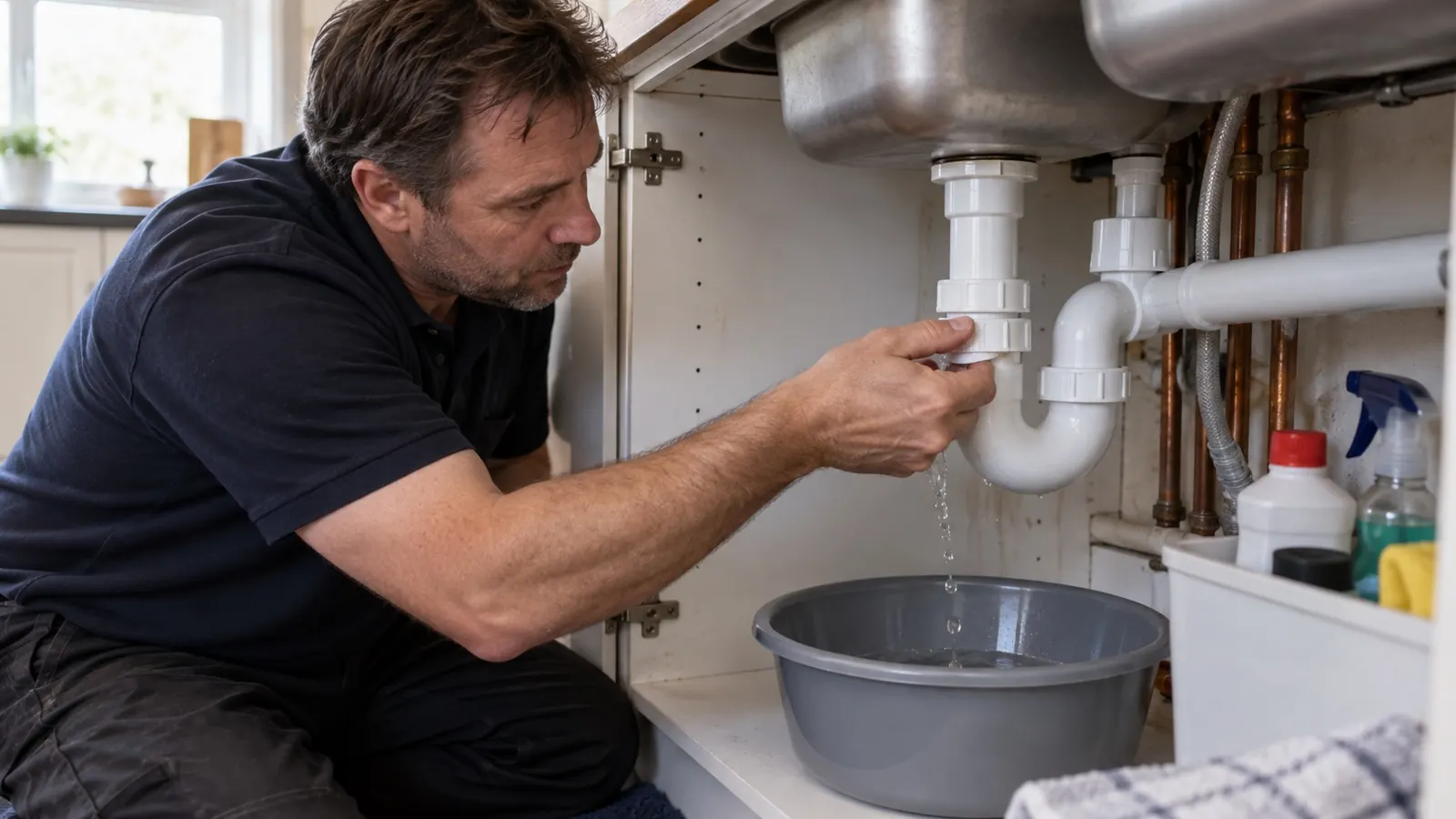
Finding the cupboard under the sink damp is one of those problems that is almost always smaller than it looks. Waste pipes run at atmospheric pressure - not under mains pressure like your supply pipes - so even a badly fitted joint only leaks while water is actually flowing past it.
That also means you have time to diagnose it properly rather than panicking.
Step 1: Find Exactly Where It Is Leaking
This step matters more than any other, because the fix depends entirely on which joint is at fault, and water travels along pipes before it drips.
- Clear the cupboard out completely and dry every surface and pipe thoroughly with a cloth.
- Lay sheets of kitchen paper across the base of the cupboard and, if you can, wrap a strip loosely around each joint.
- Run the tap for thirty seconds, then fill the sink and pull the plug so a full volume of water goes through at once.
- Watch. The first paper to darken is at or just above the leak.
Check specifically whether the leak appears when the tap runs or only when the sink empties. That single observation separates a supply leak from a waste leak, and they are completely different jobs.
The Usual Suspects
A loose compression collar
The large plastic nuts either side of the U-bend are designed to be hand-tight. They loosen over time - from vibration, from things being pushed around in the cupboard, or from the trap being knocked.
Fix: hand-tighten it. Grip the pipe with one hand and turn the collar clockwise with the other. If it turns easily and the leak stops, that was it. Do not reach for grips.
A twisted or misplaced washer
This is the most common cause of a leak that appears right after someone has cleaned the trap out.
Waste fittings use tapered rubber washers, and they only seal one way round. If a washer is fitted upside down, twisted, or has slipped out of its seat during reassembly, the joint will weep no matter how tight the collar is.
Fix: put a bowl underneath, undo the collar completely, and look at the washer. It should sit flat and square, with the tapered edge pointing into the joint. Clean it, check it is not perished or flattened, seat it properly and reassemble hand-tight.
Washers cost very little and harden with age. If yours looks flattened, shiny or cracked, replace it rather than refitting it - take the old one to match the size.
A cracked collar from over-tightening
This is the one that catches people out. Plastic collars crack when forced, often invisibly, and the crack then weeps under flow.
If a joint keeps leaking despite everything looking correct, inspect the collar closely in good light for a hairline split. It is a cheap part to replace.
The rule with plastic waste fittings is hand-tight only. The seal comes from the washer being compressed evenly, not from brute force. Requirements for domestic waste pipework are set out in Approved Document H of the Building Regulations.
A leaking sink waste flange
If the water appears at the very top, where the waste fitting passes through the sink itself, the sealant around the flange has failed.
Fix: undo the large backnut underneath and drop the waste out. Clean all the old sealant off both the sink and the fitting, apply fresh silicone sealant or a new sealing washer, refit and tighten evenly. Leave the silicone to cure before running water through it.
An appliance hose connection
If a washing machine or dishwasher drains into the sink waste, check that spigot connection. The hose can work loose, and the jubilee clip can slacken.
A telltale sign is a leak that only appears when the appliance is running rather than when you use the sink. If your machine is also draining poorly, the two may share a cause - our guide to a washing machine that will not drain covers checking that side.
Is It Actually the Waste?
Before you take the trap apart, rule out the other possibilities. A damp cupboard is not always a waste leak.
- A supply leak. If water appears when nothing is draining, look at the flexible tap connectors and the isolation valves. Supply pipes are under constant pressure and leak continuously, which makes them easy to distinguish - and more urgent.
- Condensation. Cold pipes in a warm kitchen can sweat noticeably. It leaves general dampness across a pipe rather than a drip from one point. The Chartered Institute of Plumbing and Heating Engineering has guidance on insulating pipework where this is persistent.
- A leak from the tap body. Water can run down the outside of the tap tails and drip from the underside of the sink, looking exactly like a waste leak.
- An overflow leak. The flexible overflow pipe on some sinks perishes and leaks only when the bowl is filled above the overflow level.
What to Do Right Now If It Is Running Badly
- Put a bowl or tray underneath to catch it.
- Stop using that sink - a waste leak only leaks while water passes through.
- If it is a supply leak instead, turn off the isolation valve on that pipe, or the main stopcock if you cannot find one.
- Get everything out of the cupboard and dry the base. Chipboard cupboard bases swell irreversibly, and that damage often costs more than the plumbing repair.
Reassembling Without Creating a New Leak
- Make sure pipes go squarely into fittings. A pipe entering at an angle will not seal however tight the collar is.
- Check every washer is the right way round and seated flat before tightening anything.
- Start every threaded collar by hand and turn it a full turn before applying any force - this prevents cross-threading, which is a common cause of a joint that will never seal.
- Hand-tight, then test. Only nip it a fraction further if it weeps.
- Run water through and check with dry paper again before putting everything back in the cupboard.
While the trap is off, it is worth cleaning it out - you are already there, and it prevents the blockage that would otherwise follow. Our guide to unblocking a sink covers doing that properly, and smelly drains explains why the residue inside is worth removing.
Frequently Asked Questions
Can I use tape or sealant on a waste joint?
No. Compression waste joints seal on a rubber washer, and tape or sealant on the thread does nothing useful - it can actually stop the joint pulling up squarely. If it will not seal, the washer or the alignment is wrong.
Why does it only leak sometimes?
Because a waste pipe is only full when water is flowing through it. A slow weep at a joint may only show when a full sink is drained, which is why the fill-and-empty test finds leaks that running the tap does not.
The pipe itself is cracked. Can I patch it?
Repair tape is a short-term measure to get you through until it can be replaced properly. Plastic waste pipe and fittings are inexpensive, and a cracked section should be cut out and replaced rather than patched.
How urgent is a slow drip?
More urgent than it feels. A slow drip into a cupboard base does not evaporate - it soaks into the chipboard, swells it, and encourages mould in an enclosed space. Most under-sink damage we see was a small drip left for months.
If It Will Not Seal
If you have reseated the washers, replaced the collar and it still weeps, the fitting or the pipe alignment is usually at fault - and sometimes the trap simply is not the right one for the pipe it is connected to. We cover Milton Keynes and the surrounding villages for plumbing repairs of exactly this kind. Get in touch and tell us which joint is leaking and what you have already tried.
Need Professional Advice?
Our Gas Safe registered engineers are ready to help with all your heating needs. Get a free, no-obligation quote today.