Smelly Drains: Causes and How to Stop Them
TL;DR
The most common cause of a drain smell is a dry trap - the water seal that blocks sewer gas has evaporated. Run the tap for thirty seconds and see if the smell goes. If the trap is holding water, the smell is usually a build-up of fat and food residue lining the pipe, which needs cleaning rather than masking. A persistent sewage smell with no obvious cause needs investigating.
A drain that smells is not the same problem as a drain that is blocked, and treating it like one is why so many people end up pouring product after product down the plughole with no lasting improvement.
Almost every drain smell comes down to one of four things. Working out which one you have takes a few minutes and usually points straight at the fix.
Cause 1: A Dried-Out Trap
This is the most common cause by some margin, and the easiest to fix.
Every waste fitting in your house - sink, basin, bath, shower, toilet - has a trap. In a sink it is the U-bend; in a shower it is a shallow trap under the waste. Its only job is to hold a small amount of water that forms a physical seal, stopping gases from the drainage system rising back into the room.
If a fitting is not used for a while, that water evaporates and the seal is lost. Sewer gas then has a clear path into the house.
How to tell
Run the tap into the affected fitting for thirty seconds, then wait an hour. If the smell disappears, the trap was dry and you have solved it.
Suspect this first if the smell is coming from a guest bathroom, an en-suite that is rarely used, a utility sink, a floor gully, or anywhere in the house after you have been away.
How to prevent it
Run the taps in rarely used fittings for thirty seconds every couple of weeks. If a room is genuinely never used, a small amount of cooking oil poured in after filling the trap slows evaporation considerably - it floats on the water and reduces the surface exposed to the air.
Cause 2: Build-Up Inside the Pipe
If the trap is holding water and the smell is still there, the likely cause is a layer of fat, soap scum, food residue and hair lining the inside of the waste pipe. It does not block the drain, but it holds bacteria, and bacteria produce the smell.
Kitchen sinks are the usual offender because of fat. Bathroom basins and showers suffer from soap and hair, which produce a distinctly different, more sour smell.
How to clear it
- Pour a kettle of hot water down slowly to soften the deposits.
- Follow with a generous amount of washing-up liquid and leave for ten minutes.
- Flush through with another kettle of hot water.
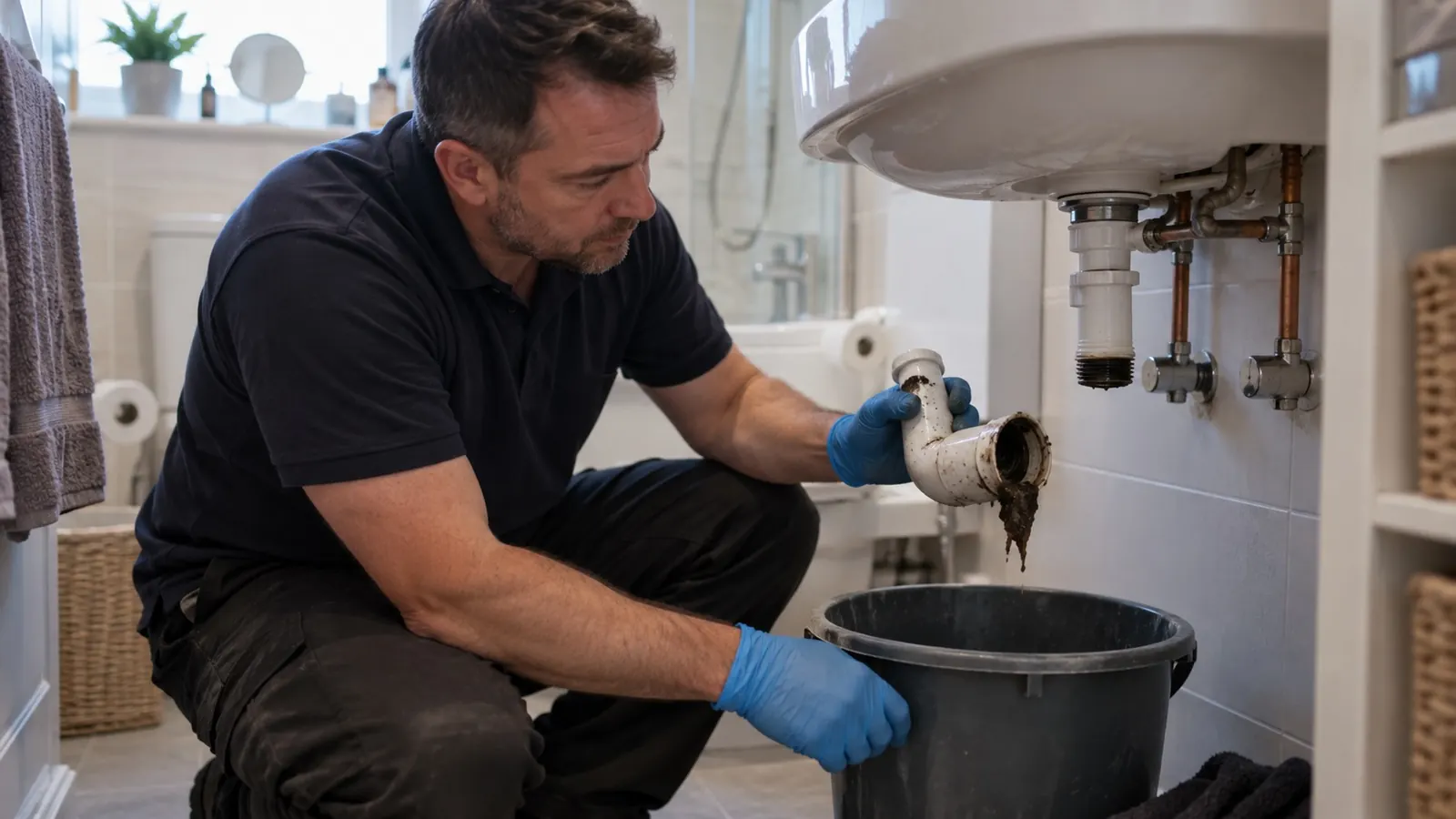
- For a thorough job, take the trap off and clean it physically - the process is the same as in our guide to unblocking a sink. You will usually be surprised by what comes out.
An enzyme-based drain maintainer used monthly is genuinely effective here, and Water UK recommends exactly this kind of routine care rather than waiting for a blockage. Unlike caustic cleaners, it digests the organic layer rather than trying to burn through it, and it will not damage plastic pipework. Use it overnight when the drain will not be used, so it has time to work.
Cause 3: A Failed or Missing Seal
If the trap holds water and the pipe is clean but the smell persists, look at the connections.
- The waste connection at an appliance. Washing machine and dishwasher hoses connect to a spigot on the sink waste. If the connection is loose or the blanking cap has been left off an unused spigot, sewer gas comes straight out of it. This is a very common find.
- A perished trap washer. Rubber washers harden over years. A poor seal lets gas escape even when water is present.
- The toilet pan connector. The flexible connector between the pan and the soil pipe can split or work loose, particularly if the toilet has ever been rocked. The smell tends to be strongest at floor level behind the pan.
- A shower trap that has been disturbed. Shallow traps under shower trays can be knocked out of position, especially after any work on the floor.
These are all worth checking visually. A smell that is strongest in one specific spot at floor level almost always means a physical seal has failed nearby.
Cause 4: A Problem in the Drainage System
If none of the above explains it, the issue may be beyond the fittings. Soil vent pipes and trap seals are covered by Approved Document H, which sets out how a domestic system should be ventilated.
Possible causes include a blocked or restricted soil vent pipe, which stops the system breathing properly and causes traps to be siphoned dry as water flows past; a partial blockage in an underground drain, holding waste that decomposes; or a cracked or displaced drain letting gas escape into the ground and up through the building.
The tell-tale signs are gurgling from fittings when others are used, more than one fitting smelling at once, a smell that is worse in wet weather, and a smell outside near the drain run as well as inside. If you are seeing those, check the outside drain - a chamber holding standing waste explains a lot of otherwise puzzling smells.
Gurgling in particular is worth acting on. It means air is being pulled through a water seal, and a trap that gurgles today is often a trap that is dry tomorrow. Our guide to airlocks and trapped air covers the related symptoms.
What Not to Do
- Do not mask it. Bleach and fragranced products cover the smell for a few hours without touching the cause, and bleach in particular kills the useful bacteria that enzyme products rely on.
- Do not mix chemicals. Bleach combined with other cleaning products can produce genuinely dangerous fumes in a small, poorly ventilated bathroom.
- Do not ignore a persistent sewage smell. Drain gases contain hydrogen sulphide and methane. At household concentrations the main effect is headaches and nausea rather than acute danger, but a strong ongoing smell means an open path from the drainage system into your home, and that should be closed.
A Quick Diagnostic Order
- Identify which fitting the smell is strongest at.
- Run that tap for thirty seconds. Wait an hour. Gone? Dry trap - solved.
- Still there? Clean the trap and pipe with hot water and detergent, or remove and clean the trap physically.
- Still there? Check the appliance connections, blanking caps and washers around that fitting.
- Still there, or affecting several fittings? Look outside at the drain chambers, and listen for gurgling.
- Still unexplained? That is the point to have it looked at properly.
Frequently Asked Questions
Why does my drain only smell in hot weather?
Two reasons. Warm weather speeds up evaporation, so traps dry out faster, and it accelerates bacterial activity in any residue lining the pipe. A drain that is fine in winter and unpleasant in July usually has a build-up that warm weather is making obvious.
Why does my bathroom smell only when the shower runs?
Water flowing through the system can siphon a nearby trap dry, or push gas ahead of it if a vent is restricted. It often points to a ventilation problem in the waste system rather than the shower itself.
Is a drain smell dangerous?
At typical household levels it is unpleasant rather than hazardous, though it can cause headaches and nausea. It should still be fixed - the smell is evidence that there is an open route between the drainage system and your living space.
Will bleach fix a smelly drain?
Only temporarily. It sanitises the surface it touches but does not remove the fat and residue that the bacteria live in, so the smell returns within days. Physical cleaning plus an enzyme maintainer is what actually lasts.
If the Smell Will Not Go
A smell that survives a clean trap, a clean pipe and sound connections usually means something in the drainage system itself - a failed seal you cannot see, a ventilation problem, or a defect in the underground pipework. We cover Milton Keynes and the surrounding area for drainage and plumbing, and can trace a smell to its source rather than guessing. Get in touch and tell us what you have already ruled out.
Need Professional Advice?
Our Gas Safe registered engineers are ready to help with all your heating needs. Get a free, no-obligation quote today.