Blocked Outside Drain: How to Clear It
TL;DR
Lift the drain cover and look. If the chamber is full, the blockage is downstream of it; if it is empty, the blockage is upstream, between the house and that chamber. Rod towards the blockage with a clockwise turn only, never anticlockwise, or you will unscrew the rods and lose them in the drain. If more than one property is affected, it is the water company's responsibility, not yours.
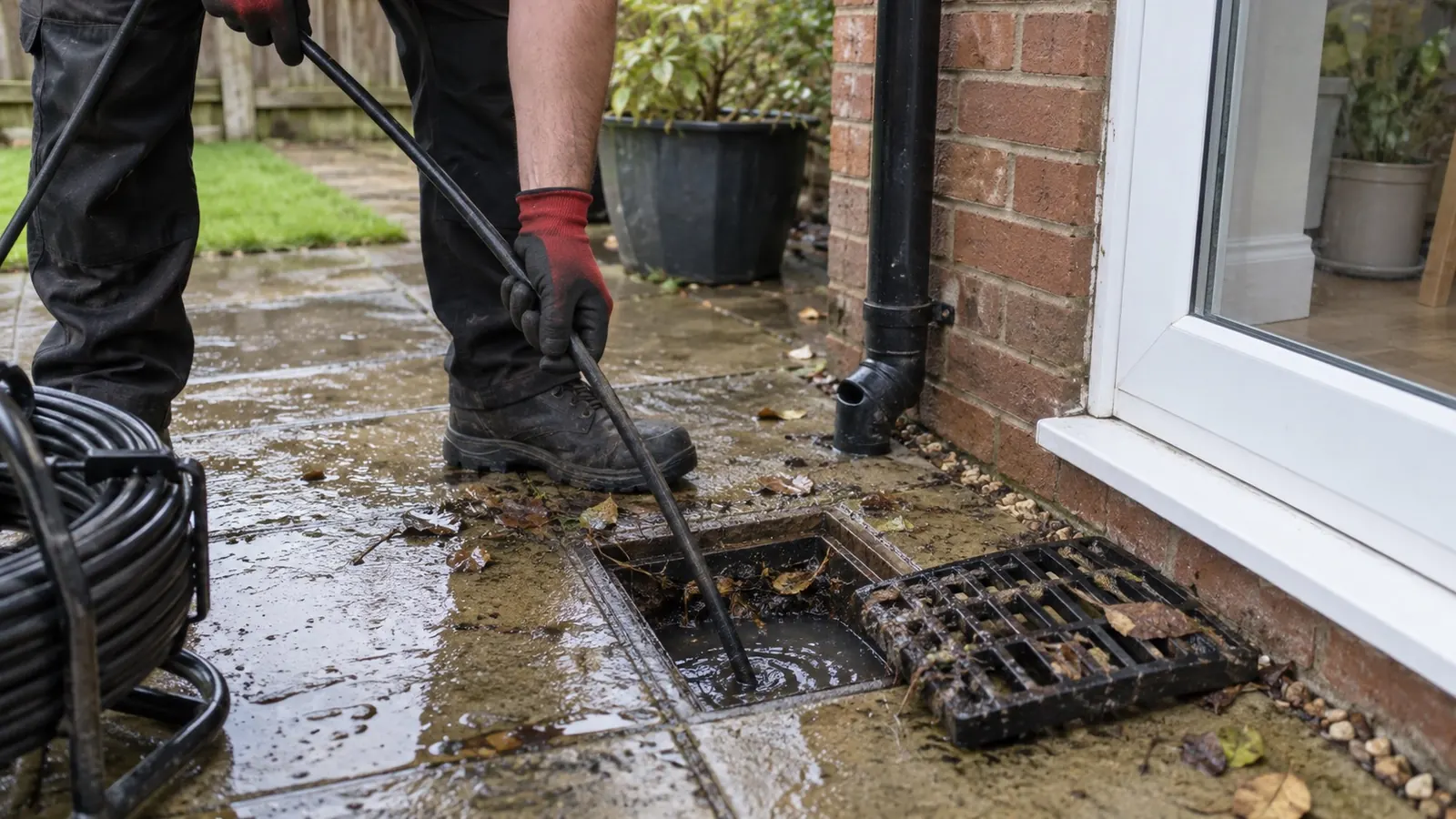
An outside drain that has backed up is unpleasant, but it is also one of the more diagnosable plumbing problems - because unlike a blockage inside the house, you can usually see exactly where it is by lifting a cover and looking.
This guide covers how to find the blockage, how to clear it with rods without making it worse, and - importantly - how to work out whether it is your responsibility or your water company's, because that determines who pays.
First, Work Out Where the Blockage Is
Your drainage runs from the house to a series of inspection chambers, and then out to the public sewer. Finding which section is blocked takes about five minutes.
Lift the covers and look
Start with the chamber nearest the house and work outwards. Most domestic covers are square or rectangular, and lift with a pair of keys hooked into slots at either end. If you do not have keys, a screwdriver in the slot and a claw hammer as leverage will usually shift it. Lift with your legs and keep your fingers clear of the edges - cast iron covers are far heavier than they look.
Then read what you find:
- Chamber full of water and waste: the blockage is downstream - somewhere between this chamber and the next one along, or the sewer.
- Chamber empty or nearly empty: the blockage is upstream - between the house and this chamber.
Work along the chambers until you find the last empty one and the first full one. The blockage is in the run between them. That single piece of information tells you exactly where to rod.
Whose Responsibility Is It?
This matters, because if the blockage is in a public sewer the water company will clear it at no cost to you.
The general rule since 2011 is that shared drainage is the water company's responsibility. Pipework that only serves your property, within your boundary, is yours. In practice:
- Blocked pipe serving only your house, inside your boundary - your responsibility.
- Blocked pipe shared with neighbouring properties - usually the water company's.
- Blockage in the main sewer in the road - the water company's.
The quickest test is to ask your immediate neighbours whether they are having drainage trouble too. If several properties are affected at once, call your water company before you spend anything - in this area that is Anglian Water, and they will attend a shared blockage without charge. Ringing them first can save you a bill you never needed to pay.
How to Rod a Drain Properly
Drain rods are inexpensive and clear most domestic blockages. There is one rule that matters more than all the others.
The golden rule: turn clockwise only
Drain rods screw together. If you turn them anticlockwise while they are in the drain, they unscrew - and you have just added several feet of steel rod to the blockage you were trying to clear. Retrieving them is a genuinely miserable job and often means excavation.
Always rotate clockwise, at every stage, including when withdrawing. If you catch yourself turning the other way, stop.
The method
- Wear gloves and old clothes, and have a hose ready. This is dirty work.
- Screw two or three rods together with the plunger or corkscrew head fitted. Start with the plunger head - it shifts soft blockages well.
- Feed them into the chamber and locate the outlet pipe. In a full chamber you will be working blind; feel for the channel at the base.
- Push towards the blockage, adding rods as you go, turning clockwise continuously.
- When you meet resistance, work the rods back and forth in short movements rather than shoving hard. You are breaking it up.
- When the water suddenly drops away, you are through. Keep rodding for another metre to make sure it is properly clear.
- Withdraw slowly, still turning clockwise, and flush the run through with a hose for several minutes.
If the plunger head will not shift it, swap to the corkscrew head, which grips fibrous material like wipes and roots so you can pull it back out.
What Usually Causes It
- Wet wipes. The most common cause we see by a distance. They do not break down, and they knit together with anything else in the pipe.
- Fat, oil and grease. Poured down the sink warm, sets solid in the cold underground pipe, and slowly narrows it until something bridges the gap.
- Leaves and silt. Particularly where a gully has no grate, or the grate is broken.
- Tree roots. Roots seek out moisture and find their way into joints in older clay pipework, then grow into a mat that catches everything.
- Collapsed or displaced pipework. Common in older properties, or where ground has settled. This one does not respond to rodding.
When Rodding Will Not Fix It
Rods clear soft blockages. They do not fix structural problems. Suspect something more serious if:
- The drain blocks repeatedly, weeks or months apart, in the same place.
- Rods reach a hard stop at exactly the same distance every time.
- You can see a dip in the ground, or paving that has sunk, along the line of the drain.
- There is a persistent smell outside even when the drain is running.
Those point to root ingress, a collapse or a displaced joint, and the way to confirm it is a CCTV drain survey. It is worth doing rather than paying to rod the same drain three times a year - and if the pipework has failed, a survey is usually what an insurer will want to see. Drainage design and construction standards are set out in Approved Document H of the Building Regulations if you want to understand what the pipework should look like.
Safety
A few things worth taking seriously:
- Never enter a drain or inspection chamber. They can contain gases that displace oxygen, and this has killed people. Everything described here is done from above ground.
- Cover open chambers if you leave them, and never leave one uncovered with children or pets around.
- Wear waterproof gloves and wash thoroughly afterwards. Foul water carries bacteria that cause real illness.
- Do not use caustic chemicals in an outside drain. They will not clear a substantial blockage, and they make the job hazardous for whoever works on it next.
Preventing the Next Blockage
- Bin wipes, sanitary products and cotton pads - never flush them, whatever the packet says.
- Let cooking fat cool and put it in the bin rather than down the sink. Our guide to unblocking a sink explains how quickly fat accumulates.
- Keep gully grates in place and clear of leaves, especially in autumn.
- Have drains rodded through as routine maintenance if you have mature trees near the run.
- Deal with slow drainage early. Slow is a partial blockage, and a partial blockage becomes a full one.
Frequently Asked Questions
How do I know which chamber is mine?
Generally, chambers within your boundary that only take waste from your property are yours. Once your drain joins a run shared with other homes, it becomes a lateral drain and is usually the water company's. If you are unsure, your water company can tell you from their records.
Can I use a pressure washer instead of rods?
A domestic pressure washer will not do much in an underground drain and can push waste back towards the house. Professional jetting units are a different thing entirely - much higher flow rates and specialised heads that pull debris back towards the chamber rather than driving it further in.
Is a blocked outside drain an emergency?
It becomes one when waste starts backing up into the house, when it is overflowing across a garden or path, or when it cannot be used at all. A slow drain that still runs can generally wait a day or two.
Does home insurance cover blocked drains?
Buildings insurance often covers damage caused by drainage failure, and some policies include drain clearance or an emergency helpline. Routine clearance of a blockage caused by misuse is usually excluded. Worth checking your policy before assuming either way.
If You Cannot Shift It
If you have rodded and the drain is still blocked, or you have found signs pointing to a collapse or root ingress, that needs jetting equipment or a camera survey rather than more rodding. We cover Milton Keynes and the surrounding villages for drainage and emergency plumbing. Get in touch with what you found when you lifted the covers - it usually tells us most of what we need to know before we arrive.
Need Professional Advice?
Our Gas Safe registered engineers are ready to help with all your heating needs. Get a free, no-obligation quote today.