Washing Machine Not Draining? Causes & Fixes
TL;DR
Switch the machine off at the socket first. The most common cause is a blocked pump filter behind the small hatch at the bottom front - check that before anything else. After that, look at the drain hose for kinks and the standpipe or sink trap it empties into. If water backs up out of the standpipe, it is a drainage blockage, not an appliance fault.
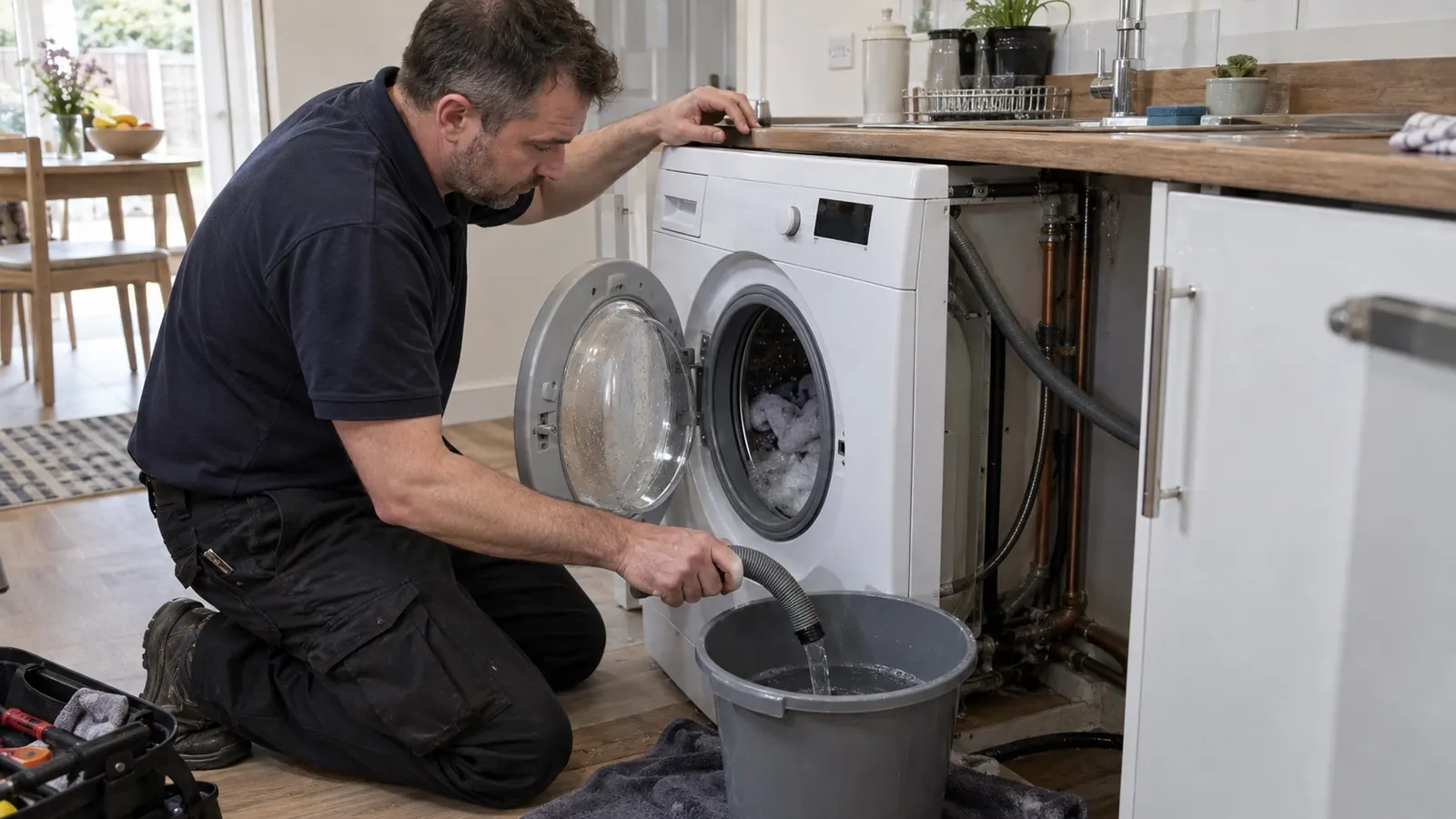
Opening the washing machine to find a drum full of grey water is a frustrating way to end a wash cycle. It is also, more often than not, something you can sort out yourself in half an hour with a bowl and a towel.
The important thing to establish early is whether you are dealing with an appliance problem or a drainage problem, because they need completely different solutions. This guide works through both, in the order that identifies the cause quickest.
Before You Start
Switch the machine off at the wall socket and turn off the water supply valves behind it. You are going to be working with standing water near an electrical appliance, and this is not a step to skip.
Have a washing-up bowl, an old towel and a shallow tray ready. There is more water in a washing machine than people expect - often fifteen to twenty litres - and it comes out faster than you can react to.
Cause 1: A Blocked Pump Filter
This is the answer in more cases than everything else combined. Almost every machine has a small hatch at the bottom front, behind which sits the drain pump filter. Its job is to catch coins, buttons, hair grips and tissue before they reach the pump - and when it fills up, the machine cannot empty.
How to clear it
- Open the hatch. Many machines have a short emergency drain hose tucked behind it - pull it out, hold it over a shallow tray, and remove its cap to drain the drum first. This makes everything afterwards far less messy.
- If there is no emergency hose, lay towels down and be ready with the bowl, because the water will come out when the filter is loosened.
- Unscrew the filter cap anticlockwise and pull it out.
- Clear whatever is caught in it. Rinse it under a tap and check the impeller visible in the housing turns freely - a coin jammed against it will stop the pump dead.
- Refit the filter, turning until it is firmly seated. If it is cross-threaded or loose the machine will leak on the next cycle.
If the filter was full, that was almost certainly your problem. Run a short rinse cycle and check it drains.
Cause 2: A Kinked or Badly Positioned Drain Hose
Pull the machine out gently and look at the corrugated drain hose at the back.
Kinks are common after a machine has been pushed back into place, and they are easy to miss because the fold can be behind the appliance. Straighten any you find and make sure the hose has a gentle route rather than a tight bend.
Height matters too. The drain hose needs to discharge at a height the pump can manage - generally somewhere around 60 to 100cm from the floor, though the manufacturer's figure for your model is the one to follow. Too high and the pump cannot lift the water. Too low, and you get siphoning, where the drum empties itself continuously and the machine keeps refilling.
Cause 3: A Blocked Standpipe or Sink Trap
This is the point where an appliance problem becomes a plumbing one.
Your machine drains into either a dedicated standpipe with its own trap, or into a spigot on the kitchen sink waste. Either can block with detergent scum, lint and fat - and if it does, the machine will fail to empty even though nothing is wrong with the machine at all.
The clearest sign is water backing up out of the standpipe or appearing in the sink when the machine tries to empty. If you see that, the fault is downstream.
To check the sink route, clear the trap under the sink - the process is the same as unblocking any sink, and our guide to unblocking a sink covers taking a U-bend apart properly. For a standpipe, the trap is usually at the bottom and can be cleaned out the same way, or reached with a drain snake pushed down from the top.
Detergent build-up is the usual culprit here, particularly if you use a lot of fabric conditioner. It forms a soft waxy layer that gradually narrows the pipe. Minimum standards for how appliance waste should be connected and trapped are set out in Approved Document H of the Building Regulations.
Cause 4: A Failed Drain Pump
If the filter is clean, the hose is clear and the standpipe drains freely, the pump itself may have failed.
You can usually hear the difference. A working pump makes a distinct whirring sound during the drain phase. A failed one is either silent or makes a humming noise without moving any water - the hum usually means the motor is trying but the impeller is jammed or the winding has gone.
This is an appliance repair rather than a plumbing job, and it needs an appliance engineer or the manufacturer. Worth checking whether the machine is still under warranty before paying for a call-out.
Cause 5: A Blocked Filter Housing or Airlock
Less common, but worth knowing. If the machine drains partially and then stops, or drains very slowly, there may be an airlock in the drain hose - often caused by the hose being pushed too far down into the standpipe, which seals it and prevents air entering.
The drain hose should sit in the standpipe loosely, not jammed to the bottom. There needs to be an air gap around it. This also prevents siphoning and stops dirty water being drawn back into the machine.
Airlocks in household pipework behave similarly and produce their own distinctive symptoms - our guide to clearing an airlock covers those.
How to Get the Water Out Right Now
If you need to empty the drum before doing anything else:
- Use the emergency drain hose behind the filter hatch if your machine has one. Slowest but tidiest.
- If not, put the drain hose into a low bucket on the floor - gravity will pull a good deal of the water out.
- Bail the drum out with a jug for the rest.
Do not try to force the door open on a machine with a full drum, and be careful if the wash was hot. Most machines will not release the door lock until the water level drops, and that interlock is there for a reason.
Preventing It Happening Again
- Clean the pump filter every couple of months. It takes five minutes and prevents most of these failures.
- Check pockets before washing. Coins are the single most common thing found in a jammed pump.
- Use a mesh bag for small or delicate items so they cannot escape into the drum seal.
- Do not overdose on detergent or conditioner - excess does not wash away, it lines the waste pipe.
- Run a hot maintenance wash with no load monthly to clear scum from the drum and hose. In a hard water area this matters more than it does elsewhere - Anglian Water can tell you how hard your supply is.
Frequently Asked Questions
Is this a plumber's job or an appliance engineer's?
If the water backs up out of the standpipe or the sink, or if other fittings drain slowly at the same time, it is a plumbing and drainage problem. If the machine alone is affected and the waste pipe runs clear when you pour water into it, it is an appliance fault.
Why does my sink fill with dirty water when the machine drains?
Because the shared waste pipe cannot take the flow rate the pump is producing. Usually that means a partial blockage in the trap or the pipe beyond it. Clearing the sink trap normally solves it.
Can I still use the machine if it drains slowly?
You can, but slow draining is the stage before not draining, and continuing puts extra load on the pump. It is better to find the cause while it is still a five-minute job.
Why are my clothes still soaking wet after the machine drains?
That is a spin problem rather than a drain problem - usually an unbalanced load, a faulty door interlock, or worn drum bearings. The drain path is working if the water has gone.
If It Is the Drainage Side
If you have traced the problem to the standpipe, the sink waste or the drain beyond it, that is where we can help. We handle blocked wastes and drainage across Milton Keynes and the surrounding area as part of our emergency plumbing service. Tell us what you have found and we will let you know whether it needs an engineer or is something you can finish off yourself.
Need Professional Advice?
Our Gas Safe registered engineers are ready to help with all your heating needs. Get a free, no-obligation quote today.