Low Water Pressure in Your Shower?
TL;DR
Start with the shower head - descaling it fixes a surprising proportion of weak showers and costs nothing. Then check the isolation valves are fully open and the filters in the shower valve are clear. If every outlet in the house is weak, the problem is the incoming supply. If only the shower is weak, it is the shower or its supply.
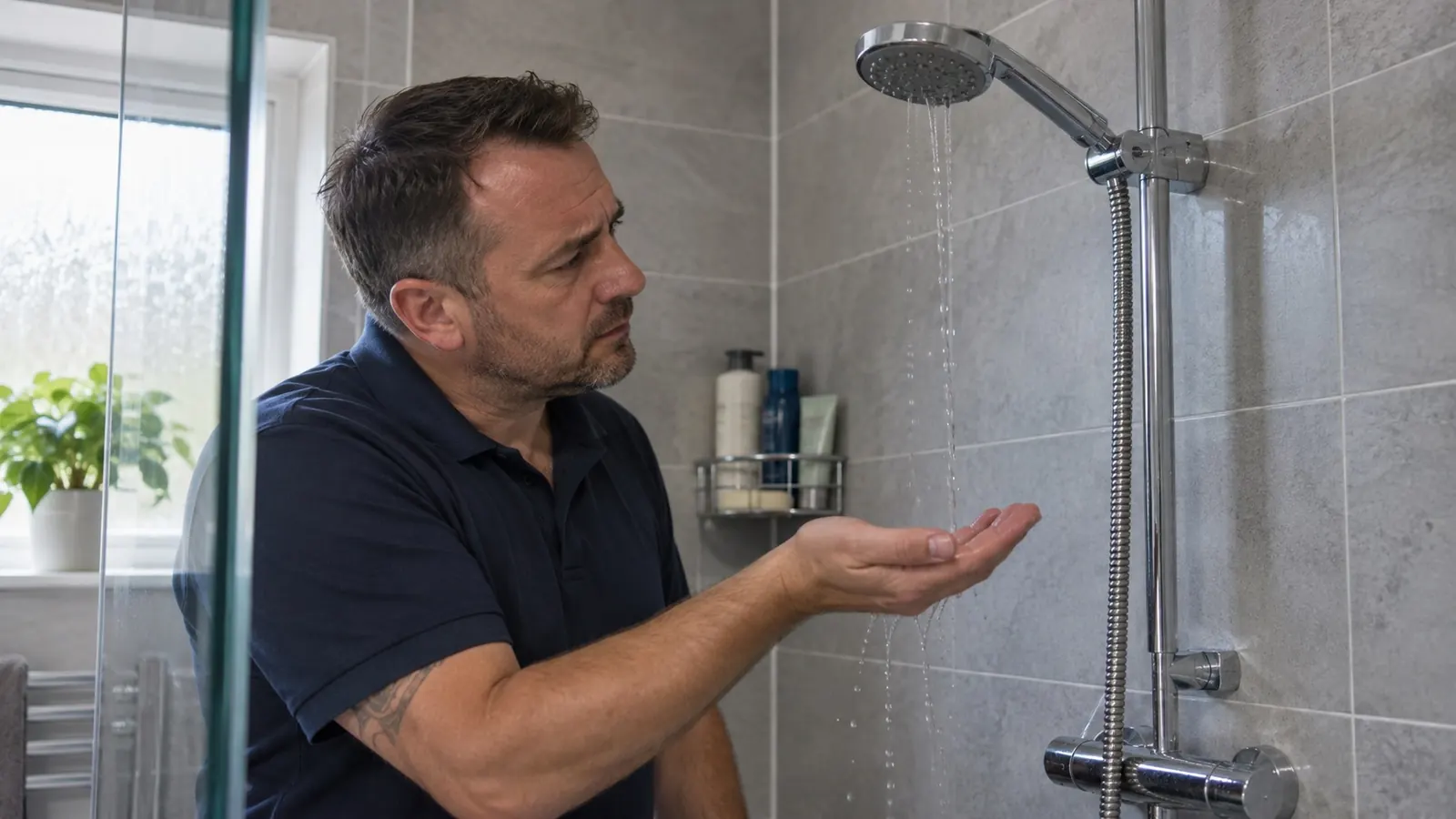
A weak shower is one of the most common complaints we hear, and the frustrating part is that people usually replace the shower before finding out why. Quite often the new one performs no better, because the shower was never the problem.
Work through this in order and you will know what you are dealing with before spending anything.
First: Is It Just the Shower?
Run the cold tap in the kitchen at full flow. That tap is almost always fed directly from the incoming main, so it tells you what is arriving at the property.
- Kitchen cold is strong, shower is weak: the problem is the shower or its supply. Continue below.
- Everything is weak: the incoming supply is restricted. Check the main stopcock is fully open, and ask a neighbour whether they have the same. If they do, it is a supply issue for the water company.
That single check saves a lot of wasted effort. The Chartered Institute of Plumbing and Heating Engineering has guidance on diagnosing domestic pressure and flow problems if you want to go deeper.
Cause 1: A Scaled-Up Shower Head
This is the most common cause and the cheapest fix. In a hard water area, limescale builds inside the nozzles and gradually narrows them. It happens slowly enough that you stop noticing.
The fix
Unscrew the head, soak it in a descaling solution or white vinegar for a few hours, then rub the nozzles with a thumb - most rubber-nozzled heads release scale under pressure. Rinse thoroughly and refit.
If the head has a fixed metal face rather than rubber nozzles, soaking still helps but a wire from a paperclip through each hole finishes the job.
Hard water is a persistent issue in this part of the country, and shower heads here scale up considerably faster than in soft water regions. Anglian Water publishes hardness figures by postcode.
Cause 2: A Partly Closed Valve
Isolation valves on the shower supply are often left partly closed after work, or vibrate closed over time. Look for small screwdriver-slot valves on the pipes feeding the shower - commonly in a nearby cupboard, under the bath, or behind an access panel.
Fully open means the slot lies along the pipe, not across it. A valve at 45 degrees looks open at a glance and halves the flow.
Cause 3: Blocked Filters in the Shower Valve
Most thermostatic shower valves have small mesh filters on the hot and cold inlets, there to catch debris. They block with scale and grit, and when they do the shower weakens on one side, which also upsets the temperature control.
Isolate the supplies, remove the valve cartridge, and check the filters. Cleaning them is a ten-minute job that restores a surprising amount of flow.
A shower that has become hard to set to a comfortable temperature, as well as weak, points strongly at this.
Cause 4: The System Itself
Some showers are weak because the system was never capable of more. It helps to know which you have.
Gravity-fed, with a tank in the loft
Pressure comes from the height of the tank above the shower head, and nothing else. A shower on the top floor, only a metre or two below the tank, will always be weak without help.
The remedy is a shower pump, which is exactly what they exist for. Our guide to shower pumps covers how they work and what goes wrong with them, and the cold water tank explains the system.
Combi boiler
Mains pressure, but limited by the boiler's flow rate - typically 10 to 15 litres a minute for hot water. A high-flow rainfall head simply cannot be supplied by a modest combi, and no amount of adjustment will change that.
You cannot fit a pump to a combi. Pumping a mains supply is not permitted and will not work.
Unvented cylinder
Mains pressure hot and cold, and normally excellent. If an unvented system gives a weak shower, suspect the pressure reducing valve, an expansion vessel problem, or a partly closed valve rather than the system design.
Cause 5: Old or Undersized Pipework
Long runs of narrow pipe, old galvanised steel that has corroded internally, or too many bends all cost flow. This is more common in older properties and shows as a shower that has become gradually weaker over years rather than suddenly.
Corroding pipework often comes with discoloured water first thing in the morning - our guide to brown water covers that.
A Quick Diagnostic Order
- Kitchen cold tap strong? If not, it is the incoming supply.
- Descale the shower head.
- Check isolation valves are fully open.
- Clean the filters in the shower valve.
- Establish which system you have and whether the shower is realistic for it.
- Only then consider a pump, an upgrade, or new pipework.
Measuring What You Actually Have
Before buying anything, time how long the shower takes to fill a two-litre jug. Multiply to get litres per minute. Under about 8 litres a minute feels weak; 10 to 12 is comfortable; above 15 feels powerful.
That number tells you far more than any product description, and it lets you check whether a shower you are considering is compatible with your supply.
Frequently Asked Questions
Why is my shower weak only when someone runs a tap?
That is a flow limitation rather than a pressure fault, and it is normal to a degree. A thermostatic valve will hold the temperature steady but cannot create flow that is not there.
Will a bigger shower head help?
Usually the opposite. A larger head spreads the same flow over more nozzles, so each one delivers less. On a low-flow system a smaller head often feels stronger.
Can I fit a pump to boost my shower?
Only on a gravity-fed system with a tank and cylinder. Not on a combi, and not on an unvented cylinder - pumping a mains supply is against the water regulations.
My shower was fine and suddenly got weak.
Sudden changes point to a blockage or a valve rather than the system. Descale the head and check the valve filters first; both are common after work elsewhere on the plumbing has disturbed debris.
If It Is the System
If you have descaled, checked the valves and cleaned the filters and the shower is still weak, the answer is usually a pump, a pipework upgrade or a different shower matched to your system. We cover Milton Keynes and the surrounding area for shower and plumbing work, and we will tell you what your system can realistically deliver before anything is bought. Get in touch.
Need Professional Advice?
Our Gas Safe registered engineers are ready to help with all your heating needs. Get a free, no-obligation quote today.