Shower Pump Not Working? Causes & Fixes
TL;DR
A pump that hums but moves no water is almost always airlocked or seized - bleeding the air out fixes a good proportion of them. A pump that will not start at all points to the power supply or the flow switch. A pump that runs then cuts out is usually overheating, often because the cold tank cannot supply it fast enough.
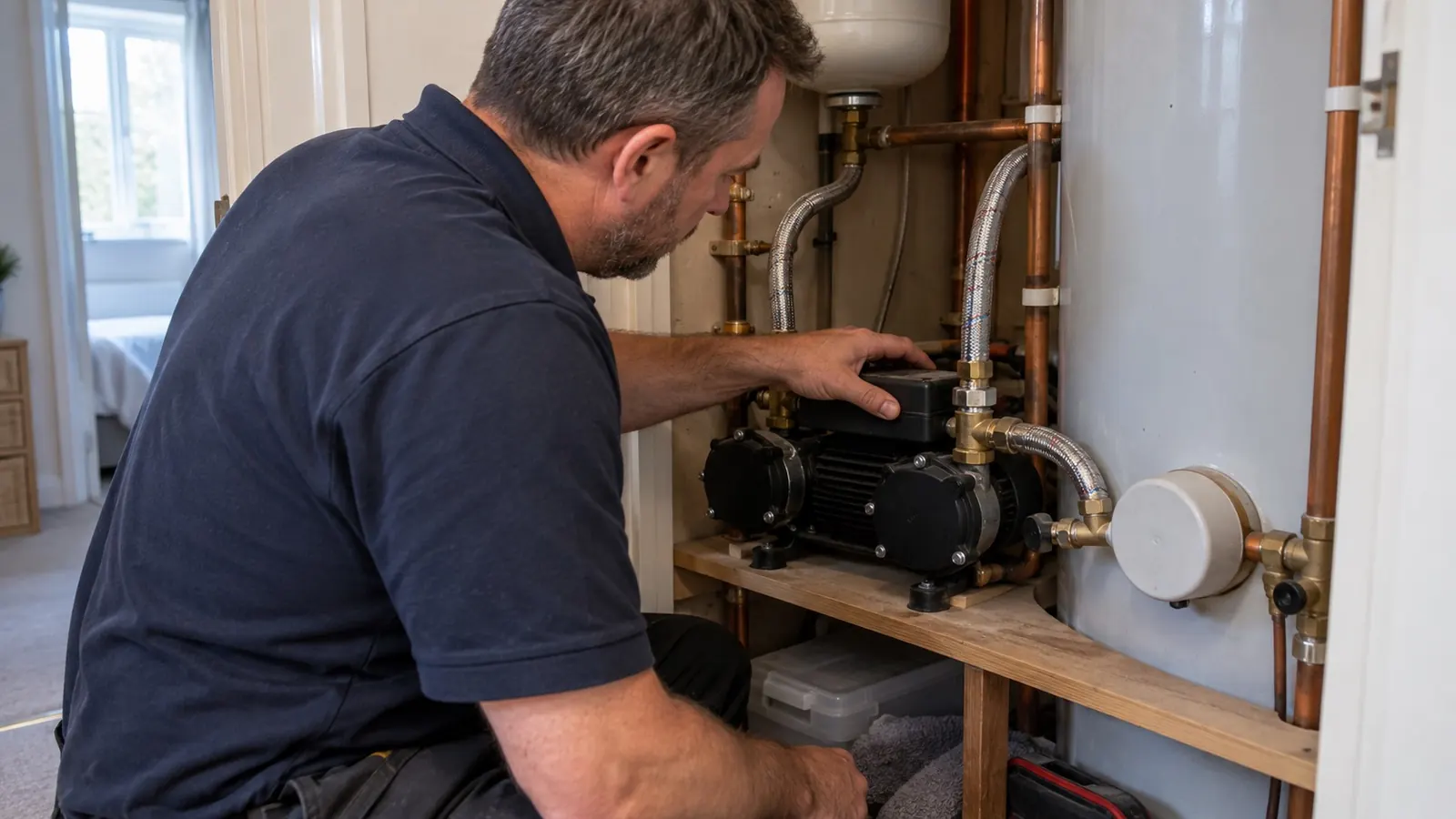
Shower pumps exist to solve one problem: a gravity-fed system where the tank in the loft is not high enough above the shower to produce decent pressure. When they work, they transform the shower. When they fail, they fail in a handful of recognisable ways.
The Chartered Institute of Plumbing and Heating Engineering sets out where boosting is and is not permitted on a domestic supply. In short, a pump only belongs on a gravity-fed system. If you have a combi boiler or an unvented cylinder you already have mains pressure, and pumping a mains supply is not permitted under the water regulations.
Symptom 1: It Hums but No Water Moves
The most common failure, and often fixable without parts.
Airlock
Air trapped in the pump body means the impeller spins in air rather than water. This typically happens after the cold water tank has run low, or after any work on the system.
To clear it: switch the pump off at its isolator. Most pumps have bleed screws on the top of each chamber. Open them slowly with the shower running and let air escape until water appears steadily, then close them and restart. Have a cloth ready.
Seized impeller
If a pump has stood unused for a long period, scale can lock the impeller. Some models allow you to turn the motor shaft by hand through a slot in the end cover to free it. If it will not turn, the pump has usually reached the end of its life.
Symptom 2: It Will Not Start At All
- Check the power. Pumps run from a fused spur, often with its own isolator. Check the switch, the fuse and the breaker.
- Check the flow switch. Most pumps start when they sense flow, triggered by opening the shower. A failed flow switch means the pump never receives the signal. This is a common failure and a replaceable part.
- Check for a thermal cut-out. Many pumps shut down if they overheat and only reset once cool. If it starts working again after an hour, this is what happened.
Symptom 3: It Runs Then Cuts Out
Usually the pump is being starved of water, which makes it overheat.
- The cold tank cannot keep up. A small tank or a slow-filling float valve leaves the pump drawing more than the tank supplies.
- A restricted inlet. Scale or debris in the inlet filters, or a partly closed valve.
- Insufficient head. Most pumps need a minimum height of water above them to prime properly. A pump installed too high relative to the tank will always struggle.
Our guide to the cold water tank covers checking the float valve and tank condition.
Symptom 4: It Is Extremely Noisy
Pumps are never silent, but a sudden change in noise means something.
- Rattling or vibration - the pump is not sitting level, or the anti-vibration feet have compressed. Pumps must be mounted level on a solid base.
- Grinding - worn bearings. The pump is near the end of its life.
- Loud gulping - air being drawn in, so back to the airlock check.
- Banging pipework - usually the flexible connecting hoses have been replaced with rigid pipe, which transmits vibration into the structure. Braided flexible hoses on both sides are there for a reason.
Symptom 5: It Runs When Nobody Is Showering
This means the pump is sensing flow that should not be there - normally a dripping tap or a leaking shower valve somewhere on the pumped circuit. Find and fix the drip and the pump will settle.
Left alone it will shorten the pump's life considerably, because it cycles constantly.
Getting the Installation Right
The Chartered Institute of Plumbing and Heating Engineering publishes guidance on siting and commissioning domestic boosting equipment. Many pump problems are installation problems that only show up later:
- Mounted level, on a solid base, ideally on anti-vibration feet.
- Flexible braided hoses on inlet and outlet, never rigid pipe.
- Fed from a dedicated tank connection rather than teed off an existing outlet, so it cannot draw air.
- Adequate head of water above it, per the manufacturer's figure.
- Accessible. Pumps need bleeding and eventually replacing, and one buried behind a boarded-in cylinder is a problem for later.
Frequently Asked Questions
How long should a shower pump last?
Around eight to twelve years in normal domestic use. Hard water shortens that, and a pump that has been cycling because of a dripping tap will fail sooner.
Can I fit a pump to my combi boiler?
No. A combi already delivers mains pressure and pumping a mains supply is not permitted. If a combi shower is weak, the cause is the incoming supply or the boiler's flow rate - see our guide to low shower pressure.
Why does my pump only run sometimes?
Usually a failing flow switch that triggers inconsistently, or an intermittent airlock. Bleed it first; if the behaviour persists, the switch is the likely culprit.
Is it worth repairing or should I replace?
Flow switches and seals are worth replacing on a reasonably new pump. Worn bearings or a seized impeller on a pump approaching ten years old usually mean replacement is better value.
If Bleeding Has Not Fixed It
A pump that still hums after bleeding, or trips out repeatedly, usually needs the impeller and flow switch checked properly. We cover Milton Keynes and the surrounding area for shower pump and plumbing work. Get in touch and describe the noise it makes - that usually identifies the fault.
Need Professional Advice?
Our Gas Safe registered engineers are ready to help with all your heating needs. Get a free, no-obligation quote today.