How to Unblock a Toilet: 6 Methods That Work
TL;DR
Most blocked toilets clear with a flange plunger used slowly and firmly for 15 to 20 pushes. If that fails, try hot (not boiling) water with washing-up liquid, then a toilet auger. Never use caustic drain cleaner in a toilet. If more than one fitting in the house is backing up at the same time, stop - the blockage is in the shared drain, not the toilet.
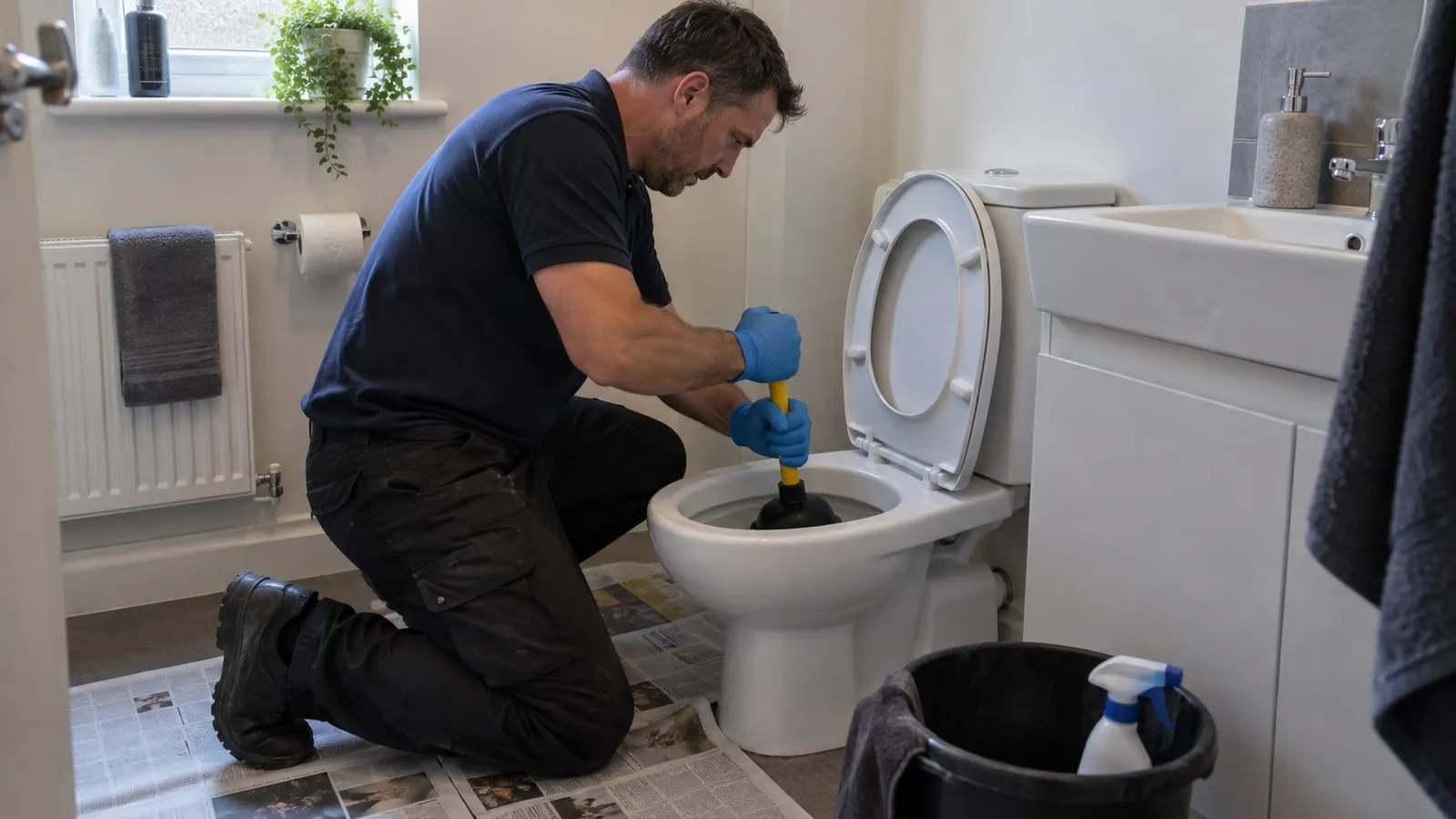
A blocked toilet is one of those problems that goes from mildly annoying to genuinely urgent in about thirty seconds. The water rises, doesn't drain, and you're left wondering whether it's about to come over the rim. The good news is that the vast majority of blocked toilets are cleared by the homeowner in under ten minutes, with tools most people already own.
This guide runs through six methods in the order a professional would actually try them - cheapest and least invasive first. It also covers the one situation where you should stop immediately and call someone, because pushing harder will make it considerably worse.
First: Stop the Toilet Overflowing
Before you try anything, take the lid off the cistern and push the flap valve at the bottom closed with your hand. That stops any more water entering the pan. If the water level is already very high, this single action buys you the time to think.
Do not flush again to "see if it clears". A second flush on a blocked pan is the most common cause of an actual overflow, and cleaning up after that is a far worse job than the blockage itself.
Method 1: The Flange Plunger
This clears roughly three quarters of the blocked toilets we attend. The critical detail is using the right plunger. A flat cup plunger - the type used on a sink - will not seal against a toilet pan. You need a flange plunger, which has a soft rubber sleeve that extends down from the cup and pushes into the outlet.
How to do it properly
- Make sure there is enough water in the pan to cover the rubber head. If the pan is nearly empty, add water from a jug - the plunger works on water pressure, not air.
- Insert the flange into the outlet at the bottom of the pan and press down gently to form a seal.
- Push down and pull up firmly but without violence, keeping the seal intact. Aim for 15 to 20 strokes.
- On the last stroke, pull the plunger up sharply to break the seal.
The mistake almost everyone makes is being too vigorous on the first push. That forces air out around the sides, breaks the seal, and splashes the bathroom. The pull is doing as much work as the push - you are rocking the blockage loose, not hammering it through.
If the water drains away, flush once and watch. A toilet that drains slowly afterwards still has a partial obstruction and will block again within days.
Method 2: Hot Water and Washing-Up Liquid
If plunging fails, this method works surprisingly often on blockages caused by too much paper or by fats and greases.
Squeeze a generous amount of washing-up liquid into the pan and leave it for five to ten minutes. It sinks and coats the blockage. Then pour in hot water from a height of about waist level - the drop adds force. The water should be hot from the tap or just off the boil, but never actually boiling.
Boiling water poured into a cold ceramic pan can crack it. A cracked pan means a full replacement and, if it happens at the outlet, a wet floor. This is a genuine risk, not a technicality.
Leave it for twenty minutes or so, then try plunging again. The combination of lubricant, heat and a plunger clears a lot of what the plunger alone will not.
Method 3: A Toilet Auger
An auger - sometimes called a closet auger or toilet snake - is a flexible cable with a crank handle and a protective sleeve. It is the tool that clears what a plunger cannot, and it costs less than a single callout.
Feed the end into the outlet and turn the handle clockwise as you push. When you meet resistance, keep turning. You are either breaking the obstruction up or hooking it so it can be drawn back out. If the cable suddenly turns freely, you have gone through.
Use a proper toilet auger rather than a general drain snake. The plastic sleeve on a toilet auger is there to stop the metal cable scoring the glaze inside the pan, and scratched glaze catches waste and blocks again more often.
Method 4: Check for a Foreign Object
If you have a young family, this is worth considering early rather than late. Toys, toothbrushes, cotton pads, sanitary products and wet wipes all block toilets, and they behave differently from a paper blockage - the water usually drains away very slowly rather than not at all, and plunging seems to help briefly before it blocks again.
A solid object needs to be removed, not pushed through. Pushing it further into the pipework turns a ten-minute job into an excavation. If you suspect something solid has gone down, use an auger to hook it back or call someone.
Wet wipes deserve a special mention. Even the ones sold as flushable do not break down like toilet paper - they stay intact, snag on any imperfection in the pipe, and gather everything else that passes. Water UK has campaigned on this for years, and the sewer blockages they describe start in exactly this way. If you take one preventive step after reading this, make it binning wipes rather than flushing them.
Method 5: A Wet and Dry Vacuum
If you own a wet and dry vacuum, it can pull a blockage out rather than pushing it through - genuinely useful when a foreign object is involved.
Vacuum the standing water out of the pan first. Then wrap an old towel around the hose end to form a seal at the outlet and switch on. This will not work with a normal household vacuum, and attempting it will destroy the machine and possibly give you a shock. Wet and dry only.
Method 6: What Not to Use
Caustic soda and strong chemical drain cleaners have no place in a toilet. There are three reasons, and all of them matter.
- They rarely work on toilets. The blockage usually sits below a water-filled trap, so the chemical is diluted long before it reaches anything.
- They make the job dangerous for whoever comes next. If you then plunge, you are splashing caustic solution around a small room. Tell any engineer immediately if you have already poured something down.
- They damage the system. Repeated use degrades seals, plastic waste pipes and older pan connectors.
Enzyme-based maintenance products are a different matter - they are slow, mild, and fine for keeping a sluggish drain clear. They will not rescue a fully blocked pan. The Chartered Institute of Plumbing and Heating Engineering is a good independent source on what is and is not safe to put into domestic drainage.
The Warning Sign That Means Stop
Everything above assumes the blockage is in the toilet. There is one clear signal that it is not.
If other fittings are affected at the same time, the problem is in the shared drain. Look for water rising in the shower tray when the toilet is flushed, a bath or basin that gurgles when the toilet is used, or waste appearing in the lowest fitting in the house. That pattern means the blockage is downstream of everything, in the soil pipe or the underground drain.
Plunging a toilet in that situation achieves nothing and can force waste back into the shower or bath. The right next step is to check the external drain - our guide to clearing a blocked outside drain covers how to lift the cover safely and what you are looking for. If the chamber is full, the blockage is beyond it and needs proper equipment.
When to Call a Plumber
Call someone if you have worked through the plunger, hot water and auger without success, if more than one fitting is backing up, if the toilet blocks repeatedly within days of being cleared, or if you can see water escaping around the base of the pan rather than draining.
Repeat blockages in particular are worth investigating rather than re-clearing. A toilet that blocks every few weeks usually has an underlying cause - a partially collapsed pipe, a poor fall on the waste run, root ingress, or a build-up that never fully cleared. Each of those gets worse and more expensive the longer it runs.
Preventing the Next One
- Only flush the three Ps: pee, paper and poo. Everything else goes in a bin, including wipes labelled flushable.
- Fit a small covered bin in the bathroom - the easiest way to change the habit is to make the alternative convenient.
- If you have a low-flush or older cistern, flush twice for larger loads rather than overloading a single flush.
- Deal with a slow-draining toilet early. Slow is the stage before blocked, and it is far easier to fix.
If your toilet is filling or flushing poorly rather than blocking, the cause is usually in the cistern rather than the drain. Our guides to a toilet that will not flush properly and drains that smell cover those separately.
Frequently Asked Questions
Will a blocked toilet eventually clear itself?
Sometimes, if the blockage is paper only - it softens and breaks down over several hours. Leaving it overnight before trying again is a reasonable step. A blockage caused by wipes, fats or a solid object will not clear itself and will usually get more compacted.
Can I use a wire coat hanger?
We would not recommend it. Straightened wire is stiff, sharp and hard to control, and it scratches the glaze inside the pan. Those scratches then catch waste and cause repeat blockages. A proper auger costs very little and does the job without damage.
Why does my toilet block more than my neighbours'?
Usually one of three things: what is being flushed, the fall on your waste pipe, or the condition of the pipework itself. Older properties sometimes have long, shallow waste runs that need more water to shift solids. If the habit side is under control and it still blocks, it is worth having the pipework looked at.
Is a blocked toilet an emergency?
Not usually, unless it is the only toilet in the property, waste is backing up into other fittings, or water is escaping onto the floor. Those three situations do justify a same-day call.
Still Blocked?
If you have tried the methods above and the toilet is still not draining - or you are seeing waste come back through another fitting - that is the point where equipment beyond a plunger is needed. Our engineers cover Milton Keynes and the surrounding area for emergency plumbing and drainage, and can usually attend the same day. Get in touch and we will tell you honestly whether it is something you can finish yourself.
Need Professional Advice?
Our Gas Safe registered engineers are ready to help with all your heating needs. Get a free, no-obligation quote today.