Hard Water: Effects on Your Plumbing
TL;DR
Hard water carries dissolved calcium and magnesium that precipitate out as limescale when the water is heated. The damage is cumulative and concentrated wherever water gets hot — heat exchangers, immersion elements, shower heads. Softeners remove the minerals; scale reducers change how they behave. Which is right depends on what you are trying to protect.
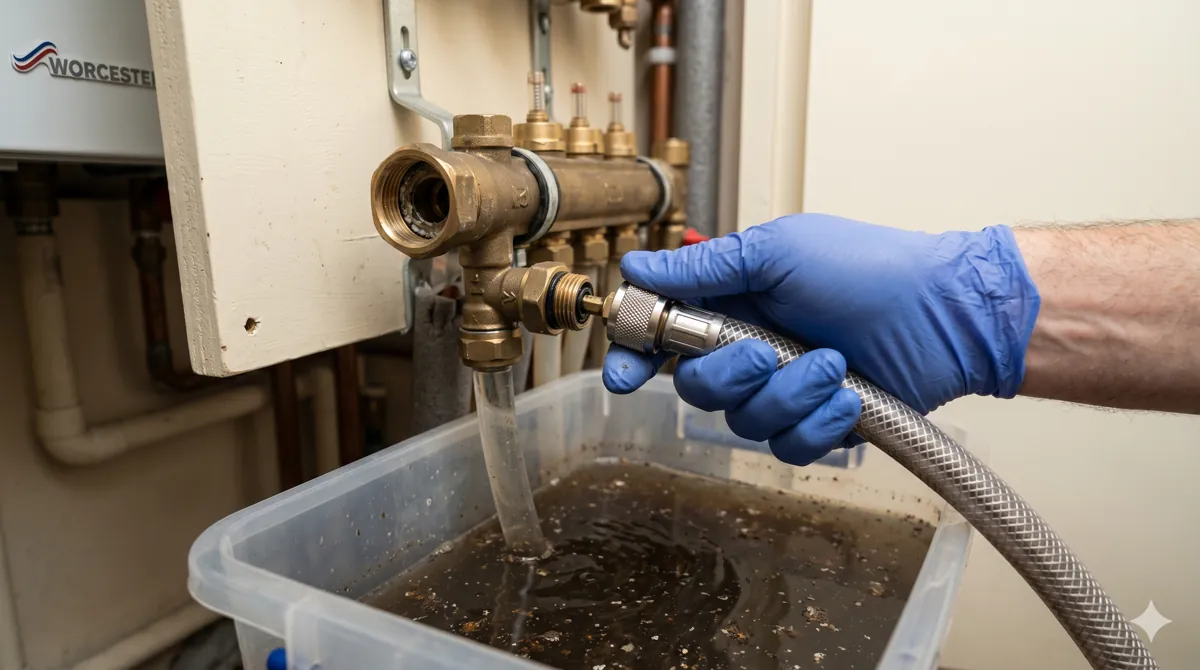
Water hardness is one of those background conditions that quietly determines how long your plumbing lasts. Much of the south and east of England sits in a hard or very hard water area, and the effects accumulate over years rather than announcing themselves.
What Hard Water Actually Is
Rain is soft. As it percolates through rock, it dissolves minerals — principally calcium and magnesium carbonates. Water drawn from chalk and limestone aquifers picks up a great deal of these; water from granite regions picks up almost none.
Dissolved in cold water, these minerals are harmless and are in fact good for you. The problem is what happens when the water is heated. Above roughly 60°C the carbonates come out of solution and deposit as limescale on whatever surface is hottest.
You can check hardness for your own supply directly — your water company publishes it by postcode, and for this region that is Anglian Water. It is worth knowing the actual figure rather than guessing.
Where It Does Damage
Combi Boiler Heat Exchangers
The most expensive place scale accumulates. A combi heats mains water on demand through a plate heat exchanger with very narrow passages. Scale narrows them further, restricting flow and forcing the boiler to work harder for less output.
Symptoms progress predictably: hot water temperature becomes inconsistent, then the flow rate drops, then the boiler starts kettling — a rumbling or knocking noise as water boils against the scaled surface. Our guide on boiler kettling covers that stage in detail.
Immersion Heaters and Cylinders
An immersion element is a heated rod sitting in stored water, which is close to the ideal conditions for scale formation. A heavily scaled element becomes insulated, takes longer to heat the tank, uses more electricity, and eventually burns out.
In stored systems, scale also settles as sediment at the bottom of the cylinder, reducing usable capacity. If you are already looking at a replacement, our cylinder replacement guide covers what to specify.
Showers and Taps
The visible nuisance. Shower heads block, spray patterns go crooked, thermostatic cartridges seize, and tap aerators clog. Cheap to fix individually, tedious cumulatively.
Heating Circuits
Worth understanding clearly, because it is frequently misunderstood. A sealed central heating system contains a fixed volume of water. It scales once, at first fill, and then stops — because there are no fresh minerals coming in.
That changes if the system is repeatedly topped up. Every top-up introduces fresh hard, oxygenated water, which both adds scale and drives corrosion. Which is exactly why a system that needs frequent topping up should be investigated rather than repeatedly refilled. Our guide on radiator leaks covers the usual source.
Efficiency Cost
Scale is an insulator. A layer on a heat transfer surface means more energy is needed for the same output, and the effect compounds as the layer thickens. The Energy Saving Trust treats maintaining hot water and heating efficiency as one of the more reliable ways to keep bills down, and descaling is part of that.
Treatment Options
Water Softeners
Ion exchange softeners genuinely remove calcium and magnesium, swapping them for sodium. They are the only option that truly eliminates scale, and the difference is obvious throughout the house — no scale anywhere, less detergent needed, cleaner glassware.
Considerations: they need space, usually under a sink, they need salt topping up periodically, and they need a drain connection. A separate hard water drinking tap is normally fitted, both for taste and because softened water is not recommended for drinking in large quantities or for making up infant formula.
Scale Reducers and Conditioners
These do not remove minerals. They alter the way scale crystals form so that they are less likely to adhere to surfaces. Physical, magnetic and electronic versions exist, and the evidence for them varies considerably by type and installation.
They are cheaper, need no drain, no salt, and no space, and they do not change the water chemistry for drinking. As targeted protection for a specific appliance they can be worthwhile; as a whole-house solution they are not equivalent to a softener.
In-Line Boiler Protection
A scale inhibitor fitted on the cold feed to a combi, protecting the appliance specifically. Modest cost, targeted benefit, and often the pragmatic middle path. Many manufacturers require some form of scale protection in hard water areas as a condition of warranty — worth checking your own paperwork.
Maintenance That Helps Regardless
- Set hot water storage temperature sensibly — hot enough for safety, not hotter than needed, since scale formation accelerates with temperature.
- Descale shower heads and tap aerators periodically. A soak in a mild acid solution does it.
- Have the boiler serviced annually so scale is spotted before it becomes a heat exchanger replacement.
- Fit and maintain a magnetic filter on the heating circuit, and keep inhibitor dosed.
- Investigate pressure loss rather than repeatedly topping up.
Frequently Asked Questions
Is hard water bad for you?
No. The dissolved minerals are harmless and contribute to dietary intake. The problem is entirely mechanical.
Will a softener damage my pipes?
Properly installed and maintained, no. Softened water should not be run to the drinking tap, which is why a hard water branch is retained.
Can a scaled heat exchanger be cleaned?
Sometimes, by chemical descaling. Whether it is worth doing depends on the severity and the age of the boiler.
Do magnetic scale reducers work?
Evidence is mixed and depends heavily on the product and the installation. They are not equivalent to a softener, and should not be sold as such.
Does hard water affect a heat pump?
Much less on the heating side, since that is a sealed circuit. The hot water cylinder is still exposed, though heat pumps run cooler which reduces scale formation.
Getting Advice
If you are seeing the symptoms — noisy boiler, dropping hot water flow, an immersion that takes forever — we can assess whether scale is the cause and what is worth doing about it. Call 07805 844 016 or contact us.
Need Professional Advice?
Our Gas Safe registered engineers are ready to help with all your heating needs. Get a free, no-obligation quote today.