Hot Water Cylinder Replacement: Signs, Vented vs Unvented, Rules
TL;DR
Rusty hot water while the cold runs clear, water that no longer stays hot, weeping at the seams or around the immersion boss, and frequent immersion failures all point to a cylinder on its way out. A like-for-like vented swap is straightforward. An unvented cylinder gives mains-pressure showers and frees the loft, but it needs enough incoming mains flow, a safe discharge route, an annual service, and by law an installer who holds the unvented qualification.
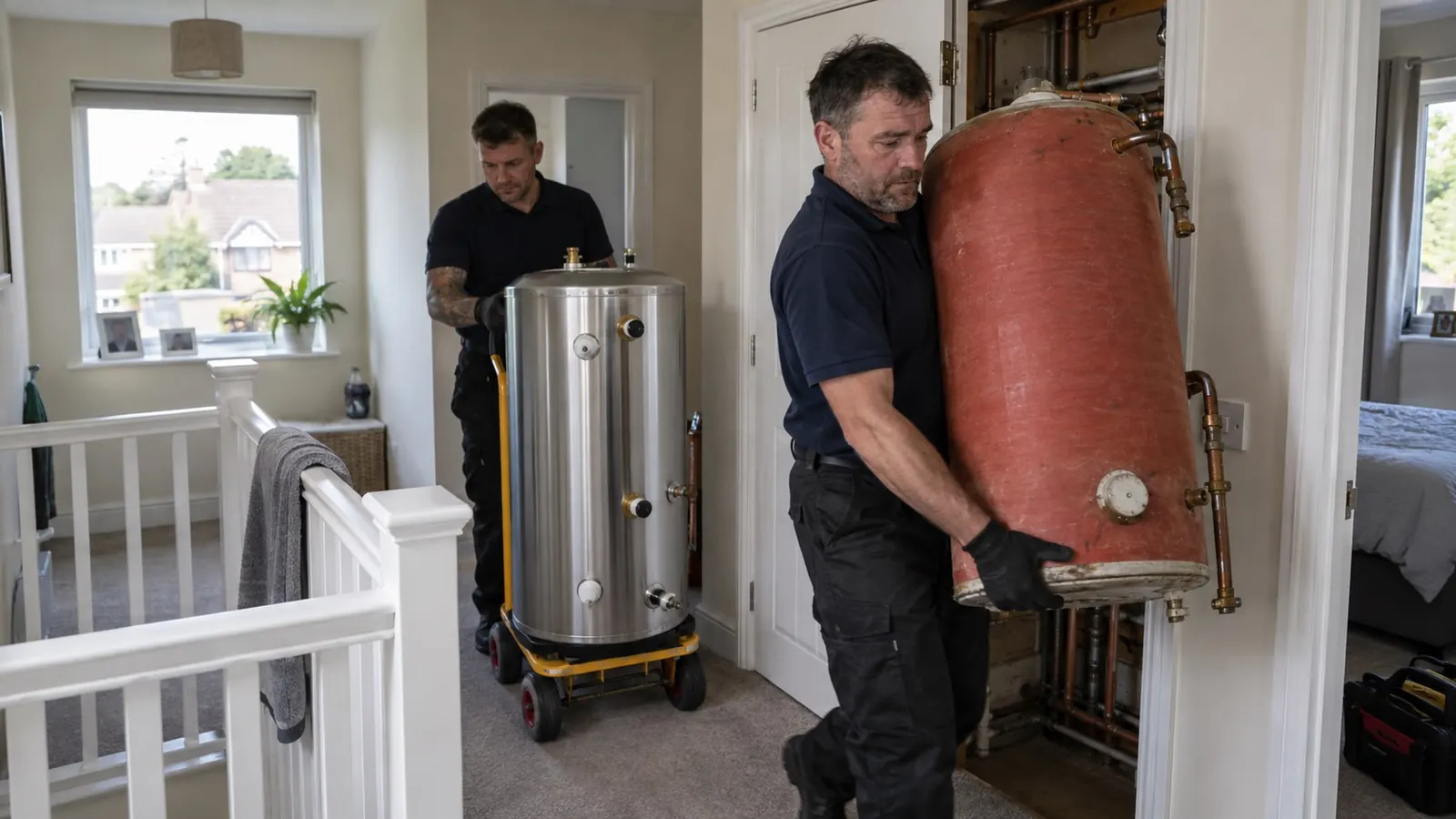
A hot water cylinder is one of the longest-lived things in a house, which is exactly why most people only think about it when it lets go. Knowing the early signs matters, because a cylinder that fails while you are out puts a great deal of water through the ceiling in one go.
Signs yours needs replacing
- Rusty or discoloured hot water while the cold runs clear. The inside of the cylinder is corroding. On a copper cylinder that usually means the end is near.
- Water no longer staying hot. Either the insulation has failed or the coil inside is heavily scaled and cannot pass heat into the water.
- Weeping or staining at the seams. Look around the immersion heater boss, the top dome and where the pipes enter. Green or white crust is dried leak.
- Much slower recovery than it used to have. Scale on the coil again, or a failing motorised valve starving it of hot water from the boiler.
- Immersion elements burning out every year or two. Scale builds on the element until it overheats. It is a symptom of the water, not just the element.
- Age. A copper vented cylinder often does twenty-five years or more. A modern stainless unvented cylinder is generally built for fifteen to twenty-five, and the difference is almost entirely whether it was serviced.
A cylinder that has started to weep does not stop. It gets worse, and it usually fails properly at the least convenient moment.
Vented or unvented?
Vented is the traditional system. A cold water tank in the loft feeds the cylinder by gravity, and the cylinder has an open vent pipe back over the tank. It is simple, cheap to replace like-for-like, and it keeps working during a mains interruption because the tank holds a reserve. The drawback is pressure. Hot water pressure depends entirely on how high the tank sits above the tap, which is why upstairs showers on a vented system are weak without a pump.
Unvented is mains pressure. The cylinder is fed straight from the incoming main, so hot water arrives at the same pressure as cold. Strong showers without a pump, no loft tank, and a bath fills quickly. Because the cylinder is a pressure vessel it carries an expansion vessel, a temperature and pressure relief valve and a discharge pipe, and it must be installed and serviced by someone holding the unvented hot water qualification. That is a requirement of the Building Regulations, Approved Document G, not a preference.
A thermal store is the third option, less common. It stores heated water and passes mains water through a coil to heat it on demand. You get mains-pressure hot water without the pressure-vessel rules, but it is bulkier and less efficient at holding heat.
Before you choose unvented: measure the mains
The most common cylinder complaint we see is an unvented cylinder fitted to a supply that cannot feed it. Mains pressure hot water is only as good as the mains. Time how long a fully open kitchen cold tap takes to fill a ten-litre bucket, with nothing else running. If it takes much more than half a minute, the flow is marginal and an unvented cylinder will disappoint, especially with two showers going. A proper survey should measure both flow and standing pressure at the stopcock, not guess.
What goes into the quote
Prices for the same-sized cylinder vary a lot between homes, and it is almost always the work around the cylinder rather than the cylinder itself. A quote for a like-for-like vented swap is mostly the cylinder, the labour to drain, remove and refit, new valves and insulation. A quote for a vented to unvented conversion is a different job altogether. Expect it to include:
- The cylinder size and grade. Capacity, and whether it is a direct or indirect model.
- Removing the loft tanks and capping the old vent and feed.
- Mains pipework. The cold feed has to be brought to the cylinder at full bore, and often the incoming main needs upgrading from the stopcock.
- The discharge route. The safety valves need a tundish and a pipe run to a safe, visible outside point, sized and routed as Approved Document G requires. In an upstairs airing cupboard with no outside wall nearby this can be the most awkward part of the job.
- An expansion vessel, pressure reducing valve and check valves on the inlet.
- Balancing the cold supply so showers get hot and cold at equal pressure, otherwise mixers behave badly.
- Electrical work for the immersion heater and any new controls, which may need a qualified electrician.
- Building Regulations notification. An unvented installation is notifiable. A competent-person installer self-certifies; otherwise a building control application is needed.
- Making good. Boxing in, pipe boxing and any plaster.
Access moves the price too. A cylinder in a ground-floor cupboard is a very different day from one at the top of a narrow loft ladder. And if the boiler is old, a survey should say whether it is up to heating a bigger cylinder before you commit.
Sizing it
Too small and you run out mid-shower. Too big and you pay to keep water hot that nobody uses. What matters most is not the number of bathrooms but how many people shower within the same hour. A couple in a two-bathroom house who shower at different times can be happy with a modest cylinder. A family of five who all leave at eight need considerably more, or a faster-recovering cylinder with a larger coil. Recovery time (how quickly the boiler can reheat it) is as important as capacity, and a bigger cylinder on a small old boiler simply takes longer to reheat. A proper survey asks how the household actually uses hot water.
Hard water changes the sums
In a hard water area a cylinder scales on the coil and the immersion element from day one. That is why immersions fail early and why an old cylinder takes longer to heat than it did. When a cylinder is replaced it is worth fitting a scale reducer on the cold feed, keeping the stored temperature at the recommended sixty degrees rather than higher, and having the immersion checked at each service. Anyone in Milton Keynes, Bedford or the surrounding towns is in some of the hardest water in England and should treat this as standard rather than optional.
Servicing an unvented cylinder
Every unvented cylinder manufacturer requires an annual service to keep the warranty, and it is regularly skipped. The expansion vessel loses its air charge over time. Once it has, expanding hot water has nowhere to go and the relief valve discharges, and the first sign anyone notices is water dripping from a pipe outside. A service checks and recharges the vessel, tests the temperature and pressure relief valves, checks the tundish and the pressure reducing valve, and checks the thermostat and immersion. It is a short visit and it is the difference between a twenty-year cylinder and a ten-year one.
Here is the honest point a sales-led company would rather not print: unvented is not automatically the upgrade. If your mains flow is poor, if the discharge route would have to run through three rooms, or if you have a vented system with a working shower pump that you are happy with, a like-for-like vented replacement is the cheaper, simpler and entirely respectable answer. We fit both and we will tell you which your house actually suits.
When to call someone
Checking for weeping, running the bucket test and noticing rusty water are all things you can do. Replacing a cylinder, and anything to do with an unvented one, is a job for a qualified installer, and any work on the boiler feeding it is a Gas Safe registered engineer's job. Plumbline MK is Gas Safe registered (957816) and covers cylinder and hot water system replacement across Milton Keynes and the surrounding towns, and we measure the flow before we recommend anything. Get in touch if yours is showing any of the signs above.
Frequently asked questions
Can I fit an unvented cylinder myself?
No. It requires the unvented hot water qualification and the installation is notifiable under the Building Regulations. An uncertified installation is unlawful, will not be covered by the manufacturer's warranty or your home insurance, and is genuinely dangerous because the cylinder is a pressure vessel.
Will an unvented cylinder improve my shower?
Usually a great deal, provided the incoming mains flow and pressure are good. If they are poor, it will not, and a pumped vented system may serve you better. Measure before you decide.
Why is water dripping from a pipe outside near my cylinder?
That is the discharge from a safety valve, and it means the cylinder is relieving pressure. Most often the expansion vessel has lost its charge. It needs attention promptly rather than being left, and it is a normal part of an annual service to put right.
Can I switch to a combi instead and get rid of the cylinder altogether?
Sometimes. A combi suits a home with one bathroom and good mains flow. With two or more showers in use at once, stored hot water is usually the better answer. Our guide to what a combi boiler is explains the trade-off.
Need Professional Advice?
Our Gas Safe registered engineers are ready to help with all your heating needs. Get a free, no-obligation quote today.