What Is a Combi Boiler? How It Works and Who It Suits
TL;DR
A combi, short for combination boiler, heats your radiators and your hot water from one wall-hung unit, with no hot water cylinder and no tank in the loft. Open a hot tap and cold mains water runs through the heat exchanger and comes out hot within seconds. It is compact, efficient and the simplest type to install. The trade-off is flow: one shower or hot tap at full strength at a time, so it suits one-bathroom homes best.
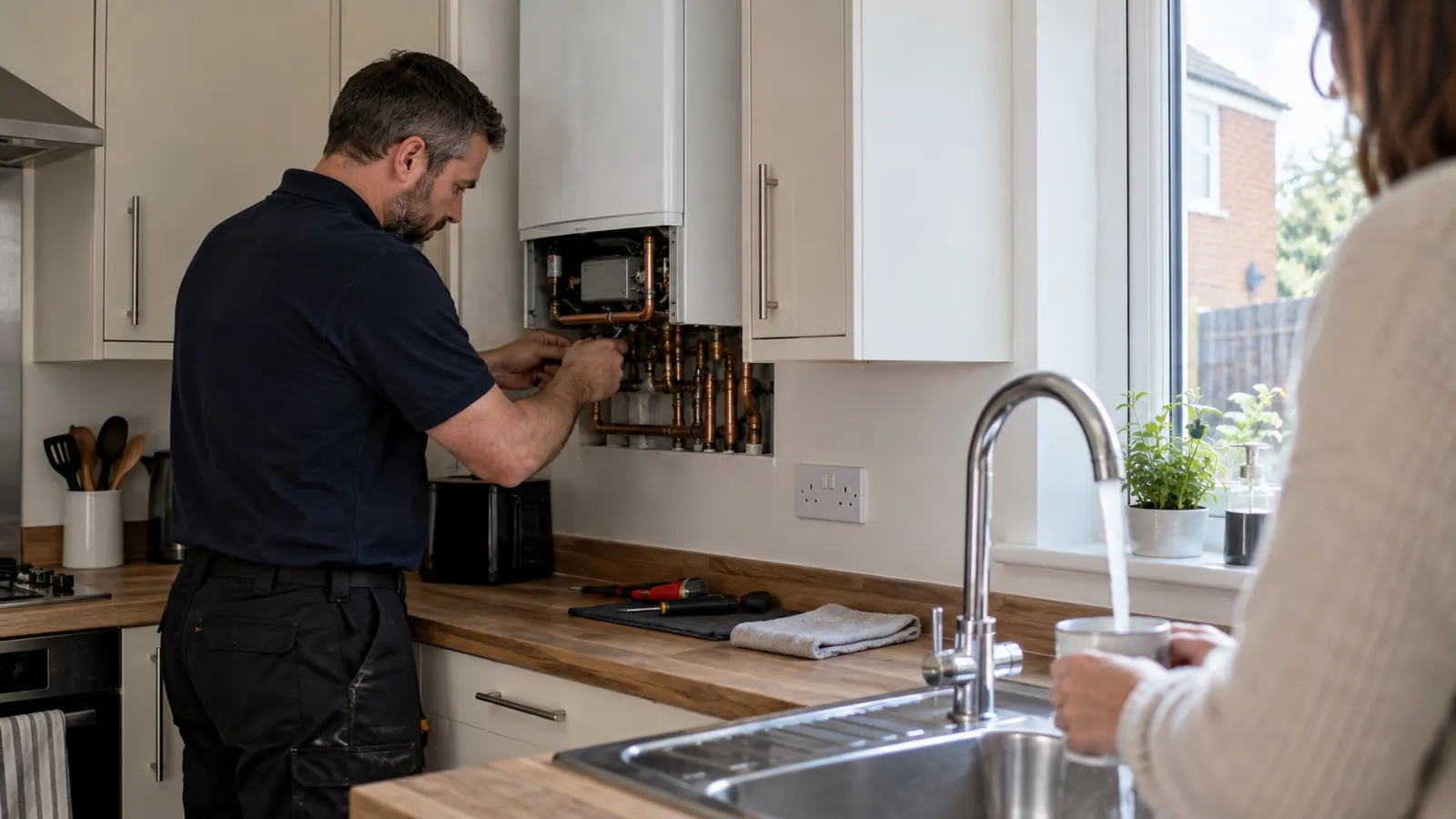
If you have started looking at a new boiler you will have seen the word combi everywhere. It is the most common type of boiler in British homes by a long way. This guide explains what one actually is, what happens inside it when you turn a tap on, how it differs from the other two types, and, honestly, which homes it does not suit.
A combi boiler, short for combination boiler, is a single unit that does both jobs: central heating and hot water. There is no hot water cylinder in the airing cupboard and no cold water tank in the loft. Hot water is made on demand, straight from the mains, at the moment you ask for it. Nothing is stored, so nothing runs out.
How a combi boiler works, step by step
Here is what happens the moment you open a hot tap.
- Cold water enters from the mains. The boiler is plumbed directly to your incoming cold supply.
- A flow sensor notices. It detects water moving and tells the boiler to make hot water.
- The burner fires. Gas is lit under the heat exchanger.
- The heat exchanger does the work. The cold water passes through it and picks up the burner's heat as it flows.
- The diverter valve sends it the right way. On a combi this valve chooses between the taps and the radiators. Hot water always wins.
- Hot water arrives at the tap within a few seconds.
- You close the tap, the burner stops. The flow sensor sees the water stop and the boiler shuts the burner down.
For central heating the sequence is much the same, except the thermostat calls instead of a tap, the diverter valve sends the hot water round the radiator circuit, and the boiler's pump keeps it circulating until the room reaches temperature.
The main parts and what they do
- Heat exchanger. Passes heat from the burning gas into the water. The most expensive part, and the one hard water scales up.
- Burner and fan. Burn the gas and push the flue gases safely outside.
- Diverter valve. Switches between hot water and heating. A very common wear part.
- Pump. Moves water round the radiators.
- Expansion vessel. Absorbs the expansion of water as it heats so the pressure does not spike.
- Pressure relief valve. A safety valve that dumps water outside if the pressure climbs too high.
- Flow sensor. Tells the boiler a tap has been opened.
- Condensate trap. Collects the slightly acidic water a condensing boiler produces and drains it away.
Why hot water takes priority
A combi cannot heat the taps and the radiators at the same instant, so the diverter valve is set to favour hot water. If the heating is on and someone runs the shower, the radiators pause for a few minutes and then pick up again. In normal use you never notice. It does explain one of the most recognisable combi faults, covered below.
Combi, system or conventional?
There are three types of boiler in UK homes and the difference is all about hot water.
- Combi. Heats water on demand. No cylinder, no tanks. Smallest footprint, simplest install. Limited to one big hot water draw at a time.
- System boiler. Heats the radiators directly and stores hot water in an unvented cylinder, at mains pressure. No loft tanks. Several showers at once are fine. Hot water can run out if the cylinder is undersized, and the cylinder needs a cupboard. Our guide to what a system boiler is covers it.
- Conventional (regular or heat-only). Works with a vented cylinder and one or two tanks in the loft. Common in older houses. Good for several bathrooms, tolerant of poor mains pressure, but the most space-hungry and the weakest showers without a pump.
What a combi does well
- Space. One box on the wall. The airing cupboard and the loft come back into use, which matters in a terrace or a town house.
- Hot water that does not run out. No waiting for a cylinder to reheat after the third shower.
- Efficiency. Modern condensing combis are highly efficient, and you are not keeping a tank of water hot all day for nobody.
- Simpler installation. Fewer parts and no tanks, so a like-for-like combi swap is the quickest and cheapest kind of boiler job.
- Mains-pressure showers. Provided the mains is decent, a combi gives a strong shower without a pump.
Where a combi falls short
Every limitation comes back to the same fact: it heats water as it flows, so the flow is finite.
- One tap at a time. Run the shower and the kitchen hot tap together and both go lukewarm. In a busy house this is the everyday frustration.
- Two bathrooms in use at once. A combi cannot keep up, however big it is. Households like that are better served by a system boiler and cylinder.
- It depends on your mains. The hot water can only flow as fast as the cold main feeds it. A poor incoming supply means a poor shower, and a bigger boiler does not fix that. Any installer should measure your mains flow before recommending a combi.
- No backup. If the boiler fails you lose heating and hot water together. There is no cylinder of warm water to fall back on and, unless the cylinder had an immersion, no second way to heat water.
Which homes suit a combi
Flats, terraces and smaller semis with one bathroom. Couples and small families whose showers rarely overlap. Newer estates that were built with a combi and good mains pressure in the first place. Anywhere the airing cupboard is wanted for something else.
If you have two or more bathrooms, a big bath you like to fill quickly, a family that all leaves at the same time, or weak mains pressure, look seriously at a system boiler before you default to a combi. Our guide to the best boiler for a three-bedroom house works through the decision for a typical family home.
The honest point most installers skip: a bigger combi is not the answer to a weak shower. Output only matters if the mains can supply the flow. We have taken out plenty of large combis that were sold as an upgrade and replaced them with a cylinder because the house never had the mains to feed them.
Common combi faults, and what they tell you
- Heating works but no hot water, or the reverse. Almost always the diverter valve stuck in one position.
- Pressure keeps dropping. A small leak somewhere, or an expansion vessel that has lost its charge. Topping up is a stop-gap, not a fix.
- Fires up, then cuts out, then fires again. Short cycling. Sludge restricting flow, a tired pump, or a sensor fault.
- Water dripping from a pipe outside. The pressure relief valve doing its job because the pressure has gone too high, often another expansion vessel symptom.
- Boiler stops in freezing weather with a fault code. Frozen condensate pipe. Thaw it with warm water and reset once.
Checking the pressure gauge, topping up through the filling loop, bleeding radiators, thawing the condensate and pressing reset once are all fine for a homeowner. Anything inside the boiler casing or on the gas side is a Gas Safe registered engineer's job by law.
Combis and hard water
Because a combi heats mains water directly through its heat exchanger every time you run a tap, it scales up faster in hard water than a system with a cylinder does. In very hard water areas a scale reducer on the cold feed, a magnetic filter on the heating return and a yearly service are what keep a combi healthy.
When to talk to someone
Whether a combi is right for you depends on your bathrooms, your mains flow and how your household uses hot water, not on what is most popular. If you are in Milton Keynes or the surrounding towns, Plumbline MK is Gas Safe registered (957816), we measure the mains before we recommend anything, and we fit, service and repair all the main combi brands. See our boiler installation service or get in touch for a straight answer.
Frequently asked questions
Is a combi boiler good?
For the right home, very. Compact, efficient, hot water that never runs out, and the simplest installation. For a home with two bathrooms in use at once or a poor mains supply, a system boiler with a cylinder is the better choice.
Can a combi boiler run two showers at once?
Not well. The flow is shared, so both showers weaken and cool. If two showers at once is a daily event, you want stored hot water.
How long do combi boilers last?
A well-maintained combi commonly gives ten to fifteen years. An annual service by a Gas Safe engineer, clean system water and a magnetic filter are what push it towards the upper end, and the service is usually a condition of the warranty.
Why is there no hot water but the heating still works?
The classic sign of a stuck diverter valve. It has jammed on the heating side and is not sending water to the taps. It is a common repair for a Gas Safe engineer.
Can a combi run underfloor heating?
Yes, with a blending valve or manifold to bring the water down to the lower temperature underfloor heating needs. For larger underfloor systems a system boiler often pairs better; our underfloor heating service can advise.
Need Professional Advice?
Our Gas Safe registered engineers are ready to help with all your heating needs. Get a free, no-obligation quote today.