Boiler F1 Error: What It Means and How to Fix It
TL;DR
On Ideal and Glow-worm boilers, an F1 error means the heating system's water pressure has dropped too low and the boiler has locked out to protect itself. You can usually clear it yourself by topping up to around 1.2 bar at the filling loop, then resetting. If F1 returns within days, the system is losing water and a Gas Safe registered engineer needs to trace the leak. Other brands use F1 for different faults, so check your manual.
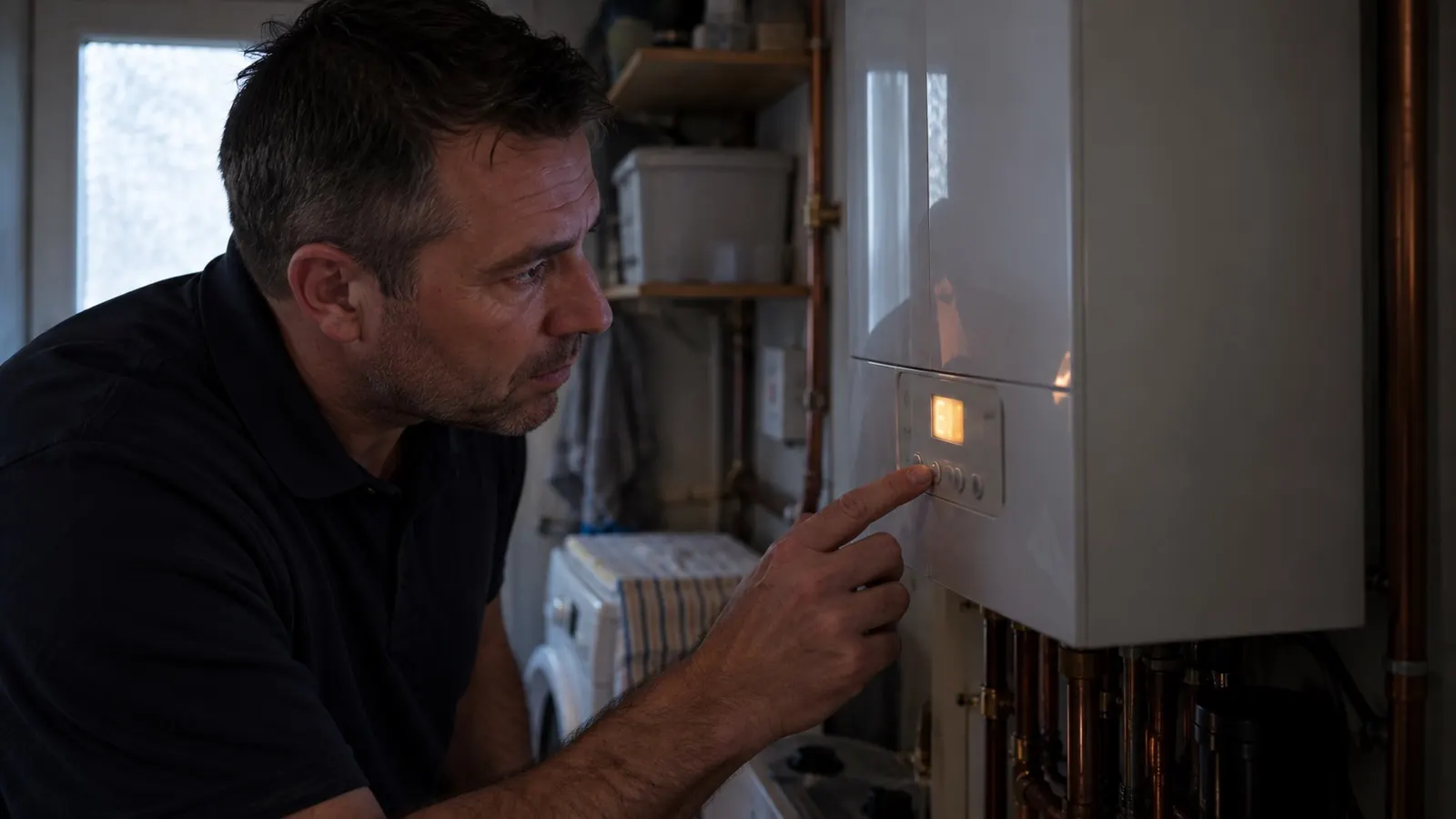
An F1 code on the boiler display looks alarming, but on the brands where it is most common it points to one of the simplest faults there is: not enough water in the heating system. This guide explains what F1 means, how to clear it yourself in a few minutes, and when it is telling you something more serious.
What F1 means
On Ideal boilers, which are very common across Milton Keynes, F1 means low water pressure. Glow-worm boilers use F1 for the same thing. The boiler has detected that the pressure in the sealed heating circuit has dropped below its minimum, so it has stopped firing until the pressure is restored. It is a protection measure, not a breakdown.
The fix is normally quick: top the system back up to around 1.2 bar using the filling loop, reset the boiler, and it should fire again.
One important caveat. Fault codes are not standard across manufacturers. Vaillant uses F22 for low pressure, Worcester Bosch uses its own codes, and on some other brands F1 means something else entirely, such as an ignition or flame fault. If your boiler is not an Ideal or a Glow-worm, check the manual or the sticker inside the front flap before assuming F1 is a pressure problem. If you have a Vaillant showing a pressure fault, our F22 guide covers that code.
How to confirm it is a pressure fault
Look at the pressure gauge. It is either a round dial with a needle on the front or underside of the boiler, or a number on the digital display. If it reads below 1 bar, and often it will be close to zero, the F1 code is a pressure fault and you can deal with it yourself. If the gauge reads normal, somewhere between 1 and 1.5 bar cold, and you are still seeing F1, stop there. Something else is wrong and it needs an engineer.
How to clear an F1 error: step by step
This is a water-side job and safe to do yourself. You are not touching gas, electrics or anything inside the boiler casing.
- Turn the boiler off and let it cool. A cold system gives an accurate reading. Twenty to thirty minutes is enough.
- Find the filling loop. On most boilers it is a short silver braided hose under the boiler with a small valve or tap at each end. On some newer models it is a built-in key or lever instead. The manual shows where.
- Open the valves slowly. Turn both taps a little at a time. You should hear water running into the system.
- Watch the gauge. When the needle reaches around 1.2 bar, close both valves firmly. Do not go past 1.5 bar. Overfilling causes its own problems.
- Turn the boiler back on and reset it. On most Ideal boilers this is the reset button or the mode dial. The F1 code should clear and the boiler should fire.
- Check again later. After the heating has run for an hour, look at the gauge again. It should sit steady. Check once more the next morning when the system is cold.
If you bled any radiators recently, this is almost certainly why the pressure dropped, and one top-up will be the end of it. Our guide to what your boiler pressure should be explains the normal hot and cold readings.
Why the F1 error keeps coming back
A sealed heating system should hold its pressure for months. If you top it up and F1 returns within hours or days, water is leaving the system somewhere. It does not evaporate. There is a leak, even if you cannot see one.
The usual suspects in Milton Keynes homes:
- Radiator valves. A slow weep at a valve nut, often just a damp patch on the carpet or a white crust on the pipe.
- Pipe joints under floors. Common in the 1970s and 1980s grid-square houses, where original copper runs under suspended timber floors and joints have been disturbed by decades of movement.
- The pressure relief valve. If it is passing, water dribbles from a small copper pipe outside. Look for a wet patch on the wall under it.
- The expansion vessel. If it has lost its air charge, pressure swings wildly between hot and cold and the relief valve ends up dumping water every time the heating runs.
- Inside the boiler. A failed seal, a weeping heat exchanger or a leaking automatic air vent. These are only visible with the casing off, which is a Gas Safe registered engineer's job.
Hard water makes some of these more likely here. Milton Keynes has very hard water, and limescale attacks seals and valve seats over time. It is one reason we see more weeping valves and tired relief valves in MK than the boiler's age alone would suggest.
Our guide to why a boiler keeps losing pressure goes through the detective work in more detail. If you cannot find the leak, do not keep topping up indefinitely. Every top-up brings in fresh oxygenated water, which speeds up corrosion inside the radiators and shortens the life of the boiler.
Is an F1 error serious?
A one-off F1 after bleeding radiators or a long spell without checking the gauge is not serious. The boiler did its job by shutting down, and a top-up fixes it.
A recurring F1 is different. The leak itself is rarely dangerous, but a slow leak under a floor causes damp and rot you will not see until it is expensive, and a boiler that is repeatedly run down to zero pressure and refilled is being worn out faster than it should be. Get it looked at rather than living with it.
What a repair visit involves
We cannot tell you what an F1 repair costs before we have seen it, and we would be wary of anyone who says they can. The visit itself is a diagnostic: checking the system pressure hot and cold, the expansion vessel charge, the relief valve discharge pipe, every radiator valve, and any accessible pipework. If the leak is at a valve, it is usually fixed there and then. If it is under a floor or inside the boiler, we will tell you what we have found, what the fix involves and what it will cost before any work starts. A repair inside the casing is priced on the part and the boiler model, so it is quoted once we know what has failed.
When to call a Gas Safe engineer
Book a boiler repair visit if:
- F1 comes back within a few days of topping up.
- The gauge reads normal but the F1 code will not clear.
- You can see or hear water leaking but cannot find the source.
- Water is dripping from the copper pipe outside.
- The pressure jumps from around 1 bar cold to 2.5 bar or more when the heating is on.
- You are not comfortable doing the top-up yourself. There is no shame in that, and we will show you how while we are there.
If you smell gas at any point, that is not an F1 problem. Leave the property and call the National Gas Emergency Service on 0800 111 999.
Frequently asked questions
Can I fix an F1 error myself?
Usually, yes. If the gauge reads low and your boiler is an Ideal or Glow-worm, topping up to around 1.2 bar via the filling loop and resetting will clear it. That is a safe water-side job. Finding the cause of a recurring F1 is an engineer's job.
What is the difference between F1 and F22?
Both mean low water pressure. F1 is the code Ideal and Glow-worm use. F22 is Vaillant's. The fix at the filling loop is the same for both.
My Ideal boiler shows F1 but the pressure gauge looks fine. What now?
Do not keep adding water. A pressure sensor can fail and report low pressure when the system is actually full. That is a diagnosis for a Gas Safe registered engineer, because the sensor sits inside the casing.
How often should I check the pressure?
A glance at the gauge once a month is plenty, plus a check after bleeding any radiators and at the start of the heating season.
Talk to us
We are Gas Safe registered (957816) and cover Milton Keynes and the surrounding towns, including Bletchley and Newport Pagnell. If your F1 code will not stay away, get in touch and we will find where the water is going.
Need Professional Advice?
Our Gas Safe registered engineers are ready to help with all your heating needs. Get a free, no-obligation quote today.