Best Smart Thermostat: How to Choose
TL;DR
Every smart thermostat does the same core job — control heating remotely and on a schedule. The differences that matter are whether it supports modulating control such as OpenTherm, whether it handles hot water and multiple zones, and whether it is compatible with your boiler at all. Savings come from load and weather compensation and an accurate schedule, not from the app.
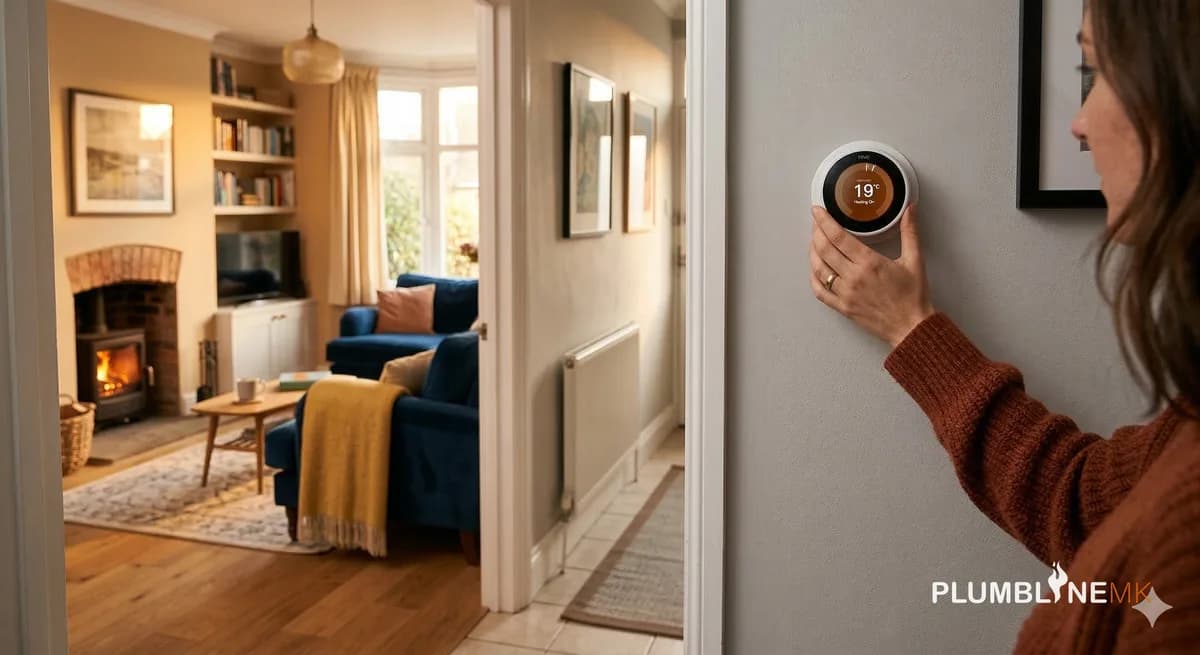
Smart thermostats get sold on the app. The app is the least important part. What determines whether one saves you money is how it talks to your boiler, and most buyers never find out until after it is fitted.
The Feature That Actually Matters
Most heating systems work on simple on-off control. The thermostat calls for heat, the boiler fires at full output, the room overshoots, the thermostat cuts out, the room cools, and the cycle repeats. This is inefficient because a condensing boiler is at its most efficient running gently at a low return temperature — and short full-power bursts are the opposite of that.
Modulating control changes this. Instead of a simple on-off signal, the thermostat tells the boiler how much heat is needed, and the boiler throttles down to match. It runs longer, cooler, and considerably more efficiently. Depending on the manufacturer this is called OpenTherm, or a proprietary equivalent.
If your boiler supports modulating control and you buy a thermostat that only does on-off, you have paid for a smart device and thrown away the main efficiency gain. Check this first — before anything about the app or the styling.
The Second Question: Zones
A single thermostat controls one temperature for the whole house, which is fine for a flat or a small, consistent property. Larger houses — particularly ones where upstairs and downstairs behave very differently, or where rooms sit empty during the day — benefit from zoning.
There are two ways to get it. Proper zoning splits the heating circuit with motorised valves so each zone genuinely gets heat only when it calls for it. Smart radiator valve systems instead control individual radiators wirelessly, which is much easier to retrofit but less precise, and still depends on the boiler being told to fire.
For most existing homes, a smart thermostat plus smart valves in a handful of key rooms is the practical answer. If you want to understand the valve side, our guide to thermostatic radiator valves covers how they work and where they help.
Compatibility Traps
Before buying, work out what you actually have:
- Combi boiler, single zone. The simplest case. Almost anything works; prioritise modulating control.
- System boiler with a hot water cylinder. You need a thermostat that controls hot water as well as heating. Not all do.
- Existing S-plan or Y-plan wiring. Determines how the new controls wire in and whether extra parts are needed.
- Underfloor heating. Needs a controller that understands slow-response systems, or it will overshoot badly.
- No mains supply near the thermostat position. Battery-powered wireless units solve this.
Getting this wrong is the most common reason a smart thermostat disappoints. A device that technically works but cannot control the hot water, or cannot modulate, is a downgrade dressed as an upgrade.
Features Worth Paying For
Weather compensation. The system adjusts flow temperature based on outside conditions, running cooler in mild weather. Genuinely effective, and increasingly built in.
Load compensation. Similar principle, driven by how far the room is from target. Combined with modulation this is where the real savings live.
Learning schedules. Useful if your routine is regular. Less useful if it is not, and some people find the unpredictability irritating enough to switch it off.
Geofencing. Heating responds to whether phones are home. Works well for one or two occupants, less well for a busy family.
Open standards support. If you want the thermostat to work alongside other home automation now or later, check it is not a closed ecosystem.
Features That Are Mostly Marketing
Voice control is pleasant and changes nothing about efficiency. Energy reports are interesting for a fortnight. Colour screens and premium finishes are a matter of taste. None of these affect your bill.
Be sceptical of headline savings claims. The Energy Saving Trust takes a measured view: controls save money when they let you heat less, for less time, at a lower temperature. A thermostat that makes it easy to do that saves money. One that simply makes the same heating pattern more convenient does not.
Installation
Some units are genuinely a competent DIY job — battery-powered wireless models replacing a like-for-like thermostat, in particular. Others involve mains wiring, wiring centres, or boiler terminals, and that is not the place to guess.
Anything involving the boiler's own terminals or a change to the wiring plan should be done by a qualified engineer, and any work on the gas side by someone on the Gas Safe Register. A miswired control can cause the boiler to short-cycle, or to run when it should not, and that will cost more than the installation saved.
Setting It Up Properly
The thermostat is only half the job. Get these right too:
- Lower the boiler's flow temperature. On a condensing boiler, a return temperature below roughly 55°C is what enables condensing operation and the efficiency that comes with it.
- Balance the radiators. An unbalanced system heats the near rooms and starves the far ones regardless of what the thermostat wants.
- Site the thermostat sensibly. Not above a radiator, not in direct sun, not in a draughty hallway.
- Set a realistic schedule. Heating that comes on shortly before you need it, at a temperature you actually want, beats any algorithm.
If your radiators are cold at one end of the house, fix that before blaming the controls — our guides on bleeding radiators and radiator valve types cover the basics.
Common Problems After Fitting
Most post-installation complaints fall into a few categories: the thermostat loses connection to its hub or receiver, the boiler fires when the app says it should not, or the room never reaches target temperature. The first is usually a signal or power issue, the second a wiring or pairing problem, and the third is usually a heating system issue rather than a control one. Our guides on Hive thermostat faults and Nest thermostat faults go through the specific diagnostics.
Frequently Asked Questions
Will a smart thermostat definitely save me money?
Only if it changes your heating behaviour or enables modulation and compensation. Used as a straight replacement with the same schedule and the same flow temperature, the saving is close to zero.
Do I need smart radiator valves as well?
Not necessarily. They help most in homes where some rooms are genuinely unused for long stretches.
Does it work if the internet goes down?
All reputable units keep running their schedule locally. You lose remote control, not heating.
Can I take it with me when I move house?
Usually yes, though you will need to leave a working control behind and check compatibility at the new property.
Which is the best one?
The one that supports modulating control with your boiler, controls hot water if you have a cylinder, and that you will actually use. That is a different answer for different houses.
Getting It Fitted Right
We fit and configure heating controls as part of a properly set-up system — correct flow temperature, balanced radiators, sensible schedule — rather than just hanging a new box on the wall. Call 07805 844 016 or get in touch.
Need Professional Advice?
Our Gas Safe registered engineers are ready to help with all your heating needs. Get a free, no-obligation quote today.