Thermostatic Radiator Valves: Full Guide
TL;DR
A TRV senses the air temperature around its head and closes when the room reaches the set point — the numbers are target temperatures, not heat settings. Setting it higher does not make the radiator hotter, it just keeps the valve open longer. The most common fault is a pin seized under the head after a summer closed, which leaves the radiator permanently cold.
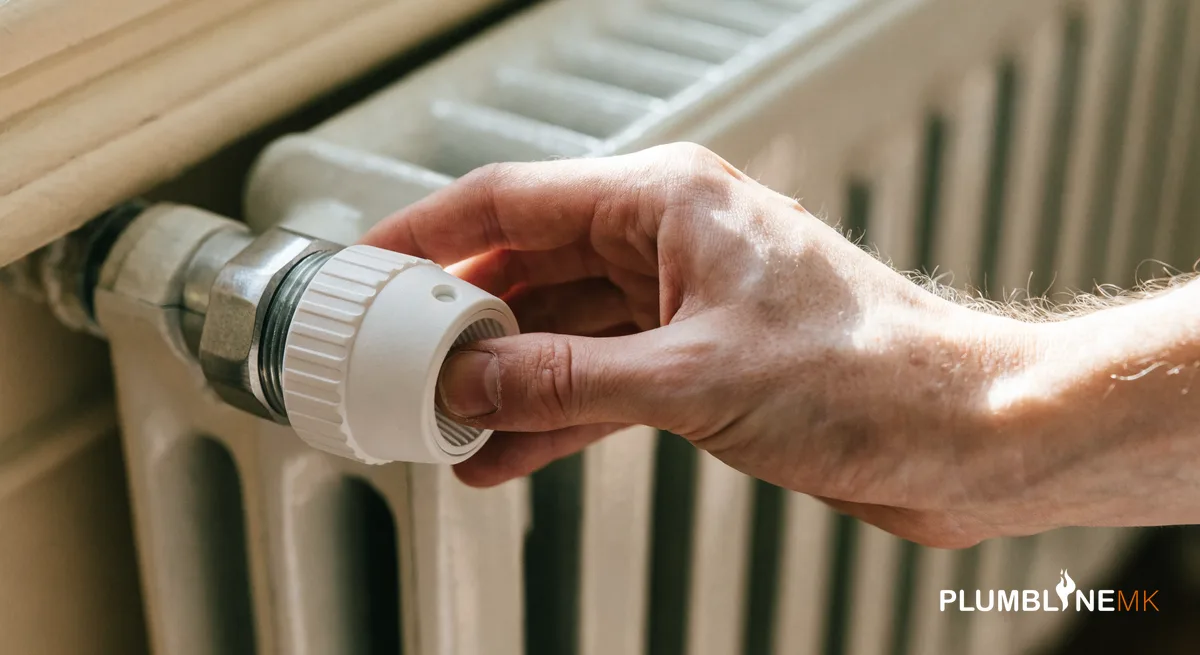
Approved Document L requires thermostatic control on most radiators in new and replacement installations. They are also widely misunderstood, and the misunderstanding costs people money. The number on the dial is not a power setting. It is a target room temperature.
Turning a TRV to 5 does not make the radiator hotter. It makes the valve stay open until the room is warmer than you probably want it.
How It Actually Works
Inside the head is a capsule of wax or liquid that expands as the air around it warms. The expansion pushes a pin down into the valve body, throttling the flow. As the room cools, the capsule contracts and the pin rises, letting flow resume.
It is a mechanical thermostat, self-powered by the room's own heat, sensing the air immediately around the head. That last detail is behind most TRV problems.
What the Numbers Mean
Roughly, on most valves:
- Snowflake / * — frost protection only, around 7°C. Keeps pipes from freezing without heating the room.
- 1 — about 10°C
- 2 — about 15°C
- 3 — about 20°C. The right setting for most living spaces.
- 4 — about 25°C
- 5 — about 28°C, effectively always open
Sensible settings: 3 for living rooms, 2 to 3 for bedrooms, 2 for hallways, 3 to 4 for bathrooms.
The Seized Pin — the Most Common Fault
If a radiator is stone cold while the rest of the house is fine, and bleeding produced no air, check this before anything else.
Over a summer with the valve closed, the pin under the head can stick down with limescale and corrosion. Come autumn the head opens but the pin does not rise, so the valve stays shut.
Freeing it
- Unscrew the collar and pull the head off. Underneath is a small metal pin.
- Press it with a thumb. It should move slightly and spring back.
- If it is stuck, tap it gently with the handle of a screwdriver.
- If that fails, grip it with pliers and work it up and down carefully — gently, because bending or snapping it means replacing the valve body.
- A little penetrating oil helps, but keep it off the rubber seal.
- Once it springs freely, refit the head.
Prevention: open every TRV fully in summer. It costs nothing — the boiler is off — and it stops the pin seizing.
Why One Room Never Warms Up
If a TRV is reading heat that is not representative of the room, it closes too early.
- Behind a curtain — the head sits in a hot pocket between curtain and radiator, reads 25°C, and shuts while the room is at 16.
- Behind a sofa — same effect.
- Above a heat source — near a TV or in direct sun.
- Head pointing upward — rising heat from the radiator itself warms the capsule. Most heads work best horizontal.
If the head cannot be repositioned, a remote-sensor TRV moves the sensing element away from the radiator on a capillary tube.
The Room With the Main Thermostat
Do not fit a TRV in the room where the main house thermostat lives.
The two controls fight: the TRV closes the radiator, the room cools, the wall thermostat calls for heat, the boiler fires with nowhere to send it. That causes short cycling, which wastes gas and shortens boiler life.
That radiator should have a manual valve, left open, so there is always somewhere for heat to go. Our guide to radiator valve types covers the alternatives.
Do They Save Money?
The Energy Saving Trust puts the saving from correctly used room controls in the meaningful range. It works when used properly — by keeping rarely used rooms cooler rather than heating the whole house to the same temperature.
What does not work is turning every TRV down and expecting savings. The boiler still fires; it just has fewer radiators to feed, and may short-cycle. The saving comes from not heating rooms you are not using, alongside a correctly set main thermostat and timer.
Smart TRVs
Motorised heads with app control and per-room schedules. Genuinely useful in a house where rooms are used at different times.
Two practical points: they need batteries, and they control the radiator rather than the boiler. Unless paired with a compatible room thermostat, the boiler may keep firing while every valve is shut.
Frequently Asked Questions
Should I turn TRVs off in unused rooms?
Set them low rather than fully off — around 1, or the frost setting. Fully off risks damp in an unheated room and lets the pin seize.
Why does my TRV make a whistling noise?
Usually flow noise through a valve that is nearly closed, or a system that needs balancing. It can also mean a directional valve fitted the wrong way round.
Can I change the head without draining?
Yes. The head unscrews from the body, so heads including smart ones swap with no water loss. Changing the valve body does need draining.
How long do TRVs last?
The head typically ten to fifteen years; the body longer. If a valve will not control temperature and the pin moves freely, the capsule in the head has failed and a new head fixes it.
If Freeing the Pin Does Not Work
A pin that will not free, or a valve that leaks once disturbed, needs the body replacing — and that means draining down. We cover Milton Keynes and the surrounding area for heating repairs. Get in touch.
Need Professional Advice?
Our Gas Safe registered engineers are ready to help with all your heating needs. Get a free, no-obligation quote today.