Leaking Toilet Cistern: Causes and Fixes
TL;DR
Dry everything, lay kitchen paper around the base and behind the cistern, then flush and watch where it wets first. A leak that appears only when you flush points to the doughnut washer between cistern and pan. A constant leak points to the inlet connection or the fill valve seal. A leak with no obvious source may be condensation rather than a fault.
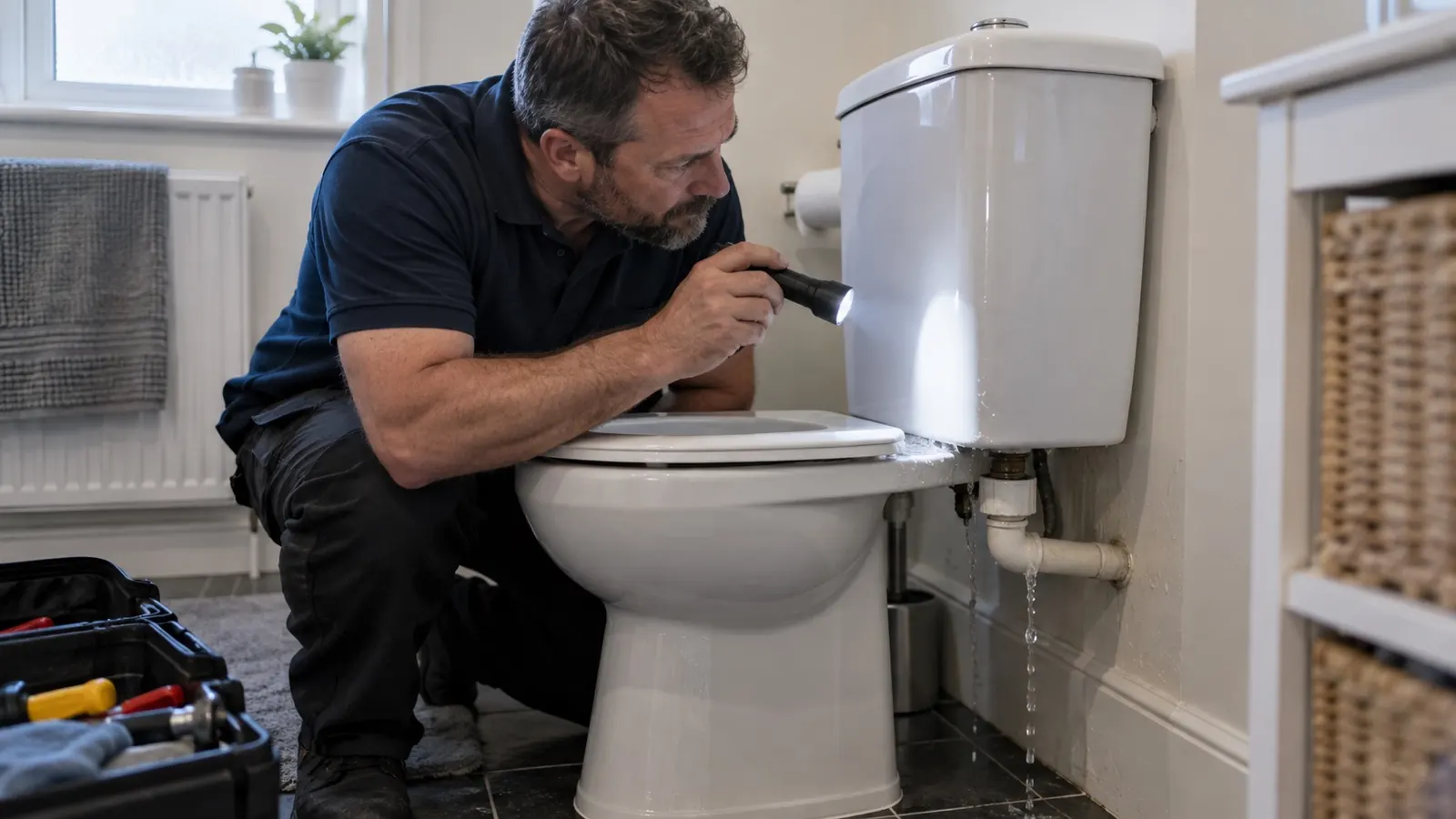
Water on the floor behind the toilet is one of those problems where finding the source takes longer than fixing it. Cisterns have four or five places water can escape from, and gravity carries all of them to the same spot on the floor.
Work through it in order and you will identify it in about ten minutes.
Step 1: Find Out When It Leaks
Dry every surface thoroughly - the cistern, the pan, the pipework and the floor. Then lay sheets of kitchen paper around the base of the pan, under the cistern, and under the supply pipe connection.
Now watch under three conditions:
- Wet without flushing: the supply side. Inlet connection or fill valve.
- Wet only after a flush: the join between cistern and pan. Doughnut washer or fixing bolts.
- Damp everywhere, slowly, with no clear source: likely condensation, not a leak.
That single observation narrows it to one of three repairs.
Cause 1: The Doughnut Washer
On a close-coupled toilet, the cistern sits directly on the pan with a thick rubber washer sandwiched between them - the doughnut. It seals the flush water as it passes into the pan.
The Chartered Institute of Plumbing and Heating Engineering has guidance on cistern maintenance and the parts that wear. Rubber hardens with age. Once it stops compressing properly, a small amount of water escapes with every flush and runs down the back of the pan.
The symptom is unmistakable: dry between flushes, wet within seconds of flushing.
The fix
Isolate the water and flush to empty the cistern, then sponge out what remains. Disconnect the supply. Undo the two bolts holding the cistern to the pan - they run down through the cistern base - and lift the cistern off. Replace the doughnut washer, check the bolt washers while you are there, and refit.
Tighten the bolts evenly, a little at a time on alternating sides. Over-tightening one side cracks ceramic, and a cracked cistern is a replacement rather than a repair.
Cause 2: The Inlet Connection
Where the supply pipe enters the cistern there is a threaded connection with a fibre or rubber washer, secured by a back nut. This is under constant pressure, so when it fails it leaks continuously rather than only on flushing.
The fix is usually just tightening the back nut a fraction. If that does not stop it, isolate the water, undo the connection and replace the washer. Do not wrap the thread in tape as a substitute - these joints seal on the washer face, and tape on the thread stops the joint pulling up square.
Cause 3: A Failed Fill Valve Seal
Some fill valves leak from the body rather than failing to shut off. You will see water weeping from around the valve inside the cistern, or from the shank where it passes through the cistern base.
Replacement fill valves are inexpensive and fit in about twenty minutes. If yours is more than a decade old and leaking, replacing it is usually better value than trying to reseal it.
If instead of leaking outward your toilet is running continuously into the pan, that is a different fault - our guide to a toilet that keeps running covers it.
Cause 4: A Cracked Cistern
Less common, and the one with no cheap fix. Hairline cracks in ceramic are hard to see. Dry the cistern completely and run a finger over the surface, particularly around the fixing bolt holes and near the base where stress concentrates.
A leak that appears at a consistent point on the ceramic with no fitting nearby is a crack. It cannot be reliably sealed - the cistern needs replacing, and matching an older pan can be the harder part of that job.
Cause 5: It Is Not a Leak At All
Water UK notes that escape of water is one of the most common household insurance claims, so it is worth being certain before dismantling. First, rule out condensation. A cistern full of cold mains water in a warm, humid bathroom will sweat, and the water runs down the outside and pools exactly where a leak would.
Tell-tale signs: the whole outside surface is evenly damp rather than wet in one place, it is worse after someone showers, and it is worse in summer.
The cure is ventilation - a working extractor fan makes the biggest difference. Insulated cistern liners exist but are rarely necessary if humidity is under control.
What to Do Straight Away
- Put a towel down and keep the floor dry - laminate and chipboard both swell irreversibly.
- Isolate the supply at the small valve on the pipe if the leak is constant.
- Do not keep tightening bolts hoping it will stop. Ceramic cracks without warning.
- Check the ceiling below if the bathroom is upstairs.
Frequently Asked Questions
Why does my toilet only leak when flushed?
That is the doughnut washer between the cistern and the pan. It is the most common cistern leak and one of the cheaper parts to replace.
Can I use sealant around the base to stop it?
No. Sealing the outside traps water inside the joint, hides the leak while it continues, and rots the floor underneath. Fix the washer instead.
How much water does a leaking cistern waste?
A doughnut leak wastes relatively little because it only escapes during a flush. A leaking inlet connection under constant pressure wastes far more and should be dealt with promptly.
My floor is damp but the toilet seems dry.
Check the pan connector at the back where the pan joins the soil pipe. A perished connector leaks at floor level and is easy to mistake for a cistern problem, especially if the toilet is boxed in.
If You Cannot Trace It
Leaks that only appear intermittently, or that soak a floor with no visible source, usually need the toilet lifting to find. We cover Milton Keynes and the surrounding villages for plumbing repairs. Get in touch and tell us when the water appears - that alone narrows it considerably.
Need Professional Advice?
Our Gas Safe registered engineers are ready to help with all your heating needs. Get a free, no-obligation quote today.