Immersion Heater Not Working? Fixes
TL;DR
Check the switch and the fuse or breaker first, then look for a reset button on the immersion thermostat - a tripped overheat cut-out is the single most common cause and resetting it is free. If it trips again immediately, the thermostat or element has failed and needs replacing. Always isolate the electricity before removing any cover.
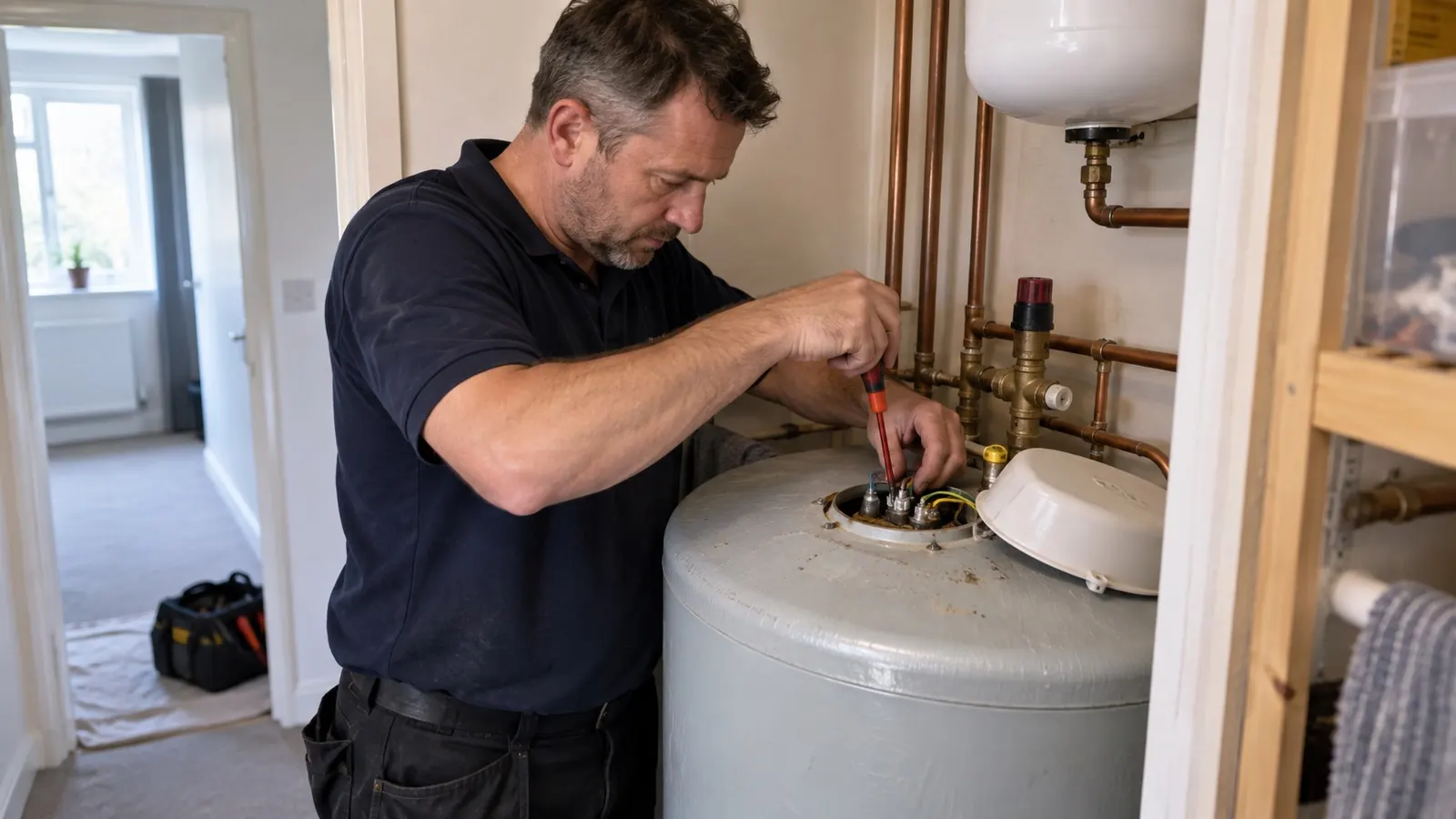
An immersion heater is an electric element sitting inside your hot water cylinder - effectively a very large kettle element. Most homes with a cylinder have one, either as the main way of heating water or as a backup for when the boiler is out of action.
When it stops working the cause is usually one of four things, and two of them cost nothing to fix.
Safety First
An immersion heater runs on a high-current circuit and sits in a tank of water. Before removing any cover:
- Switch it off at the wall switch and at the consumer unit.
- Confirm it is dead before touching any terminal.
- Anything beyond pressing a reset button or replacing a fuse is an electrician's job.
If you are not confident, stop at the checks in the next section and call someone. This is not a good place to learn.
Check 1: The Switch and the Supply
Start with the obvious, because it is often the answer.
- Is the immersion switch on? Many have a neon indicator - if it is unlit, no power is reaching the switch.
- Check the consumer unit for a tripped breaker or a blown fuse on the immersion circuit.
- If there is a timer or an Economy 7 controller, check it is calling for heat. Off-peak systems only heat overnight unless boosted.
A repeatedly tripping breaker means a fault in the element or the wiring - do not keep resetting it.
Check 2: The Thermostat Reset
This is the most common cause and the easiest fix.
Immersion thermostats have an overheat cut-out - a safety device that trips if the water gets too hot, and stays tripped until manually reset. Once it has tripped, the immersion is dead until someone presses the button.
How to reset it
- Isolate the electricity at the consumer unit.
- Remove the plastic cover on top of the immersion boss - usually one central screw.
- Look for a small red or black button, often marked with an arrow. Press it firmly until it clicks.
- Refit the cover, restore power, and switch on.
Give it an hour and check for hot water.
If it trips again straight away, do not keep resetting it. Something is causing genuine overheating - usually a failed thermostat that is no longer switching off, and the cut-out is doing exactly the job it exists to do.
Check 3: A Failed Element
Immersion elements fail, and in hard water areas they fail sooner because limescale coats them - Anglian Water publishes hardness figures by postcode if you want to know what yours is dealing with. Scale insulates the element, so it runs hotter, which shortens its life and trips the cut-out more often.
Symptoms of a failed element:
- Power reaching the immersion but no heat at all
- The breaker tripping the moment the immersion is switched on
- Water heating very slowly compared with how it used to
Replacing an element means draining the cylinder and using an immersion spanner to remove it. The old one often comes out coated in scale. It is a job for someone comfortable with both the plumbing and the electrical side.
Check 4: The Thermostat Setting
If the water is warm but not hot, the thermostat may simply be set low. It sits under the same cover as the reset button, usually with a small dial.
Around 60°C is the sensible setting. Hot enough to control legionella bacteria - the Drinking Water Inspectorate and HSE both treat stored water temperature as a genuine safety matter - but not so hot that it scalds or accelerates scaling. Below about 50°C is not recommended for stored water.
One or Two Elements?
Many cylinders have two immersion heaters - one near the top and one near the bottom, with separate switches often labelled bath and sink, or on and off peak.
- The top element heats only the upper portion, giving a smaller amount of hot water quickly.
- The bottom element heats the whole cylinder, more slowly and more cheaply on an off-peak tariff.
If one works and the other does not, that narrows the fault to the dead one rather than the supply.
When It Is Not the Immersion
If the immersion works but you still have no hot water at the taps, the problem is elsewhere - a failed cylinder thermostat, a stuck motorised valve, or the boiler side of the system. The cylinder itself may also be scaled or, if it is old, corroding internally, which shows as rusty hot water. Our guide to discoloured water covers that.
Frequently Asked Questions
How long should an immersion take to heat a tank?
Roughly an hour to ninety minutes for a typical cylinder from cold with a 3kW element. Much longer than that suggests scaling or a partly failed element.
Is it expensive to run?
Electricity costs considerably more per unit than gas, so heating water by immersion is expensive compared with a boiler. It makes sense as a backup, or overnight on an off-peak tariff.
Why does my immersion keep tripping the breaker?
Almost always a failed element with a breakdown to earth. It needs replacing rather than resetting - repeatedly resetting a breaker on a genuine fault is not safe.
Can I replace an immersion heater myself?
It combines draining a cylinder, a specialist spanner, and a high-current electrical connection. Unless you are competent in both trades, it is not a good DIY job.
If Resetting Has Not Fixed It
A cut-out that trips again immediately means a genuine fault, and continuing to reset it is not safe. We cover Milton Keynes and the surrounding area for hot water and cylinder work. Get in touch and tell us what happened when you pressed the reset.
Need Professional Advice?
Our Gas Safe registered engineers are ready to help with all your heating needs. Get a free, no-obligation quote today.