How to Turn Off Water at the Mains
TL;DR
Turn the internal stopcock clockwise until it stops — usually under the kitchen sink. Then open all the cold taps downstairs to drain the pipes and reduce what is left to escape. If water is anywhere near electrics, switch off the consumer unit before touching anything. If the stopcock is seized, use the external one at the boundary or call your water company.
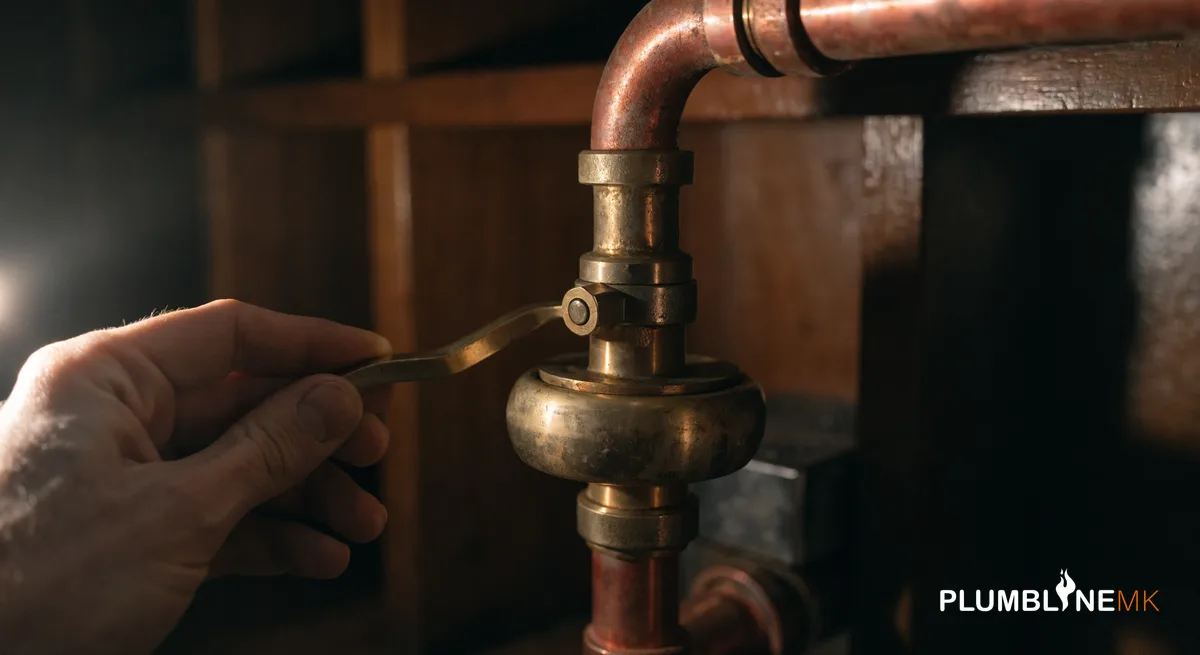
When a pipe bursts, the difference between a wet floor and a ruined ceiling is usually about a minute. This guide is deliberately short, because in the moment you need the sequence rather than the background.
If nothing is currently leaking, read our guide to finding your stopcock now and check it turns. That is the preparation that makes this page unnecessary.
The Sequence
1. Turn the stopcock clockwise
Most internal stopcocks are under the kitchen sink, on the pipe feeding the cold tap. Clockwise closes. A wheel handle may need several turns; a lever type closes with a quarter turn and is off when it sits across the pipe.
2. Open the cold taps downstairs
This drains the pipework quickly, so there is less water left to come out of the leak. Start with the lowest taps in the house. Leave them open.
3. If water is near electrics, isolate the power
Water coming through a ceiling means it is running across whatever is in that void, which usually includes cables and light fittings. If water is anywhere near a socket, a light or the consumer unit itself:
- Switch off at the consumer unit if you can reach it safely and it is dry.
- Do not touch a wet consumer unit or a wet switch. If it is already wet, leave it and call an electrician or the emergency services.
- Do not use ceiling lights in the affected room.
4. Contain it
Water UK member companies treat a burst as an emergency and will attend the external stopcock if you cannot isolate. Meanwhile: buckets under the worst of it. Move anything valuable. If a ceiling is visibly bulging with trapped water, putting a small hole in the lowest point over a bucket releases it in a controlled way — a bulging ceiling that comes down on its own does far more damage.
5. Then call someone
With the water off, the emergency is over and you have time to make a considered call rather than a panicked one.
If the Stopcock Will Not Turn
Common, especially in hard water areas where the spindle has scaled up over years of never being touched.
- Do not force it. Old brass snaps, and a snapped stopcock is a full-bore leak you cannot stop.
- Steady pressure rather than a sudden effort. If there is time, penetrating oil on the spindle and a few minutes helps.
- Go to the external stopcock — a small cover in the path or verge near the boundary. You need a stopcock key to reach it.
- If neither works, call your water company. They can isolate at the boundary and treat a burst as an emergency.
Heating Systems Are Separate
Closing the stopcock stops water entering the property, but a sealed central heating system holds its own water. Radiators and pipework will still contain several tens of litres.
Drainage and water supply requirements for domestic properties are set out in Approved Document H. For a heating leak, close the valves either side of the leaking radiator if you can, and switch the boiler off. A gravity system with a loft tank will keep feeding the leak until the tank empties, so tie up the float valve in the feed and expansion tank to stop it refilling.
After the Water Is Off
- Photograph everything before moving or drying anything. Insurers will want it.
- Contact your insurer early. Most buildings policies cover escape of water and many have a 24-hour helpline.
- Get air moving. Open windows, use fans. Drying quickly limits the secondary damage.
- Do not turn the water back on until the leak is found and fixed. If you need water temporarily, turn it on briefly, fill containers, and turn it off again.
Worth Doing Today
- Find your internal stopcock and check it turns.
- Label it, and tell everyone in the house.
- Find the external one and buy a stopcock key.
- Clear the cupboard so it is reachable without emptying it first.
- Exercise it twice a year so it does not seize.
That is fifteen minutes of preparation against the single most damaging thing that can happen to a house short of a fire.
Frequently Asked Questions
Which way does a stopcock turn to shut off?
Clockwise, the same as a tap. Lever types close with a quarter turn when the lever sits across the pipe.
Will turning off the water damage the boiler?
No, but a combi boiler should be switched off if the water is going to be off for a while, since it needs mains water to operate. A sealed heating system is unaffected.
Can I turn off the external stopcock myself?
It belongs to the water company but householders are generally permitted to operate it in an emergency. Turn it gently — they are often old and stiff.
How do I stop a burst pipe until help arrives?
Water off first, then drain the system through the taps. A temporary repair clamp or even tape wrapped tightly over a small split will slow it, but the pipe still needs replacing properly.
If You Need Someone Now
Once the water is off the situation is contained, but a burst pipe still needs repairing before the supply goes back on. We cover Milton Keynes and the surrounding area for emergency plumbing and can usually attend the same day. Get in touch.
Need Professional Advice?
Our Gas Safe registered engineers are ready to help with all your heating needs. Get a free, no-obligation quote today.