Where Is My Stopcock? How to Find It and Turn Off the Water
TL;DR
Look under the kitchen sink first; that is where most internal stopcocks are, on the pipe feeding the cold tap. After that try the downstairs cloakroom, under the stairs, near the front door in older houses, or the garage. Turn it clockwise to close, then open the downstairs cold taps to drain the pipes. If it will not budge, do not force it: use the external stopcock at the boundary or ring your water company.
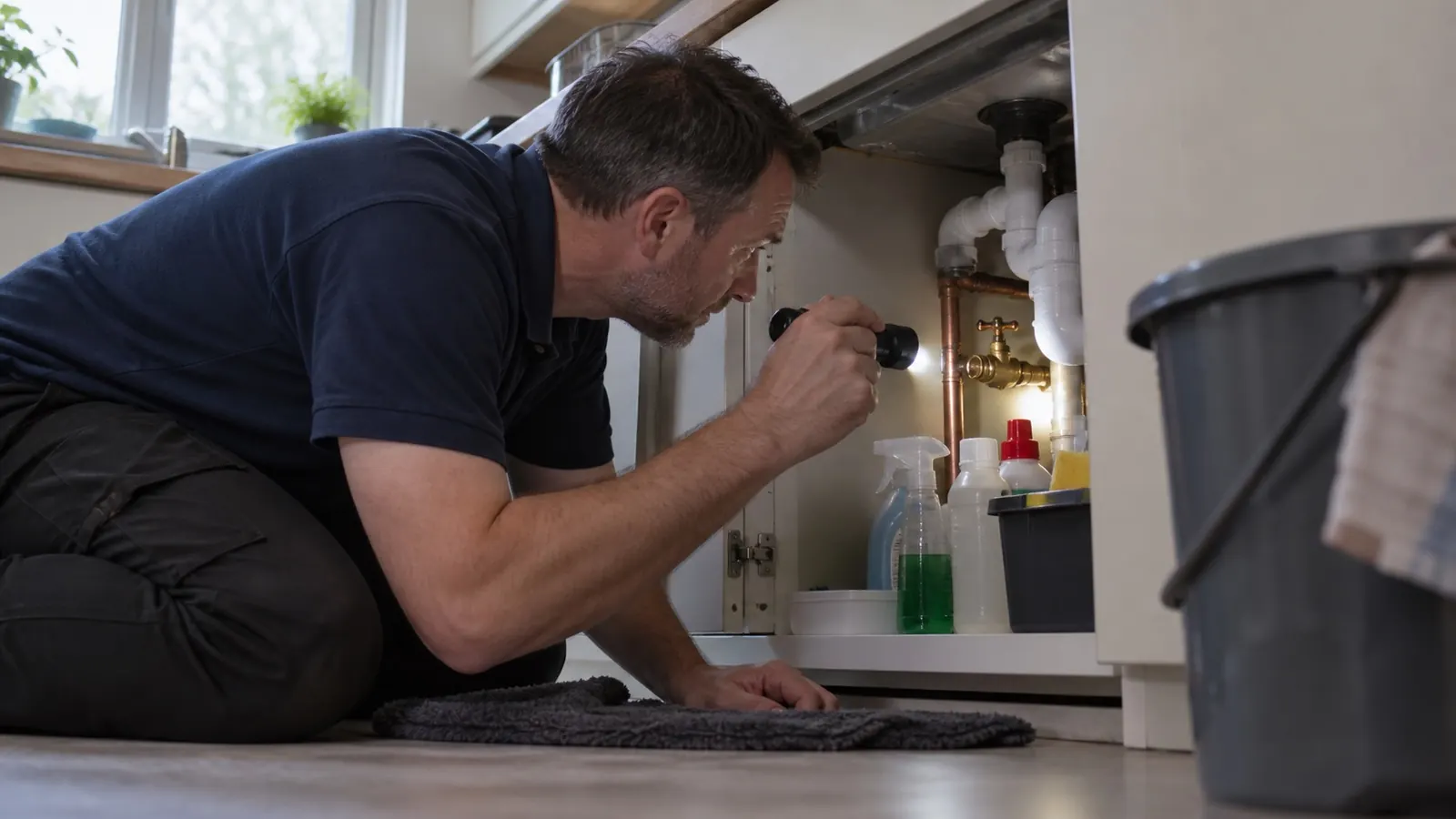
Finding your stopcock takes two minutes and can save thousands of pounds of damage. Almost nobody looks until water is already coming through a ceiling, which is precisely the moment hunting through cupboards is least useful.
Find it now. While you are there, check it actually turns. Then read the rest of this page so that if a pipe ever does go, you know the sequence rather than the theory.
You have two stopcocks
- The internal stopcock is inside the house and shuts off the water to the whole property. This is the one you want in an emergency.
- The external stopcock sits at the boundary, under a small metal or plastic cover in the path, driveway or verge. It belongs to the water company and needs a long-handled key to reach. It is your fallback if the internal one has failed.
Where to look inside
In rough order of likelihood:
- Under the kitchen sink. By far the most common. Look right at the back, behind the cleaning bottles, on the pipe that feeds the cold tap. That tap is fed straight off the main, so the stopcock is nearly always on its pipe.
- Downstairs cloakroom or utility room, on the pipe where it enters the building.
- Under the stairs, in the cupboard.
- Near the front door in older properties, sometimes under a floorboard with a small hatch. Common in the older terraces in Wolverton, Bletchley and Newport Pagnell.
- Garage or outbuilding, where that is where the main comes in. Common on the 1970s and 80s grid-square estates where the garage is integral.
- Under the bath panel in some flats and newer builds.
- A service cupboard in a block of flats, sometimes shared with the neighbours.
You are looking for a brass or chrome valve on the incoming pipe, either with a small wheel-shaped handle like an outside tap, or a lever. In new-build estates it is often a lever valve in a plastic manifold box under the sink.
How to turn it off
- Clockwise closes it. Same as a tap.
- A wheel handle may take several full turns to close.
- A lever closes with a quarter turn, and is off when it sits across the pipe rather than along it.
- Check it has worked. Open the kitchen cold tap. It should run for a moment as the pipe empties, then stop.
If it will not turn
Stopcocks seize because they sit untouched for years and scale builds up around the spindle. In Milton Keynes' very hard water this is the norm rather than the exception, and it is the most common thing we find when we arrive at a flood: a stopcock that has not moved since the house was built.
- Do not force it. Old brass snaps. A snapped stopcock is a full-bore leak you cannot stop, which is worse than the one you started with.
- Firm, steady pressure rather than a sudden heave. If there is time, penetrating oil on the spindle and ten minutes of patience often frees it.
- If it still will not move, go to the external stopcock at the boundary.
- If neither works, ring your water company. In Milton Keynes that is Anglian Water. They can isolate at the boundary and treat a burst as an emergency.
Finding the external stopcock
Look for a small round or rectangular cover in the path, drive or verge near the boundary, often marked with a W or the water company's name. Lift it and you will see a vertical shaft with the valve at the bottom, sometimes a metre down. You need a stopcock key, a long T-shaped tool that costs little from any DIY shop, and it is worth owning one before you need it. Reaching in with a hand or a broom handle rarely works. The chamber is often full of soil or water, so a torch and something to scoop with help.
If you cannot find the cover, the water company can tell you where it is. If you live in a flat, the managing agent will know whether there is a shared riser valve serving several flats and who operates it.
What to do in an actual emergency
This is the sequence. In the moment, the order matters more than the reasons.
- 1. Turn the stopcock clockwise until it stops.
- 2. Open all the cold taps downstairs and leave them open. This drains the pipework quickly, so there is less water left to come out of the leak. Start with the lowest taps in the house.
- 3. If water is near electrics, isolate the power. Water through a ceiling is running over the cables and light fittings in that void. Switch off at the consumer unit if you can reach it safely and it is dry. Do not touch a wet consumer unit or a wet switch; leave it and call an electrician. Do not use the ceiling lights in the affected room.
- 4. Contain it. Buckets under the worst of it, move anything valuable. If a ceiling is bulging with trapped water, a small hole in the lowest point over a bucket lets it out in a controlled way. A bulging ceiling that comes down on its own does far more damage.
- 5. Then call someone. With the water off, the emergency is over and you have time to make a considered call rather than a panicked one. Our emergency plumbing page explains what we can and cannot do on a call-out.
Heating systems are separate
Closing the stopcock stops water entering the property, but a sealed central heating system holds its own water. The radiators and pipework will still contain a lot of it. For a heating leak:
- Close the valves either side of the leaking radiator if you can reach them.
- Switch the boiler off.
- If you have a gravity system with tanks in the loft, the feed tank will keep refilling the leak until it empties. Tie up the float arm in the small feed and expansion tank to stop it.
A combi boiler needs mains water to make hot water, so if the supply is going to be off for a while, switch the boiler off too. Nothing inside the boiler's casing is a DIY job; that is for a Gas Safe registered engineer.
After the water is off
- Photograph everything before you move or dry anything. Your insurer will want it.
- Ring the insurer early. Most buildings policies cover escape of water and many have a 24-hour line.
- Get air moving. Windows open, fans on. Drying quickly limits the secondary damage.
- Do not turn the water back on until the leak is fixed. If you need water in the meantime, turn it on briefly, fill containers, and turn it off again.
Use your water meter to check for a hidden leak
If you have a meter, it is the most reliable leak detector you own, and it finds a leak long before a damp patch appears. Most meters are in the same boundary chamber as the external stopcock, or inside next to the internal one.
- Turn off every tap and appliance. No washing machine mid-cycle, nobody about to flush, no softener regenerating or garden timer about to run.
- Write down the full reading, including the red digits or the numbers after the decimal point. Black digits are whole cubic metres and are what you are billed for; the red ones are the fractions you need for this test.
- Leave it for at least an hour. Overnight is best.
- Read it again. If it has moved and nobody has used water, water is escaping somewhere. The meter only turns when water passes through it.
- Narrow it down. Repeat with the internal stopcock closed. If the meter still creeps, the leak is in the underground supply pipe between the boundary and the house, which is usually the homeowner's responsibility. If it stops, the leak is inside.
The usual hidden culprits are a toilet quietly passing water from cistern to pan, a dripping tap in a spare bathroom, an outside tap, or the supply pipe itself. Many water companies offer help with a first supply-pipe leak and a leak allowance on the bill once it is fixed, so ask before you pay for anything.
Stop it seizing in the first place
- Turn it fully off and back on twice a year. Thirty seconds. It keeps the spindle free and tells you it works before you need it.
- Leave it a quarter turn back from fully open so it cannot bind in the open position.
- Clear the cupboard so you can reach it without emptying it first.
- Label it and tell everyone in the house, including anyone who house-sits.
- If it is seized or in an impossible spot, have it replaced. A modern lever valve in a sensible place is a small job compared with the flood it prevents.
Frequently asked questions
Which way does a stopcock turn to shut off?
Clockwise, the same as a tap. Lever types close with a quarter turn when the lever sits across the pipe.
Does turning off the stopcock stop the heating too?
No. It stops the supply refilling the system, but a sealed heating system holds its own water. For a heating leak, isolate the radiator and switch the boiler off.
Is the external stopcock mine or the water company's?
It belongs to the water company, but householders are generally allowed to operate it in an emergency. Turn it gently; they are often old and stiff.
I live in a flat and cannot find one.
Under the sink first, then any service cupboard on the landing. The managing agent will know. Some blocks have a shared riser valve that the building manager operates.
If your stopcock is seized, missing or somewhere you cannot reach, and you are in Milton Keynes or the surrounding towns, get in touch. Replacing it is a quick job, and it is the cheapest insurance a house can have.
Need Professional Advice?
Our Gas Safe registered engineers are ready to help with all your heating needs. Get a free, no-obligation quote today.