Lukewarm Hot Water but the Heating Works: What It Means on a Cylinder System
TL;DR
If your radiators get hot but the hot water on a cylinder system only runs lukewarm, the cause is usually the cylinder thermostat, the programmer, a sticking motorised valve, a boiler temperature turned down, or a coil furred up with hard water. Check the programmer and the cylinder thermostat setting first. HSE guidance is to store hot water at 60C. Leave the valves, wiring and boiler to a Gas Safe engineer. Plumbline MK can diagnose it in one visit.
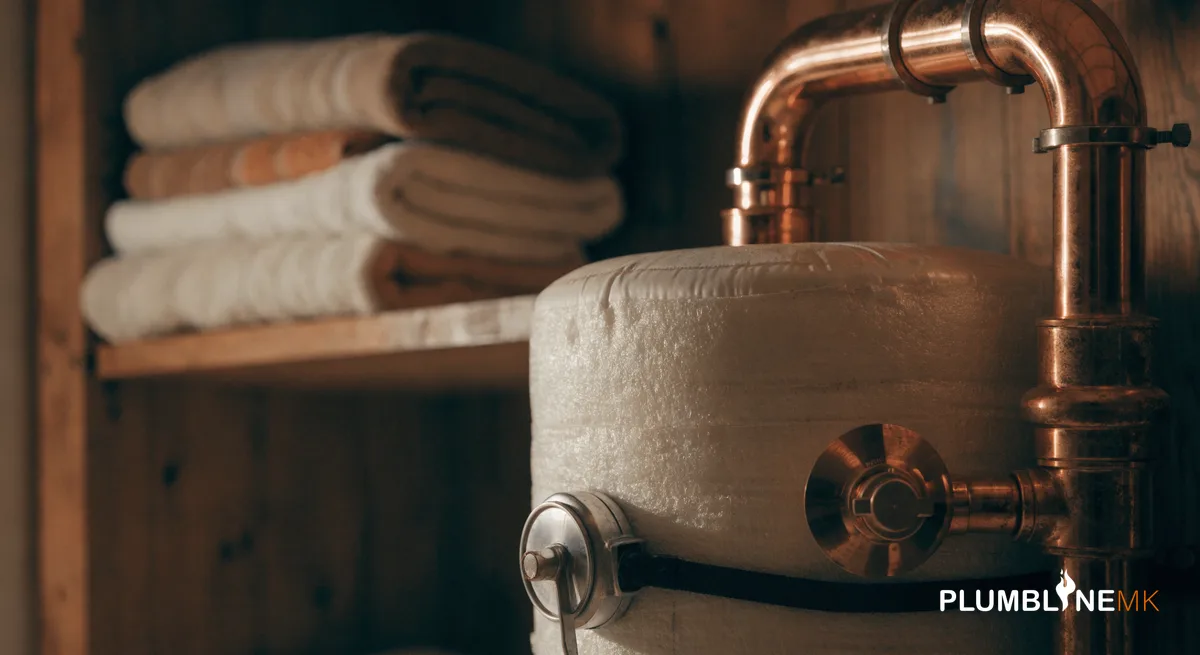
The heating comes on, the radiators are hot, and yet the hot tap never gets past warm. If your home has a hot water cylinder, usually in the airing cupboard, this is one of the most common calls we get in the first cold weeks of autumn. It is a different problem from having no hot water at all, which our no hot water guide covers. Lukewarm water means heat is reaching the cylinder, just not enough of it.
First, which pattern do you have?
Run a hot tap and notice what happens. It narrows things down quickly.
- Lukewarm from the first minute, at every tap. The water in the cylinder is not getting hot enough. The cause is in the controls, the valve, the boiler setting or the coil.
- Hot at first, then lukewarm after a shower or a bath. The cylinder is heating properly but running out. That is about size, reheat time or timing.
- Lukewarm at one tap or one shower only. The cylinder is fine. The problem is at that outlet: a mixer cartridge, a shower valve or a blending valve.
How a cylinder gets its heat
On a cylinder system the boiler does not heat your tap water directly. It heats water that runs through a coil inside the cylinder, and that coil warms the stored water around it. Three things decide whether the boiler sends heat to the coil: the programmer (is hot water switched on at this time?), the cylinder thermostat (is the stored water already hot enough?) and a motorised valve (which opens the route to the cylinder). Most cylinders also have an electric immersion heater as a backup.
When the heating works but the hot water does not, one of those links is usually the weak one.
The causes, from most to least likely
1. The cylinder thermostat is set too low or has failed
The cylinder thermostat is a small dial strapped or fitted to the side of the cylinder. If it has been turned down, perhaps to save energy, the water will only ever reach that temperature. HSE guidance for landlords gives storing hot water at 60C as a control against Legionella bacteria, so a cylinder should not be set to run cooler than that. You can look at the dial without touching anything else. If it reads well below 60, that may be your answer. If it reads 60 and the water is still lukewarm, the thermostat itself may have failed, which is a job for an engineer because it is mains voltage.
2. The programmer is not giving hot water enough time
Many programmers have separate hot water and heating channels. Check that hot water is on, and that its time slots are long enough to heat the whole cylinder before you need it. A clock change, a power cut or a new thermostat can reset these without anyone noticing.
3. The motorised valve is sticking
On a lot of older systems in Milton Keynes a single three-port valve shares the boiler's heat between the radiators and the cylinder. When its motor or spring wears, it can stop part way and send most of the heat to the radiators. You get exactly this symptom: hot radiators, warm water. Two-port valve systems fail in a similar way. This is one of the most common faults we find, and replacing the motor head is often enough, but it needs an engineer.
4. The boiler temperature has been turned down
Lowering the boiler's flow temperature can make a condensing boiler more efficient for the radiators. On a system with a cylinder, though, the boiler has to run hot enough to bring the stored water up to temperature. If someone turned the boiler down recently and the hot water went lukewarm at the same time, that is very likely the link. Turn it back up, or ask us to set the boiler and the cylinder up to work together.
5. The coil is furred up with scale
Anglian Water describes much of its supply area, including Milton Keynes, as hard water. Over years, scale and sludge cut the coil's ability to pass heat into the stored water, so the cylinder heats slowly and never quite gets there. A system clean can help where the boiler side is sludged up; a cylinder with a badly scaled coil is often at the point where replacement makes more sense than repair. Our cylinder replacement guide covers the signs.
6. Air or sludge in the boiler circuit
On older open-vented systems with tanks in the loft, air locks or sludge can starve the coil of flow while the radiators still get enough. The tell is gurgling, cold patches at the bottom of radiators, or a history of the system being drained. A powerflush is sometimes the fix, but only after the valve and controls are ruled out.
A useful test: the immersion heater
If your cylinder has an immersion heater with its own switch, turn it on for an hour or two. If the water then gets properly hot, the cylinder itself is fine and the problem is on the boiler side: the valve, the thermostat, the programmer or the boiler setting. If the water stays lukewarm even with the immersion on, look at the immersion and the cylinder instead. Our immersion heater guide explains what can go wrong there. Remember to turn it off again afterwards, or it will run on electricity alongside the boiler.
When it is only one tap
If the kitchen tap is hot but the bath is lukewarm, the cylinder is not the issue. Approved Document G of the Building Regulations limits the hot water supplied to a bath in new homes to 48C, which is done with a blending valve. A failing blending valve or a worn mixer or shower cartridge can make one outlet run cooler than it should. That is a plumbing repair, not a heating one.
Unvented cylinders: one sign not to ignore
If you have an unvented cylinder, a sealed white or steel cylinder fed straight from the mains, it has safety devices that discharge through a pipe into a small open funnel called a tundish. If you see hot water running through the tundish, turn the water heating off and call an engineer. It means a safety device has opened, and only a qualified engineer should look at it.
What to leave alone
Checking the programmer, looking at the cylinder thermostat dial and switching the immersion on and off are fine. Taking the cover off a motorised valve or a thermostat is not: they are mains electrics. Anything on the boiler beyond its user controls is a job for a Gas Safe registered engineer.
What changes the price of the repair
We do not publish prices, because the fix ranges from a setting to a new cylinder. What decides the cost:
- The part: a valve motor head, a whole valve, a cylinder thermostat or a programmer.
- Whether the system needs draining to change the part.
- The condition of the system: sludge or scale that needs cleaning out.
- Whether the cylinder is worth keeping, or has reached the point where replacement is the better money.
The honest bit
A good share of lukewarm hot water calls turn out to be a setting: a programmer that lost its times, or a cylinder thermostat or boiler turned down. Check those two first. If that is all it is, you have saved yourself a call out. If it is not, a sticking motorised valve is the most likely culprit, and it is usually a straightforward repair.
Getting it looked at
If you are in Milton Keynes or the surrounding towns and the hot water is still lukewarm after those checks, get in touch. Rob or Sam will check the controls, the valve, the boiler settings and the cylinder in one visit and tell you what it needs. See our boiler repair service.
Frequently asked questions
Why are my radiators hot but my hot water only warm?
On a cylinder system it is usually the cylinder thermostat, the hot water timer, a sticking motorised valve, a boiler temperature set too low or a scaled coil inside the cylinder.
What temperature should my hot water cylinder be set to?
HSE guidance gives storing hot water at 60C as a Legionella control. Do not set a cylinder to store water cooler than that to save money.
Is a lukewarm hot water fault an emergency?
Usually not. The exception is an unvented cylinder discharging hot water through its tundish, which needs an engineer straight away.
Sources
Need Professional Advice?
Our Gas Safe registered engineers are ready to help with all your heating needs. Get a free, no-obligation quote today.