Landlord Gas Safety Certificate (CP12): The Rules Explained
TL;DR
If you let a property with gas appliances, the Gas Safety (Installation and Use) Regulations 1998 require a Gas Safe registered engineer to check every landlord-owned appliance and flue at least every 12 months. The record, still called a CP12, goes to existing tenants within 28 days and to new tenants before they move in, and is kept for two years. A gas safety check is not a boiler service. Licensed HMOs must also send it to the council.
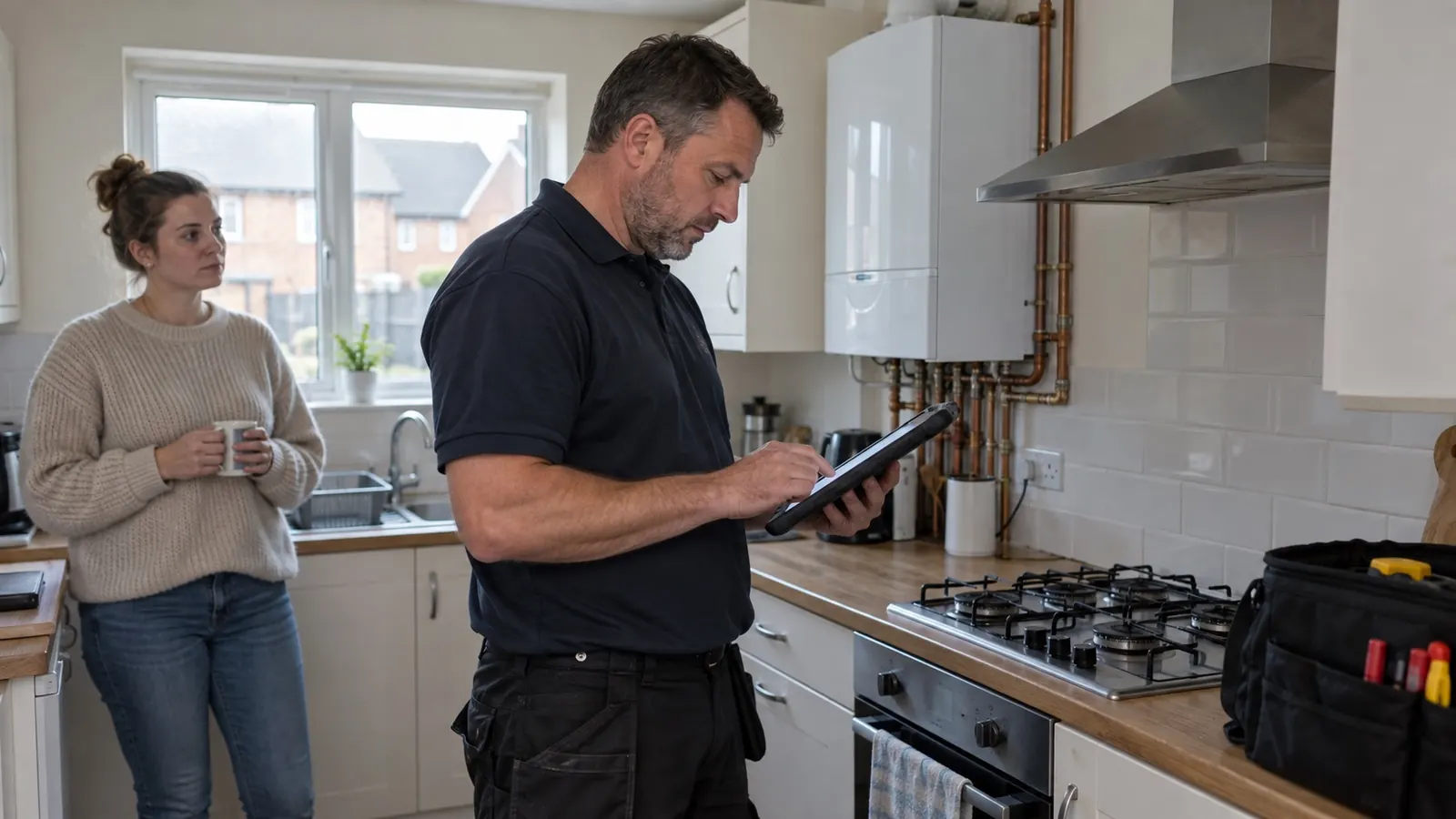
Letting a property carries a legal duty that catches out more landlords than it should: the annual gas safety check. Whether you own one buy-to-let in Bletchley, a few houses across Wolverton and Newport Pagnell, or you manage tenancies for other people as an agent, the responsibility for gas safety sits with the landlord. Getting it wrong is not a paperwork slip. It is a criminal matter enforced by the Health and Safety Executive.
This guide sets out what the certificate is, what the law requires, what the engineer actually checks, how it differs from a boiler service, the deadlines, the penalties, and the extra rules for houses in multiple occupation.
What a gas safety certificate is
The document is properly called a Landlord Gas Safety Record. Most people still call it a CP12, after the old CORGI form number, and the terms mean the same thing. It is the record a Gas Safe registered engineer issues after inspecting the gas appliances, pipework and flues in a let property.
It lists every appliance checked, the results of each test, any defects found and what was done about them, and the engineer's name and Gas Safe registration number. That number is what makes the document valid. A record issued by anyone not on the Gas Safe Register is worthless, and you can check any engineer's registration and the categories of work they are qualified for on the Gas Safe Register website or by asking to see their ID card. Our guide to checking a Gas Safe engineer explains what to look for.
The law: Gas Safety (Installation and Use) Regulations 1998
Regulation 36 places three duties on anyone who lets residential property with gas:
- Maintenance. Keep all gas pipework, appliances and flues you own in a safe condition. This is a continuous duty, not a once-a-year event.
- Annual checks. Have every gas appliance and flue you provide checked for safety at least once every 12 months by a Gas Safe registered engineer.
- Records. Obtain a record of each check, keep it, and give copies to your tenants within the set deadlines.
These duties apply to most residential lettings, including assured shorthold tenancies, room lets, licences and holiday lets. They cover the appliances the landlord provides. A tenant's own gas cooker is generally outside the annual check, but the pipework feeding it remains your responsibility and the engineer will still inspect it. If you are not sure who owns an appliance, treat it as yours to check.
What the engineer checks
A landlord gas safety check is a safety inspection of every gas appliance and flue in the property. For each appliance the engineer will:
- Confirm it is operating at the correct gas pressure and heat input.
- Check that it is burning gas correctly and safely, including combustion checks where the appliance allows.
- Test that the flue is removing products of combustion safely to outside, including flue flow and spillage tests on open-flued appliances.
- Check there is adequate ventilation for the appliance to burn safely.
- Test the safety devices, such as flame supervision and overheat cut-outs.
- Inspect the visible pipework and check the installation is sound.
- Check the appliance is stable, secured and suitable for where it is fitted.
If everything passes, you get the record. If something fails, the engineer classifies the fault, tells you and the tenant, and with permission makes a dangerous appliance safe. More on that below.
A gas safety check is not a boiler service
This is the most common confusion and it matters because the scope is different. A gas safety check covers every gas appliance in the property and asks one question: is it safe? A boiler service is a deeper inspection of the boiler alone: the casing comes off, components are cleaned and inspected, the condensate trap is checked, flue gas readings are taken and the boiler's condition is assessed. An appliance can pass a safety check and still be dirty, inefficient and heading for a breakdown.
The law only requires the safety check. Most manufacturers require an annual service to keep a boiler warranty valid, and most landlords sensibly have both done on the same visit, because the engineer is already there. Our gas safety certificate visits can be combined with a full boiler service.
What the visit costs depends on
We do not put a fixed number on this page because the honest answer is that it varies. The price of a landlord gas safety check is driven by the number of gas appliances in the property, since each one is tested individually, whether a boiler service is being done on the same visit, and whether it is one property or a batch across a portfolio. A house with a boiler, a gas hob and a gas fire takes longer than a flat with a combi alone. Ask for the price up front and ask exactly what it includes. Be wary of a figure that is far below everyone else's, because a proper check takes time.
How often, and the two-month rule
The check must be done at least every 12 months. There is a rule that protects organised landlords: you can have the next check carried out up to two months before the current record expires, and the new record runs for 12 months from the old expiry date rather than from the day of the check. You lose nothing by booking early, so there is no reason to leave it to the last week.
For new tenancies the rule is firm. A valid record must be in place before the tenant moves in. You cannot let someone take occupation and arrange the check afterwards.
Giving the record to tenants and keeping it
- Existing tenants: a copy within 28 days of the check.
- New tenants: a copy before they move in.
- Retention: keep each record for at least two years.
A copy by email is fine if the tenant has agreed to receive documents that way. Keep evidence of when and how you sent it. If a dispute ever arises, or you need to regain possession, proof that the paperwork was served on time is what the court will want to see. Letting agents should build these dates into their compliance calendar for every property they manage.
Penalties for getting it wrong
Breaches of the gas safety regulations are prosecuted under the Health and Safety at Work etc. Act 1974. The courts can impose unlimited fines and, in serious cases, imprisonment. Where a failure to maintain gas safety leads to a death, manslaughter charges are possible. Beyond the criminal side, many landlord insurance policies are void if the statutory checks were not done, which leaves you carrying the full cost of any incident. And a missing or late record has a habit of surfacing at exactly the wrong moment, usually when you are trying to end a tenancy.
If an appliance fails
The engineer classifies unsafe situations using the industry procedure. The two serious categories are Immediately Dangerous and At Risk. With the tenant's permission the engineer will make the appliance safe, which usually means turning it off and labelling it or capping the supply, and will leave a warning notice explaining why.
Your duty is then to have it repaired promptly by a Gas Safe registered engineer. You cannot let the tenant carry on using an appliance that has been condemned, and a tenant left without heating or hot water needs a plan the same day, not next week. Once the repair is done and the appliance passes, a new record is issued.
Carbon monoxide alarms
Separately from the gas regulations, the Smoke and Carbon Monoxide Alarm (England) Regulations require a carbon monoxide alarm in every room of a let property that contains a fixed combustion appliance, gas cookers excepted, and the alarm must be working at the start of each tenancy. Carbon monoxide has no smell and the symptoms mimic flu. Our guide to CO alarm requirements covers placement and testing.
HMOs: the extra layer
A house in multiple occupation is generally one where three or more people from more than one household share a kitchen or bathroom. Larger HMOs, with five or more occupants, need a mandatory licence from Milton Keynes City Council. The annual gas safety duties above still apply in full, and on top of them:
- Licence condition. A current gas safety certificate is a standard condition of an HMO licence, and the council can demand to see it.
- Annual submission. Licensed HMOs must send a copy of the latest certificate to the council each year, not just to tenants.
- More appliances. Shared houses often have more than one kitchen and several appliances, so the check takes longer and the record covers more.
- Active enforcement. HMO standards are inspected, and breaches can bring civil penalties and the loss of the licence alongside the criminal sanctions above.
Homeowners: do you need one?
No. The legal duty is on landlords. An owner-occupier is not required to have an annual gas safety check. It is still a sensible thing to have done, particularly on an older boiler or if you have a gas fire, and it is normally folded into an annual boiler service. If you are selling, a recent record is a useful thing to hand to a buyer, though it is not a legal requirement either.
The honest bit
A gas safety check that takes ten minutes and never touches a flue is not a gas safety check, whatever the paperwork says. Every appliance has to be tested, and on a house with a boiler, a hob and a fire that means the engineer is there for a proper stretch of time. If your current provider is in and out in the time it takes to make a cup of tea, ask what they actually tested. The certificate protects you only if the work behind it was done.
Booking a landlord gas safety check
We are Gas Safe registered (957816) and carry out landlord gas safety checks across Milton Keynes and the surrounding towns, on their own or combined with a boiler service. We confirm the price before the visit, send the record to you and your tenant the same day, and can put your properties on a renewal schedule so nothing lapses. Get in touch to book.
Need Professional Advice?
Our Gas Safe registered engineers are ready to help with all your heating needs. Get a free, no-obligation quote today.