Carbon Monoxide Alarm Rules for Milton Keynes Homes
TL;DR
In England, landlords must provide a working carbon monoxide alarm in every room used as living accommodation that contains a fixed combustion appliance such as a gas boiler or gas fire. Gas cookers do not count. This has applied to private and social lets since 1 October 2022. Owner-occupiers are not legally required to have one but should, because carbon monoxide has no smell and a boiler fault can produce it without warning.
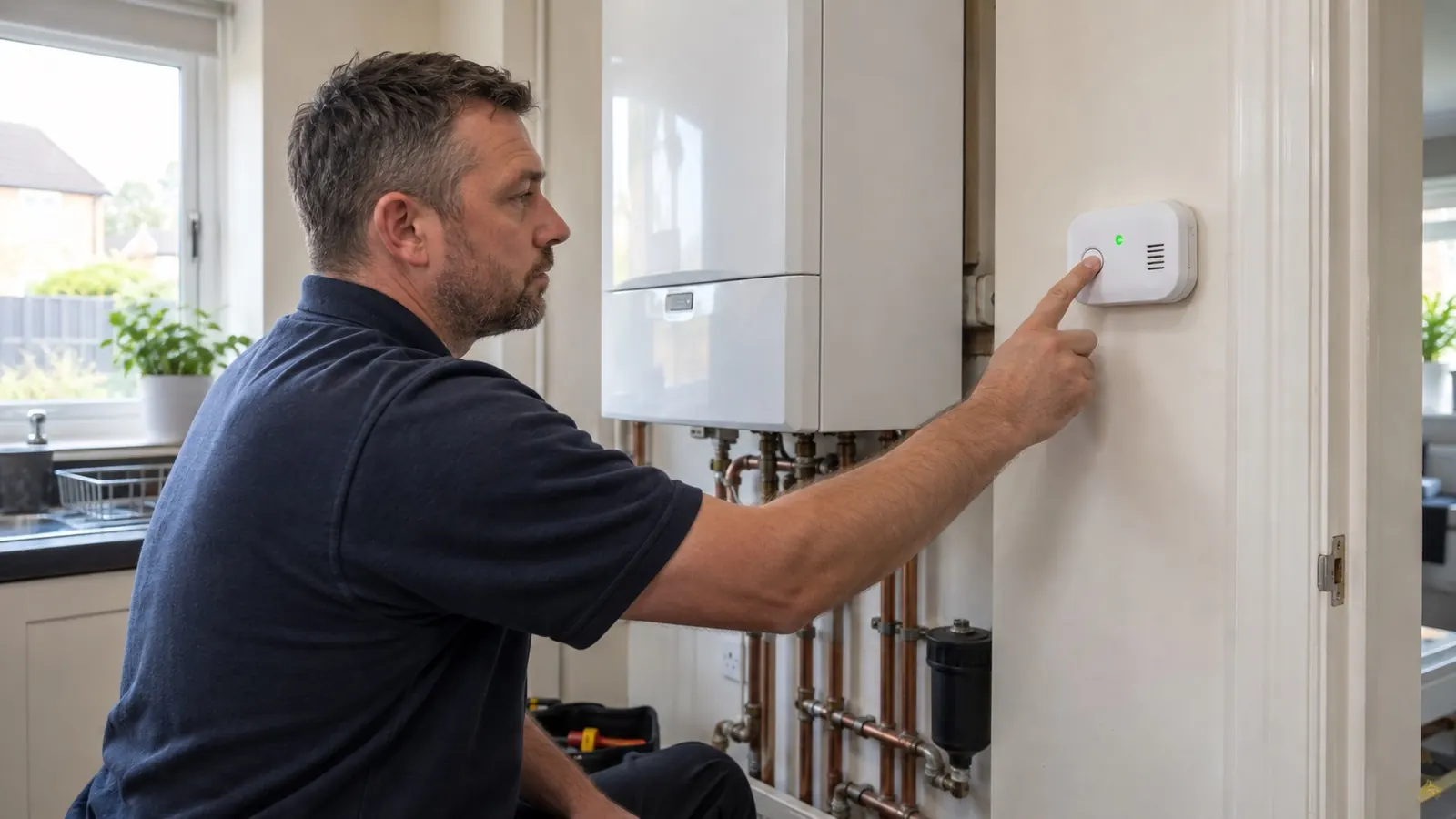
Carbon monoxide is produced when gas, oil, wood or coal does not burn completely. You cannot see it or smell it, and the early symptoms feel like a cold or a hangover. A healthy, serviced boiler produces almost none. A boiler with a blocked flue, a cracked heat exchanger or a fouled burner can. An alarm is the only way to know, which is why the rules below exist and why we fit them even where the law does not insist.
One thing first: an alarm is the last line of defence, not the first. Annual servicing by a Gas Safe registered engineer is what stops the fault happening. The alarm is there for the day something goes wrong between services.
Rented homes in England: it is a legal duty
The Smoke and Carbon Monoxide Alarm (Amendment) Regulations 2022 came into force in England on 1 October 2022. They extended the 2015 rules to cover social landlords as well as private ones, and widened the carbon monoxide requirement. Since that date, landlords in England must:
- Fit a carbon monoxide alarm in any room used as living accommodation that contains a fixed combustion appliance. That means a gas boiler, a gas fire, a wood burner, an oil heater. A gas cooker is specifically excluded.
- Fit at least one smoke alarm on every storey with living accommodation.
- Check the alarms work on the first day of every new tenancy.
- Repair or replace an alarm as soon as reasonably practicable once a tenant reports it faulty.
'Room used as living accommodation' is wider than it sounds. It includes kitchens, hallways, landings and bathrooms, and the government guidance treats a boiler cupboard opening off one of those as part of it. The alarm needs to be in that room, not somewhere on the same floor. A boiler in an airing cupboard with the alarm two rooms away does not meet the requirement.
Enforcement sits with the local housing authority, Milton Keynes City Council here. They can serve a remedial notice and impose a financial penalty on a landlord who does not comply. The regulations set the maximum, and the council publishes its own penalty policy, so check those directly rather than relying on figures quoted on trade websites, including ours.
Two things landlords often miss. First, the alarm rule sits alongside the annual gas safety check, it does not replace it. Second, the regulations do not say the alarm must be mains-wired or of a particular brand, only that it works. A sealed-battery alarm meeting BS EN 50291 is acceptable.
Owner-occupied homes: recommended, not required
There is no law forcing a homeowner to have a CO alarm in an existing house. However, Approved Document J of the Building Regulations now expects a carbon monoxide alarm to be fitted whenever a new or replacement fixed combustion appliance goes in, so if you have a new boiler installed the installer should be fitting or confirming one as part of the job. We do this on every boiler installation. The Gas Safe Register and the HSE both advise an audible alarm in every home with a gas appliance.
An alarm is one of the cheapest safety items you can buy for a house and it lasts for years. There is no sensible argument against having one.
Where to put it so it actually works
Carbon monoxide is very slightly lighter than air and mixes with warm combustion gases, so it spreads through a room rather than pooling on the floor. The placement guidance in BS EN 50292, which is what alarm manufacturers print in their instructions, comes down to this:
- Same room as the appliance, between one and three metres from it horizontally.
- Wall-mounted: at roughly head height, higher than any door or window top, and at least 150 mm below the ceiling.
- Ceiling-mounted: at least 300 mm from any wall.
- Not directly above the appliance, not next to an extractor fan, window or air vent, not in a very steamy spot, and not behind a curtain or inside a cupboard unless the appliance is in that cupboard.
- Boiler in a cupboard: inside the cupboard or immediately outside its door, per the alarm's instructions.
- Bedrooms and rooms you sit in for long periods that share a wall or flue route with an appliance benefit from a second alarm, because that is where you would be asleep or unaware.
For a typical Milton Keynes three-bed with the boiler in the kitchen and a gas fire in the living room, that means two alarms. For a new-build on Broughton or Tattenhoe with the boiler in a utility cupboard and no other gas appliance, one alarm in or just outside that cupboard covers the legal position, and a second near the bedrooms is cheap peace of mind.
Which type to buy
- Look for BS EN 50291-1 printed on the alarm and a recognised test mark such as the BSI Kitemark. That is the residential standard.
- Sealed long-life battery alarms are the sensible default. The battery lasts the life of the unit, nobody can borrow it for the TV remote, and you replace the whole alarm at end of life. The expiry date is printed on the back.
- A digital display is worth having. It shows low-level readings that would not trigger the alarm but tell an engineer something is drifting.
- Mains-wired with battery backup makes sense for landlords doing several properties or where alarms are being interlinked with smoke alarms anyway.
- Avoid unbranded units sold online without a standard number, and 'black spot' colour-change cards, which make no noise and will not wake you.
Press the test button monthly. It checks the electronics and sounder. It does not check the sensor, which is why the alarm has an expiry date.
If the alarm goes off
- Get everyone outside into fresh air straight away, pets included. Do not stop to look for the cause.
- Open doors and windows on the way out if you can do it without delay.
- Call the National Gas Emergency Service on 0800 111 999 from outside. It is free and available 24 hours a day. They will attend, make the supply safe and tell you when it is safe to go back in.
- Anyone with symptoms (headache, dizziness, nausea, confusion, breathlessness) should be seen by a medic. Call 999 if it is serious, and tell them it may be carbon monoxide.
- Do not use the appliance again until a Gas Safe registered engineer has found and fixed the cause. The emergency service makes things safe; they do not repair.
A frank point that does not make it into most safety guides: a good share of the CO alarm call-outs we get in Milton Keynes turn out to be a dying alarm chirping its end-of-life warning, or a genuine but low-level reading from a gas hob left on under a big pan with the window shut. That is fine. You still leave and you still call, because the one time it is a cracked heat exchanger you will not know the difference from inside the house.
Milton Keynes specifics
A lot of the 1970s and 1980s grid-square housing here has the boiler in a kitchen cupboard or a landing airing cupboard, often with a flue running through the loft. Those hidden flue runs are the reason alarm placement matters; you cannot see a joint failing. Older stone houses in Olney, Stony Stratford and the villages more often have an open-flued gas fire or a back boiler behind the fire, which is exactly the type of appliance the regulations were written for. If you are not sure what you have, our gas safety inspection checks the appliance, the flue and the alarm position together.
Landlord checklist
- Alarm in every room with a fixed combustion appliance other than a gas cooker.
- Smoke alarm on every storey.
- Test on day one of each tenancy and record it, ideally with the tenant's signature on the inventory.
- Written procedure for tenant reports of a faulty alarm, and act on them promptly.
- Annual gas safety record (CP12) issued by a Gas Safe registered engineer and given to the tenant within 28 days.
If you want the alarm fitted, checked and noted on the same visit as the gas safety certificate, get in touch. Plumbline MK is Gas Safe registered (957816) and covers Milton Keynes, Newport Pagnell, Bletchley, Wolverton, Stony Stratford and the surrounding towns.
Need Professional Advice?
Our Gas Safe registered engineers are ready to help with all your heating needs. Get a free, no-obligation quote today.