Boiler Flue Regulations Explained
TL;DR
A boiler flue must terminate a set distance from windows, doors, openings, boundaries and other flues, and those distances come from the manufacturer's instructions read alongside the gas safety regulations. Flues in voids need inspection hatches. A flue that does not comply is a genuine safety issue and will be flagged at any gas safety check.
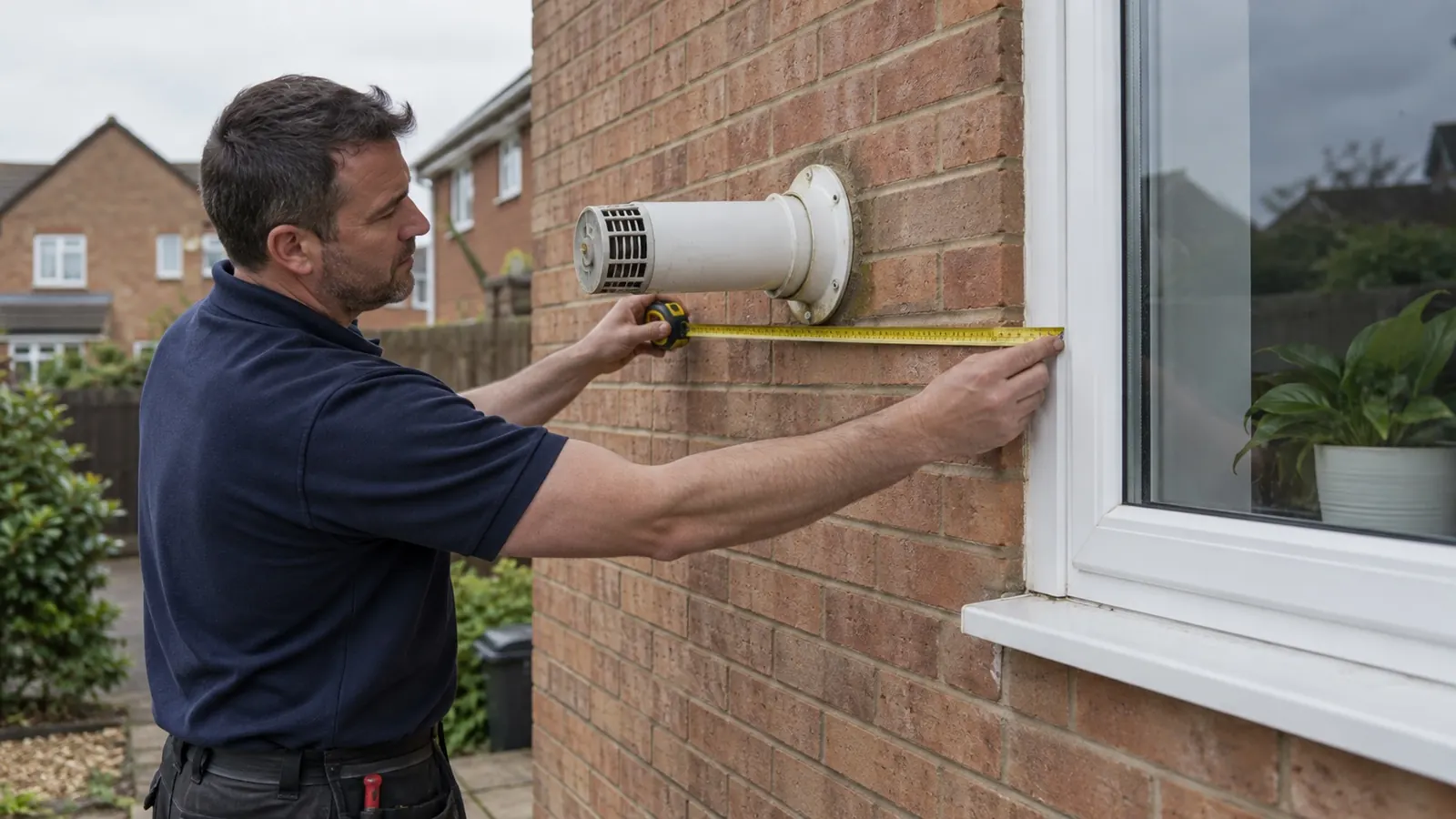
This covers what applies to a normal domestic installation, and why an installer may tell you the position you had in mind is not available.
Where the Rules Come From
Three things stack together:
- The Gas Safety (Installation and Use) Regulations - the legal framework, which requires work to be done by a competent person and installations to be safe.
- The manufacturer's installation instructions - these are legally binding for that appliance, and they set the specific clearances.
- Building Regulations - including requirements around combustion appliances and, since flue gas is a combustion product, ventilation and safety.
The practical upshot: the manufacturer's figures are the ones that apply. There is no single universal set of distances, which is why a flue position that was fine for an old boiler may not be for its replacement.
Typical Clearances
Figures vary by appliance, but a fan-flued domestic condensing boiler typically requires something in the region of:
- 300mm from an opening window, door or air vent - often more directly below one
- 300mm from an internal or external corner
- 300mm below eaves, guttering or a balcony
- 600mm from a surface facing the terminal
- 1,200mm facing another flue terminal
- 300mm above ground or a balcony level
- Clear of the boundary so the plume does not discharge over neighbouring land
Treat these as indicative. Your boiler's manual governs, and some appliances require considerably more in specific directions.
Plume Management
Condensing boilers produce a visible white plume of water vapour. It is harmless, but it is a nuisance if it blows across a neighbour's window, a footpath or a doorway.
Where the ideal flue position would cause that, a plume management kit redirects the discharge - usually a duct taking it up and away from the problem area. It is a common and legitimate solution, and it is better than siting the flue somewhere non-compliant.
Flues in Voids and the Inspection Hatch Rule
This one catches out a lot of flats and houses with boxed-in flues.
Where a flue runs through a void - a ceiling space, a boxed duct, a riser - the engineer must be able to inspect its whole length. If it cannot be seen, they cannot confirm the joints are sound, and a failed joint inside a ceiling void discharges combustion products into the building.
The requirement is inspection hatches at appropriate intervals so the flue can be visually checked. Without them, an engineer is entitled to classify the appliance as At Risk and may refuse to work on it until access is provided.
If you have been told your boiler needs hatches before it can be serviced, that is not an upsell. It is the rule.
Vertical Flues
Where a horizontal flue is not possible - a mid-terrace with no suitable wall, or a flat - the flue can go up through the roof. Requirements include clearance above the roof surface, distance from windows in the roof, and correct weathering where it passes through.
More expensive to install, and the right answer where a horizontal route would be non-compliant.
What Happens at a Gas Safety Check
An engineer will check the terminal position against the manufacturer's figures, look for damage or blockage, verify the flue seals, check for signs of spillage, and confirm the flue is properly supported.
Problems get classified. At Risk means there is a fault that could become dangerous. Immediately Dangerous means it presents a danger now, and the appliance will be disconnected with your permission. Both are recorded.
The Gas Safe Register publishes guidance on what these classifications mean and what happens next.
Landlord Obligations
Landlords must have every gas appliance and flue checked annually by a registered engineer and provide the record to tenants. The flue is explicitly part of that check, not an optional extra. Our guide to landlord gas safety certificates covers the wider duty.
Frequently Asked Questions
Can my flue discharge over my neighbour's garden?
The terminal should not be sited so the plume causes a nuisance across a boundary. Where geometry forces it, a plume management kit is the usual remedy.
My flue was fine for the old boiler. Why not the new one?
Because the clearances come from the manufacturer's instructions for the specific appliance, and they differ. A replacement boiler frequently needs the flue moved or extended.
Do I really need inspection hatches?
If the flue runs through a void and cannot be seen, yes. Without visual access an engineer cannot confirm the joints are sound, and they are entitled to refuse to work on the appliance.
How much clearance does a flue need from a window?
Commonly around 300mm, but it depends on the appliance and the direction. Always check the specific manual rather than a general figure.
If You Are Not Sure Yours Complies
Flue position is one of the first things we check on a service, and it is the thing most likely to complicate a boiler replacement. We cover Milton Keynes and the surrounding area for gas safety checks and boiler installation. Get in touch.
Need Professional Advice?
Our Gas Safe registered engineers are ready to help with all your heating needs. Get a free, no-obligation quote today.