Glow-worm Boiler Problems: The Faults That Keep Coming Back
TL;DR
The Glow-worm faults engineers see most are pressure loss from a flat expansion vessel or a weeping pressure relief valve, a sticking diverter valve giving heating or hot water but not both, ignition lockouts from a worn electrode, pumps seizing after a summer idle, and a scaled plate heat exchanger in hard water areas. Nearly all are repairable. The judgement call is whether to keep repairing a boiler past about twelve years old.
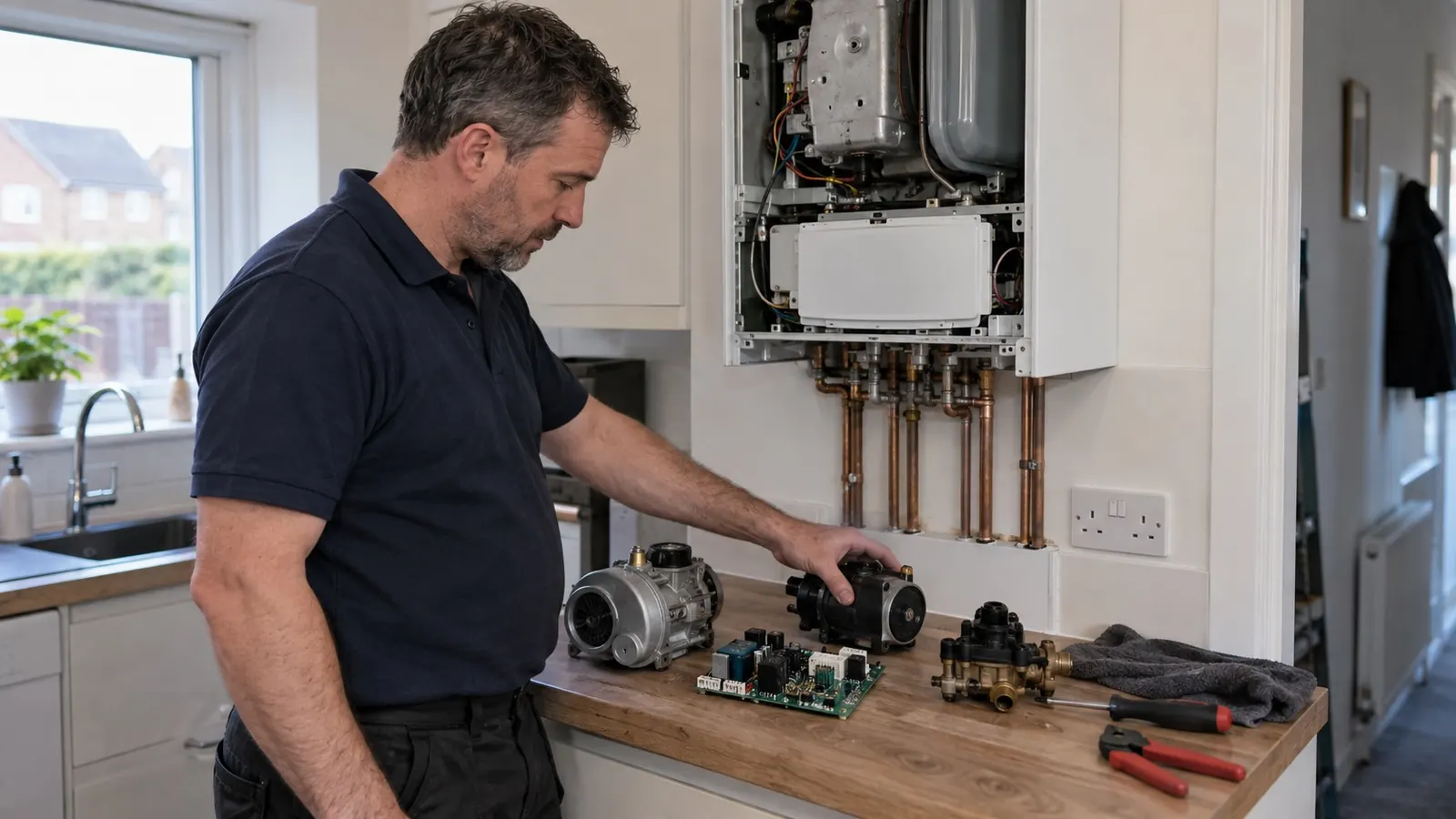
Glow-worm sits at the value end of the market and is part of the Vaillant Group, so it shares a lot of engineering with dearer boilers and parts are easy to get. That is good news if yours has developed a fault. These are the problems we actually attend on Glow-worm boilers, in the order we see them, rather than a list of every code in the manual.
Fault 1: losing pressure
The most common Glow-worm complaint, with three usual causes.
The expansion vessel. Inside the boiler is a vessel with a rubber diaphragm and a charge of air on one side. It soaks up the expansion of the water as it heats. When the air charge is lost, the pressure swings: low when cold, very high when hot, often pushing water out through the relief valve. The tell-tale is a gauge that reads well under 1 bar cold and close to 3 bar hot. Recharging the vessel is often all it needs, and it is a routine service job for an engineer.
The pressure relief valve. Once a relief valve has discharged and picked up a bit of debris on its seat, it tends to weep for good. The symptom is a drip from a small copper pipe outside, and pressure that slowly falls whatever you do. It is a cheap part.
An actual leak somewhere on the system rather than inside the boiler: a radiator valve, a joint under the floor, a towel rail. Our guide to a boiler losing pressure covers how to find it.
Fault 2: diverter valve
The classic combi failure. The diverter valve sends flow either to the radiators or to the plate heat exchanger for hot water. When it sticks, you get one but not the other: hot water fine but radiators cold, or heating fine but the shower lukewarm. It usually starts as an intermittent fault and becomes permanent.
It is repairable, either a new cartridge or the whole valve depending on the model, and it is one of the most common repairs on Glow-worm units between roughly six and ten years old.
Fault 3: ignition lockout
The boiler tries to fire, the fan runs, you hear clicking, then it locks out and shows a fault. Most often the cause is a dirty or worn ignition electrode, which is a cheap part and a routine service item. Other causes are a failed flame sensor, a condensate pipe backing up, or a gas supply problem.
Reset it once. If it locks out again, stop. Repeatedly resetting an ignition fault is not safe and it is not going to fix itself. The diagnosis inside the casing is a Gas Safe registered engineer's job.
Fault 4: pump problems
Two versions of this one.
Seized after summer. The pump has stood still for months and sticks when the heating is asked for in October. The boiler fires, detects no flow and locks out. Sometimes it can be freed, sometimes it needs replacing.
Worn by sludge. A system with no magnetic filter and depleted inhibitor circulates black iron oxide that grinds the pump bearings. You get noise before failure. The fix is a new pump plus dealing with the sludge that killed the old one, otherwise the new pump goes the same way. In a bad case that means a powerflush.
Fault 5: a scaled plate heat exchanger
In a hard water area this is a matter of when, not if. The plate heat exchanger is where a combi transfers heat to the hot water, and scale coats it a little more every year. Symptoms: hot water that starts hot and drifts lukewarm, or takes noticeably longer to come through than it used to.
Sometimes it can be chemically descaled; often it is replaced. A scale reducer on the incoming main slows the recurrence. Anglian Water publishes hardness figures for its area, and around Milton Keynes the water is at the harder end, which is why we see this fault so often here.
Fault 6: frozen or blocked condensate pipe
Not a Glow-worm-specific fault but it catches a lot of them. The condensate pipe carries the acidic water a condensing boiler produces to a drain. If it runs outside and freezes, or a trap silts up, the boiler shuts down, usually on the coldest morning of the year. If the pipe is external and you can reach it safely, thawing it with warm (not boiling) water and resetting the boiler is fine to do yourself. If it keeps happening, the pipe needs re-routing or lagging properly.
What you can safely check before you call
- The pressure gauge: if it is below the green band when cold, top it up with the filling loop to around 1 to 1.5 bar and see whether it holds.
- The condensate pipe: look outside for a frozen or blocked outlet.
- The thermostat and timer: batteries, schedule, and that it is actually calling for heat.
- One reset: then stop if it locks out again.
- Radiators: if the top is cold and the bottom warm, bleed it.
Anything beyond that, including taking the front cover off, is a Gas Safe registered engineer's job by law.
Repair or replace?
A reasonable rule of thumb for a Glow-worm:
- Under 8 years: repair. Parts are available and the boiler has plenty of life left.
- 8 to 12 years: depends on the part. A diverter valve, electrode or relief valve is worth doing. A main heat exchanger usually is not once you set the cost against a new boiler with a long warranty.
- Over 12 years with a major component gone: replacement is usually better value, particularly when you factor in the efficiency and the warranty you get on a new unit.
The other signal is repeat failures. A boiler needing its third repair in two years is telling you something, and an honest engineer will say so rather than keep taking the call-out.
Keeping one healthy
- Annual service by a Gas Safe registered engineer, with the electrode cleaned and the expansion vessel charge checked.
- A magnetic filter fitted and emptied at each service.
- Inhibitor checked and topped up.
- Run the heating for ten minutes once a month in summer so the pump and diverter valve do not seize.
- A scale reducer if you are in a hard water area.
The honest bit
Glow-worm boilers are reasonably reliable for what they cost, but they are less forgiving of a neglected system than a premium boiler. Plenty of the faults above are not really the boiler's fault; they are the result of no filter, no inhibitor and no service for five years. If you buy a value boiler, budget for looking after it.
Frequently asked questions
Are Glow-worm boilers reliable?
Reasonably, for the price. They share engineering with the Vaillant Group's dearer boilers. Maintenance matters more than it does on a premium unit.
Why does mine lose pressure every few weeks?
Most often the expansion vessel has lost its charge or the pressure relief valve is weeping. Both are fixable and neither means a new boiler.
Is a magnetic filter worth fitting to an older boiler?
Yes. It stops circulating debris reaching the pump and heat exchanger, and it is cheap compared with either.
My hot water goes cold after a few minutes.
Usually a scaled plate heat exchanger or a failing diverter valve. Both are common and both are repairable.
If yours needs looking at
Most of these faults can be narrowed down from the symptom before anyone opens the casing. If you are in Milton Keynes or the surrounding towns, we cover boiler repair across the area. Get in touch and describe what it is doing, including any fault code on the display, and we will tell you straight whether it is worth fixing.
Need Professional Advice?
Our Gas Safe registered engineers are ready to help with all your heating needs. Get a free, no-obligation quote today.