Frozen Condensate Pipe? How to Thaw It and Stop Your Boiler Shutting Down This Winter in Milton Keynes
TL;DR
A frozen condensate pipe is the most common reason a modern boiler suddenly shuts down during a Milton Keynes cold snap. You can usually identify it by a specific error code and a gurgling sound, then thaw the pipe safely yourself with warm water and a hot-water bottle before resetting the boiler. Lagging the pipe or rerouting it indoors stops it happening again.
There are few things more unsettling than waking up to a silent, cold house on a frosty Milton Keynes morning, especially when your boiler was working perfectly the night before. The good news is that if your boiler has shut down during a cold snap, the cause is very often a simple one: a frozen condensate pipe. It looks alarming, but in most cases it is something you can sort out yourself in around twenty minutes, without needing to wait for an engineer.
This guide explains what a condensate pipe is, why it freezes during cold weather here in MK, and how to be confident that this is what has happened, rather than a more serious fault. We will walk you through thawing the pipe safely, resetting your boiler, and, crucially, how to stop it freezing again. Keep it calm and methodical and you will most likely have your heating back on before lunch.
What is a condensate pipe, and why does your boiler have one?
Modern boilers are condensing boilers. They are far more efficient than the older models they replaced because they extract extra heat from the flue gases before those gases leave the boiler. As they do this, the water vapour in those gases cools and turns into a small amount of mildly acidic water, known as condensate. That water has to go somewhere, so it drains away through a plastic pipe called the condensate pipe.
The condensate pipe usually connects to your household drainage. In a lot of Milton Keynes homes, particularly in newer estates and converted properties, part or all of that pipe runs outside the building before it reaches a drain or soakaway. It is normally a white or grey plastic pipe, around 21mm or 32mm across, fixed to an external wall. That outdoor section is the weak point. When temperatures drop below freezing, the small amount of water sitting inside can turn to ice and block the pipe completely.
Why condensate pipes freeze during MK cold snaps
Milton Keynes sees plenty of clear, still, frosty nights through the winter, and these are exactly the conditions that cause condensate pipes to freeze. The condensate trickles out in small amounts rather than a steady flow, so it has time to sit in the pipe and freeze, especially overnight when the heating cycles less often and outdoor temperatures are at their lowest.
An external pipe with a small diameter, a long outdoor run, or a section that dips and holds water is the most vulnerable. Pipes that were fitted without insulation are particularly at risk. Once a plug of ice forms, the condensate produced by the boiler has nowhere to go. It backs up inside the boiler, a safety sensor detects the blockage, and the boiler shuts itself down to protect itself. This is the boiler doing its job correctly, not breaking.
How to tell a frozen condensate pipe is the cause
Before you do anything, look for the tell-tale signs. A frozen condensate pipe almost always produces a few recognisable symptoms together. The boiler shuts down and will not restart, often after a cold night. You may hear a gurgling or bubbling sound coming from inside the boiler as it tries and fails to push condensate through the blocked pipe. And, most usefully, your boiler will usually display a specific fault or error code on its screen.
Different brands use different codes, but most point clearly towards a condensate or ignition lockout caused by the blockage. The table below covers the codes you are most likely to see on the common boilers fitted across Milton Keynes.
| Boiler brand | Typical error code | What it usually indicates |
|---|---|---|
| Worcester Bosch | EA or D5 | Flame not detected or condensate blockage causing lockout |
| Vaillant | F28 or F29 | Failed ignition, frequently due to a blocked condensate pipe |
| Baxi | E133 | Gas supply or ignition fault, commonly a frozen condensate |
| Ideal | L2 or F2 | Ignition lockout or flame loss, often from condensate blockage |
If your code matches, you hear that gurgling sound, and it is freezing outside, you can be fairly confident a frozen condensate pipe is to blame. The fix below is safe for a homeowner to carry out. If your symptoms do not match, or you are unsure, it is always fine to call us instead of pressing on.
How to thaw a frozen condensate pipe safely
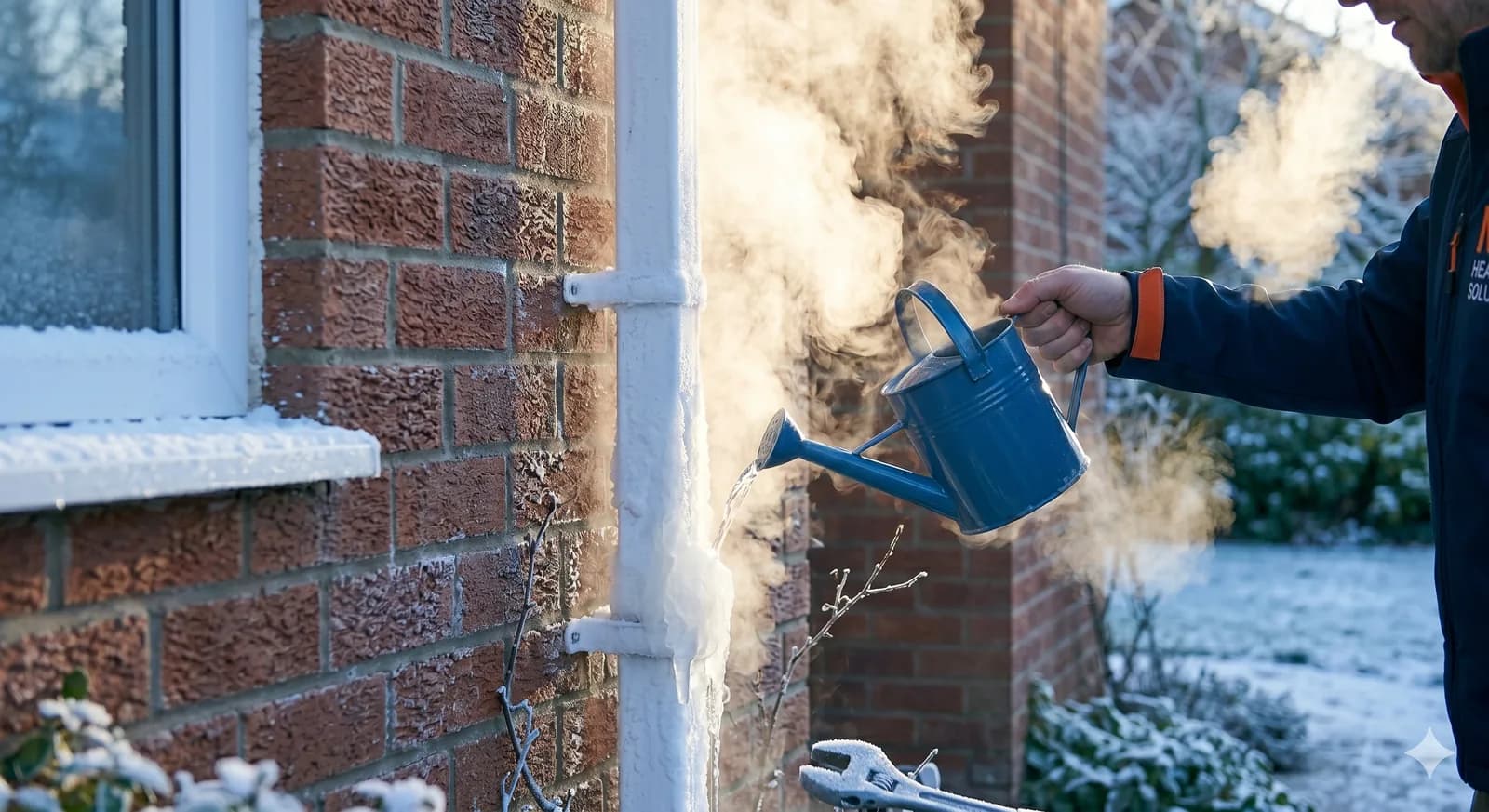
Thawing the pipe is straightforward, but the most important rule is this: never use boiling water. Boiling water can crack the plastic pipe or cause it to warp, turning a free fix into a paid repair. Warm water, around the temperature of a comfortable bath, is all you need.
Work through these steps calmly:
- Find the frozen section. Follow the condensate pipe to where it runs outside. The blockage is usually at the most exposed point, at a bend, at the open end, or wherever the pipe is thinnest.
- Boil the kettle and let it cool, or mix hot and cold water until it is warm but not scalding. A jug or a watering can works well.
- Pour the warm water slowly along the outside of the frozen section, starting at the end nearest the open outlet and working back towards the wall. Refill and repeat as the water cools.
- For stubborn ice, hold a hot-water bottle or a warm cloth against the pipe for a few minutes to soften the blockage, then pour more warm water over it.
- You will often hear the condensate start to flow and drip from the pipe once the ice clears. That is the sign it has worked.
Take care on frosty mornings, as the ground around the pipe may be slippery. Use a stable footing and do not stretch up to reach high pipework. If the frozen section is on a first floor or anywhere you cannot reach safely from the ground, stop and call an engineer rather than risk a fall.
Resetting your boiler afterwards
Once the pipe is clear and condensate is flowing again, reset the boiler. Most boilers have a reset button on the front panel, or you press and hold the reset symbol for a few seconds. The boiler should fire up and the error code should clear. If it does not restart on the first attempt, wait a couple of minutes and try once more. If it still will not run after the pipe is definitely thawed, the cause may be something else, and it is worth a quick call to us.
How to stop the condensate pipe freezing again
Thawing the pipe gets your heating back, but if you do nothing else it may well freeze again on the next cold night. A few simple measures will protect it through the rest of winter:
- Insulate the pipe. Foam pipe lagging from any DIY shop slips over the external pipe and makes a big difference for only a few pounds. Use weatherproof lagging on outdoor sections and tape the joints so no bare pipe is exposed.
- Increase the pipe diameter. A wider external pipe, typically 32mm or more, holds heat better and is far less likely to block with ice. An engineer can upgrade an undersized pipe quickly.
- Reroute the pipe indoors. The most reliable long-term fix is to reroute the condensate so it drains internally wherever possible, keeping it in the warm. This is engineer's work, but it virtually removes the risk of freezing.
- Run your heating sensibly in very cold spells. Keeping the heating ticking over during a hard frost keeps warm condensate moving through the pipe and reduces the chance of a standing freeze.
If you found yourself thawing the pipe this winter, it is well worth arranging one of these permanent fixes before the next cold snap. It turns a recurring nuisance into a one-off job.
When it is more serious than a simple freeze
Most frozen condensate pipes are harmless and easily fixed, but a few situations mean you should stop and call a Gas Safe registered engineer rather than carrying on:
- The pipe is clearly thawed and flowing, but the boiler still will not restart or keeps locking out on the same code.
- You smell gas, in which case turn off the gas at the meter, open windows, do not touch electrical switches, and call the National Gas Emergency line on 0800 111 999 straight away.
- There is water leaking from inside the boiler casing, or you can see staining and damp around the unit.
- The boiler freezes and locks out repeatedly even after lagging, which can point to an undersized or poorly routed pipe that needs upgrading.
- You see error codes that are not in the table above, or the symptoms simply do not match a condensate freeze.
In any of these cases the safe move is to get a professional eye on it. A repeated lockout can sometimes mask a separate fault, and condensate, ignition and flame faults can overlap. If you are not certain, our guides on diagnosing no hot water and on central heating problems can help you narrow things down before you pick up the phone.
Need a hand? Plumbline MK is here for Milton Keynes
If you have thawed the pipe and your boiler still will not play ball, or you would rather not tackle it on a freezing morning, we are happy to help. Plumbline MK is a Gas Safe registered team covering Milton Keynes and the surrounding area, and we handle frozen condensate pipes, lockouts and winter breakdowns day in, day out through the cold months.
Call us on 07805 844 016 or 01908 229 560 for fast, friendly advice or to book a visit. We can clear a stubborn blockage, reset and check your boiler, and fit lagging or reroute the pipe so it does not happen again. For non-urgent enquiries or to arrange a convenient time, see our boiler repair page, our emergency plumbing service, or simply get in touch through our contact page. Stay warm, and do not panic, most winter shutdowns are far simpler to fix than they first appear.
Need Professional Advice?
Our Gas Safe registered engineers are ready to help with all your heating needs. Get a free, no-obligation quote today.