Why Is My Boiler Leaking Water?
TL;DR
A leaking boiler is never normal. Switch it off at the appliance and the fused spur, put a bowl under it, and call a Gas Safe registered engineer. The six usual causes are the pressure relief valve discharging, internal corrosion, a worn pump seal, a loose pipe fitting, a cracked heat exchanger and a failed auto air vent. Where the water shows up is the best clue to which one you have. Do not keep using it.
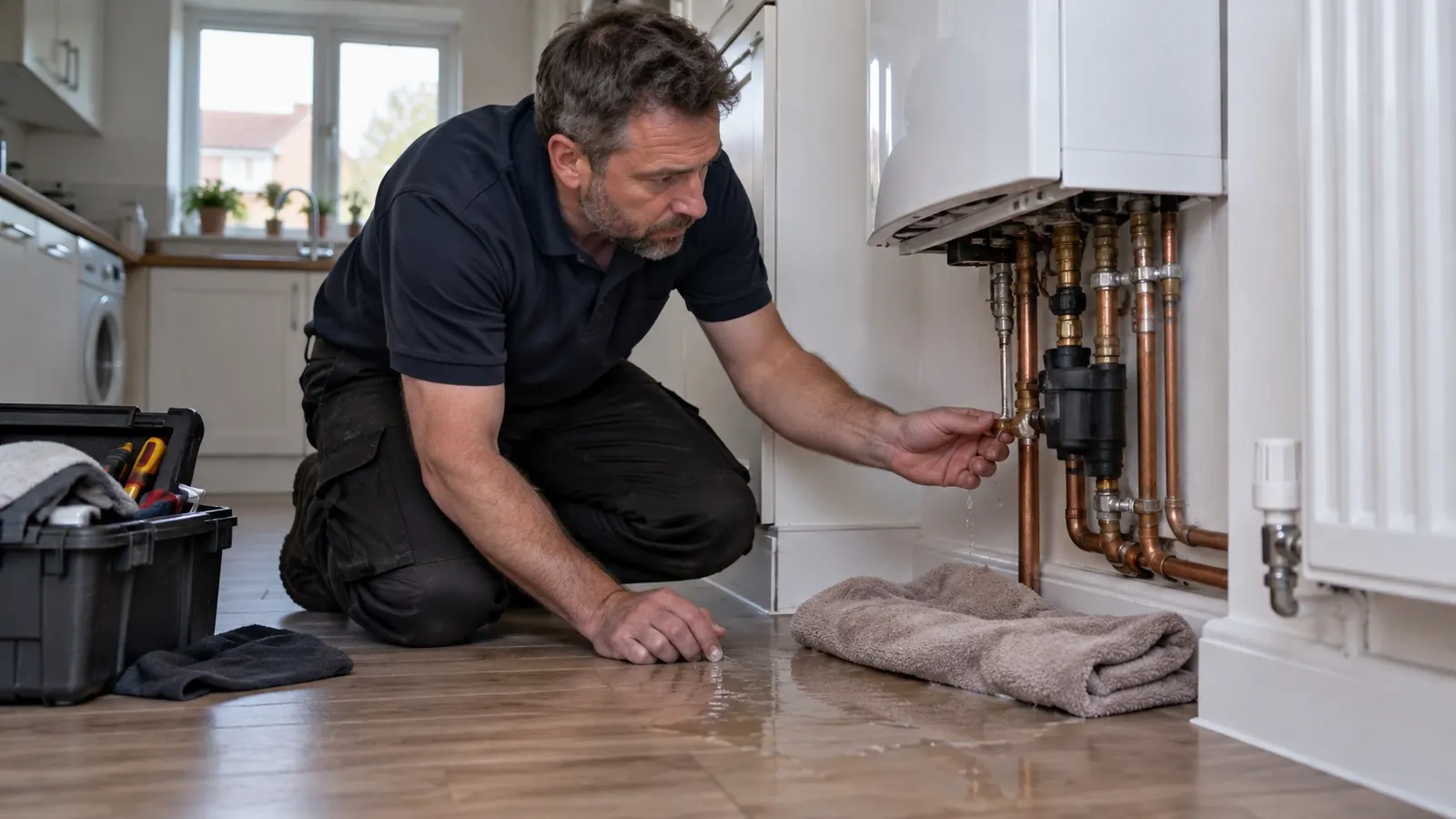
Water under the boiler is unsettling, and it should be. A boiler is a sealed, pressurised system. If water is getting out, something has failed. The question is not whether to act but how quickly and what to do while you wait.
This guide covers the six most common reasons a boiler leaks, what the position of the leak tells you, which ones are serious, what you can safely do yourself, and what a repair quote is made of.
First: make it safe
Water and electricity do not mix, and a boiler has both. Before anything else:
- Switch the boiler off at the appliance, and at the fused spur on the wall if you can reach it safely.
- Isolate the water if you can find the valves on the pipes under the boiler. If you cannot, leave them.
- Catch the water with a bowl or towel, and move anything electrical from underneath.
- Do not turn it back on to see if the leak has stopped. It has not.
- Call a Gas Safe registered engineer. Do not take the casing off yourself. Everything inside the case is a Gas Safe engineer's job.
If you smell gas at any point, leave the property and call the National Gas Emergency number on 0800 111 999.
The six most common causes
Roughly in order from most common to most serious.
- Pressure relief valve discharging. The PRV is a safety valve. When system pressure climbs too high it lets water out, usually through a small copper pipe that ends outside the house. If your pressure gauge is sitting up near 3 bar, the valve is doing its job and the real fault is whatever pushed the pressure up. A PRV that drips at normal pressure has failed and needs replacing, because once it has passed water it rarely reseals properly.
- Internal corrosion. Over the years, sludge and rust eat through internal pipework or the heat exchanger casing. Corrosion leaks are slow, steady and get worse. They are a sign of an ageing boiler or a system that has never been cleaned.
- Worn pump seal. The circulating pump pushes hot water round the radiators. Its seals harden and fail with age. A leak that is clearly coming from the pump body points at the seal or the pump itself.
- Loose pipe fitting. Joints work loose with years of heating and cooling. It is the easiest fix on the list and is also common in the first few weeks after a new installation as everything beds in. If your boiler is under warranty, call the installer.
- Cracked heat exchanger. The heat exchanger is the heart of the boiler. It cracks through limescale or corrosion, and it is the most serious cause here. On an older boiler it often makes a repair uneconomic and a replacement the sensible option.
- Failed automatic air vent. The auto air vent lets trapped air out of the system. When its seal perishes it lets water out too. It is a cheap part and a quick job for an engineer.
Where is the water coming from?
You do not need to open the case to get a good idea. Look at where it is appearing.
- From a copper pipe outside the wall. That is the PRV discharge pipe. Check your pressure gauge. If it reads high, the pressure is the problem, not the pipe. If it is above 3 bar it is worth bleeding a radiator to drop it while you wait for the engineer.
- From underneath the boiler. The one we get asked about most. It does not mean one fault. Water is running down inside the casing from a component higher up and dripping out of the bottom. Pump seal, corroded internal pipe or heat exchanger are the usual candidates. Only an engineer with the case off can say which.
- From a visible pipe joint below the boiler. Usually a loose or failed compression fitting. Do not tighten it yourself with the system pressurised; a slipped olive turns a drip into a flood.
- From the middle of the unit, often with a hissing or gurgling. Heat exchanger. Turn it off and leave it off.
- Only when the heating runs, not the hot water. Points at the heating circuit side: pump, diverter valve seals or a heating connection.
Is a leaking boiler dangerous?
Treat it as urgent rather than panic. The risks are a short circuit on the boiler's electrics, water damage to whatever is underneath, and a leak inside the case making corrosion worse. A leak does not by itself mean a gas or carbon monoxide risk, but a boiler with water inside it has not been checked, and you should not be running it until someone has confirmed it is safe. If you have a carbon monoxide alarm and it sounds, get out and call 0800 111 999.
What is safe to do yourself
- Read the pressure gauge and note the number for the engineer.
- Bleed a radiator to bring high pressure down.
- Top up via the filling loop if the pressure has dropped below 1 bar after the leak and the engineer has asked you to, so you have heating in the meantime. Do not keep topping up a boiler that keeps losing pressure; you are feeding fresh oxygenated water into the system and speeding up corrosion.
- Check the condensate pipe in cold weather. A frozen condensate pipe can back water up and make a boiler look like it is leaking when it is actually just blocked.
Anything beyond that, and anything inside the casing, is a Gas Safe registered engineer's job. Our guide to a boiler losing pressure explains how leaks and pressure drops are tied together.
What a repair quote is made of
We do not put prices on this page because a leak repair is priced on what is actually wrong, and that is only known once the casing is off. What decides the cost:
- Diagnosis time. A leak from a visible joint takes minutes to find. A leak from underneath means stripping the case and running the boiler to trace it.
- The part. An air vent or a fitting is cheap. A pump or a PRV is more. A heat exchanger is the expensive one, and on an older boiler the engineer should tell you straight if it is not worth doing.
- Boiler age and make. Parts for current models are on the van or next-day. Parts for a boiler that went out of production years ago may be hard to get or unavailable, which changes the conversation.
- Damage caused by the leak. If water has reached the PCB or the fan, there may be a second fault to fix.
A good engineer diagnoses, tells you the price before touching anything, and tells you honestly when a repair is throwing money at a boiler that is on its way out. That last part is the bit a sales-led firm tends to skip: if your boiler is over 12 or 15 years old and the heat exchanger has gone, nobody should be selling you a repair. More on how we work on our boiler repair page.
How to stop it happening again
Most leaks are corrosion, limescale and tired seals, and all three build up slowly. An annual service is where an engineer spots early corrosion, checks the PRV and the expansion vessel, and cleans the condensate trap. A magnetic filter on the return pipe catches the iron sludge before it settles in the boiler. And in a hard water area, keeping scale off the heat exchanger is what makes it last.
Frequently asked questions
Can I still use a boiler that is leaking?
No. Turn it off, contain the water and have it inspected. Running it risks electrical faults and makes internal damage worse.
My boiler is leaking from underneath. What is it?
Water is running down inside the case from a higher component, usually the pump seal, an internal pipe or the heat exchanger. It needs the case off to confirm, which is an engineer's job.
Why is water dripping from a pipe outside my house?
That is the pressure relief valve discharge. Either the system pressure is too high or the valve has failed. Check the gauge first.
Is a small drip worth calling someone out for?
Yes. Small drips are how heat exchanger failures and PCB faults start. It is cheaper to fix a seal than what the seal was protecting.
If this is beyond a bowl and a towel and you are in Milton Keynes or the surrounding towns, a Gas Safe registered engineer from Plumbline MK can trace and fix it. Get in touch and tell us where the water is showing.
Need Professional Advice?
Our Gas Safe registered engineers are ready to help with all your heating needs. Get a free, no-obligation quote today.