Winter Heating Checklist for Milton Keynes Homes: 10 Steps
TL;DR
Book the annual boiler service early, in September or October, before the autumn rush. Then run the heating for a full cycle, check the pressure gauge reads between 1 and 1.5 bar, bleed the radiators, lag the condensate pipe and any exposed pipework, test the carbon monoxide alarm, set the thermostat and TRVs for winter, clear around the boiler and flue, and save a Gas Safe engineer's number. About ninety minutes, and it prevents most winter breakdowns.
The worst time to find out your heating has a problem is the first cold evening in October, when you turn the boiler on after six months off and it will not fire. Milton Keynes gets plenty of nights at or below freezing between November and February, and once the first cold snap hits, every heating engineer in MK is booked solid for days.
This checklist takes about ninety minutes, needs almost nothing from the DIY shop, and covers the things that actually cause winter breakdowns. Do it in September or early October and you go into winter knowing the system works.
Step 1: book the annual boiler service now
The most important step, and the one people put off. A service by a Gas Safe registered engineer checks combustion, the flue, the seals, the safety devices and the condensate trap, and picks up worn parts before they fail on a cold night. It also keeps the manufacturer's warranty valid, which nearly all of them require.
Book it for September or October. Once the temperature drops, slots fill within days and a non-urgent service gets pushed behind the breakdowns. If you are due, our boiler servicing page explains what we do and how to book.
Step 2: run the heating before you need it
Turn it on for a full cycle on a mild September day and walk round the house. You are checking that:
- Every radiator heats within twenty to thirty minutes, top and bottom.
- There are no strange noises from the boiler or the pipes: banging, kettling, gurgling.
- Hot water works at the taps.
- The boiler fires without a fault code or a lockout.
- The programmer and thermostat actually make it come on and go off.
A problem found in September gets fixed at a normal appointment. In January it is an emergency.
Step 3: check the boiler pressure
The gauge on the front of the boiler should read between 1 and 1.5 bar when the system is cold.
- Below 1 bar: top it up at the filling loop, slowly, to about 1.2 bar. Your boiler manual shows where the loop is.
- 1 to 1.5 bar: fine, leave it.
- Above 2.5 bar: do not add water. Bleed a radiator slightly to let some out, and if it climbs again, the expansion vessel or filling loop needs an engineer.
A small top-up once a year is normal. Needing to top up every few weeks means a leak somewhere, and a leak dripping through a ceiling in December is a much bigger job than finding it now.
Step 4: bleed the radiators
Air collects over summer and leaves radiators cold at the top. You need a bleed key and a cloth.
- Run the heating for fifteen minutes so the radiators are warm.
- Start at the radiator furthest from the boiler and work back towards it.
- Turn the bleed valve at the top corner anticlockwise with the cloth underneath. Air hisses out, then water. Close it as soon as water flows steadily.
- Check the boiler pressure afterwards and top up if it has dropped.
If the water that comes out is black, the system is sludged. That is worth mentioning at the service, because sludge is what shortens the life of pumps, sensors and heat exchangers, and in MK's hard water it builds faster than most places. A powerflush and a magnetic filter fix it properly.
Step 5: lag the condensate pipe
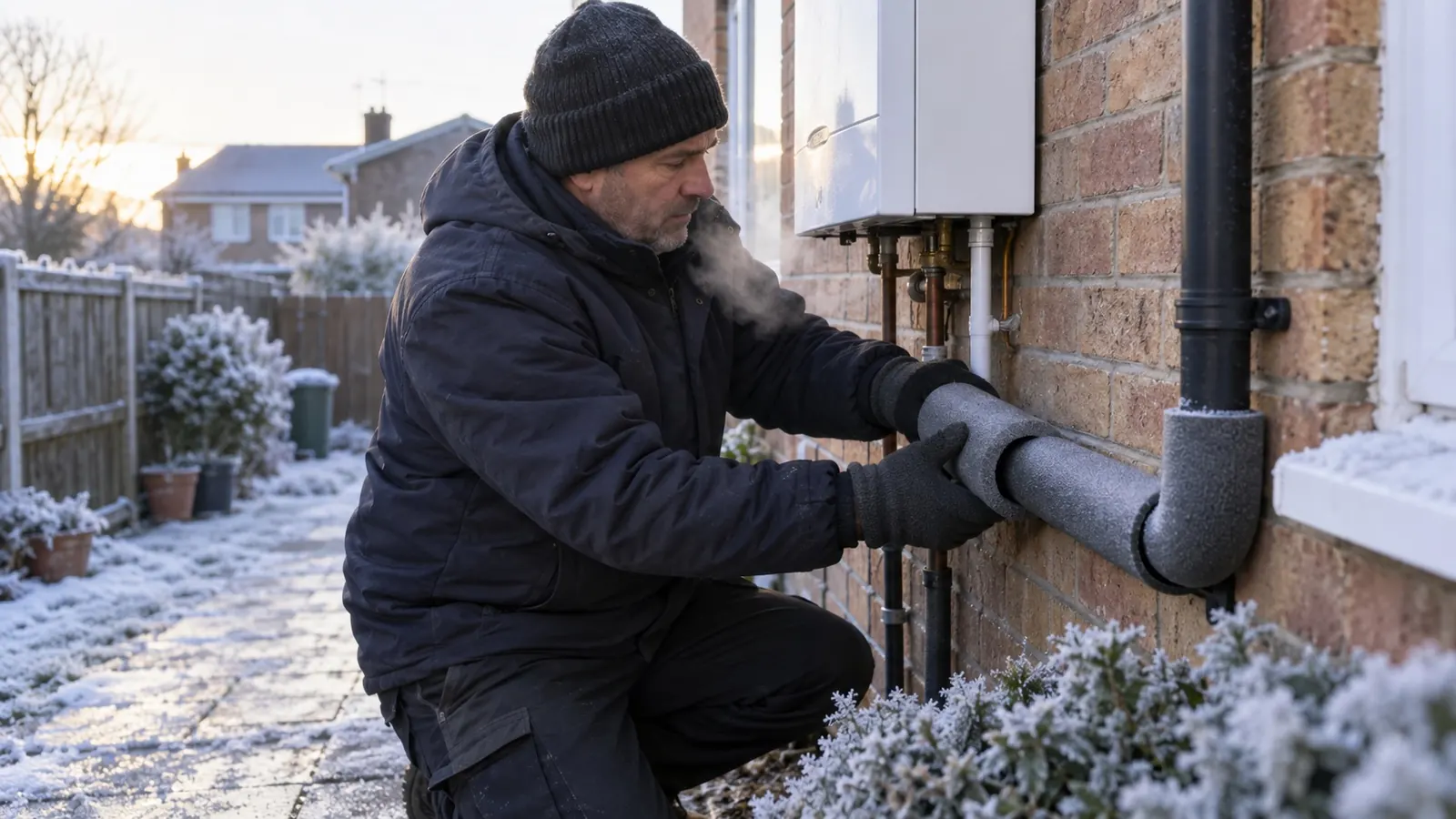
This is the single commonest cause of winter boiler lockouts we attend in Milton Keynes. The condensate pipe is the white plastic pipe that carries acidic water from the boiler to a drain. Where it runs outside or through an unheated garage, it freezes in a cold snap, the boiler cannot drain and it locks out. It happens most where the boiler sits in a garage or on an outside wall.
- Find it: follow the pipe out of the boiler. If any section is outside or in a cold space, it needs insulating.
- Lag it: foam pipe lagging from any DIY shop, pushed on and taped at the joints. Ten minutes. Make sure the outside run falls steadily to the drain with no sags where water can sit.
- If it freezes anyway: pour warm (not boiling) water along the frozen section, wait a few minutes and reset the boiler. Then lag it properly.
Step 6: lag other exposed pipes
Water pipes in the loft, the garage, an outbuilding or along an outside wall can freeze and split in a long cold spell, and the flood arrives when they thaw. Foam lagging on every exposed run, including the pipe to the outside tap and around the stopcock, is cheap insurance. If you have a cold water tank in the loft, the lid should be insulated but the loft floor directly under the tank should not be, so a little warmth from the house reaches it.
Step 7: test the carbon monoxide alarm
Every home with a gas boiler should have a CO alarm made to BS EN 50291, fitted where the manufacturer's instructions say, on the same floor as the boiler and within the recommended distance. Press the test button. It should sound. Check the expiry date on the back, because the sensors have a fixed life and the alarm is useless after it. If it does not respond or is out of date, replace it.
If the alarm ever sounds while the boiler is running, open the doors, get everyone outside, and call the National Gas Emergency Service on 0800 111 999. Do not go back in to look for the cause.
Step 8: set the controls for winter
The controls decide most of what you spend, and getting them right costs nothing.
- Room thermostat: set it to the lowest temperature you are comfortable at and leave it. Turning it up does not heat the house faster. It just runs for longer.
- Schedule: heating on half an hour before you want the house warm, off half an hour before you leave or go to bed. Use a setback temperature overnight rather than switching fully off, so the fabric of the house never goes stone cold.
- TRVs: around 3 in living rooms, 2 to 3 in bedrooms, 1 or the frost setting in rooms you rarely use. Never fully off. And no TRV in the room with the main thermostat.
- Flow temperature: a condensing boiler runs most efficiently when the water coming back from the radiators is cool enough for it to condense. Many boilers are left at the factory setting, which is higher than most homes need. Ask the engineer to check and set it at the service. If the house then takes too long to warm on a very cold day, it can go back up a notch.
- Batteries: if the thermostat or programmer takes them, change them now, not when it goes blank on Christmas Eve.
- Smart thermostat: check the schedule and any geofencing match your winter routine.
Step 9: clear around the boiler and flue
- Move anything stored in front of or beside the boiler. It needs air around it and the engineer needs to get at it.
- Never store paint, solvents or anything flammable in the boiler cupboard.
- Look at the flue terminal outside. Clear leaves, cobwebs and plant growth away from it.
Step 10: know who you will call
If the boiler is out of manufacturer warranty, winter is when it is most likely to fail and hardest to get fixed. Decide now whether a boiler care plan makes sense for you, and either way save a Gas Safe engineer's number in your phone before you need it.
While you are at it: condensation and cold rooms
Two winter complaints where the heating system is often part of the fix.
Condensation on the windows. Warm, damp indoor air touching cold glass. The windows are not faulty. The fixes, cheapest first: lids on pans and washing dried outside or in one room with the door shut and the window cracked, extractor fans run during and for twenty minutes after a shower, trickle vents open, and the heating run at a steady lower temperature rather than short hot blasts. Steady heat keeps the walls and glass warmer, and warm surfaces do not run with water. Turning a spare room's radiator fully off and shutting the door is the reliable way to grow mould in it. Leave a low background heat.
One room that never warms. Usually a TRV pin seized over summer, a radiator that needs bleeding, or a system out of balance so the far radiators are starved. Occasionally the radiator is simply too small for the room, which is common in extensions and loft conversions. All of these are things a service visit can check.
The honest bit
Nine of the ten steps on this list are free and you can do them yourself. Only the service costs money, and it is the one that stops the expensive failures. A firm that sells you a "winter check" separately from a proper annual service is charging you twice for the same visit. Ask for the service, do the rest yourself, and keep the money.
Getting winter-ready with Plumbline MK
Plumbline MK is Gas Safe registered (957816) and covers Milton Keynes, Newport Pagnell, Bletchley, Wolverton, Stony Stratford, Buckingham, Leighton Buzzard, Olney, Woburn Sands, Bedford and Towcester. Book the service early and we will check the pressure, the condensate run, the flue and the controls while we are there. Get in touch to book a September or October slot.
Frequently asked questions
When should I turn the heating on for the first time? Test it in September regardless of the weather, so you have time to fix anything. For actual use, most MK households start when the evenings drop into single figures, usually October.
How do I stop the condensate pipe freezing? Lag every outside section with foam pipe insulation and make sure it runs downhill to the drain with no sags. If it freezes, warm water along the pipe and a reset gets you going.
Should I leave the heating on all the time in very cold weather? A setback overnight, rather than fully off, keeps the house and pipes above the danger point without running the boiler hard all night. If you are going away in freezing weather, leave the heating on low or make sure the boiler's frost protection is active. Most modern boilers have it built in, but it only works if the boiler has power and pressure.
Need Professional Advice?
Our Gas Safe registered engineers are ready to help with all your heating needs. Get a free, no-obligation quote today.