Wet Underfloor Heating With a Combi Boiler in Milton Keynes
TL;DR
A modern combi boiler can run wet underfloor heating in most Milton Keynes homes, provided the UFH has its own manifold with a blending valve to drop the flow temperature, the boiler can modulate low enough for the smallest zone, and the total heat demand sits within its output. It works best in one to three bedroom homes with one bathroom and one or two zones. Larger multi-zone houses usually suit a system boiler and cylinder better.
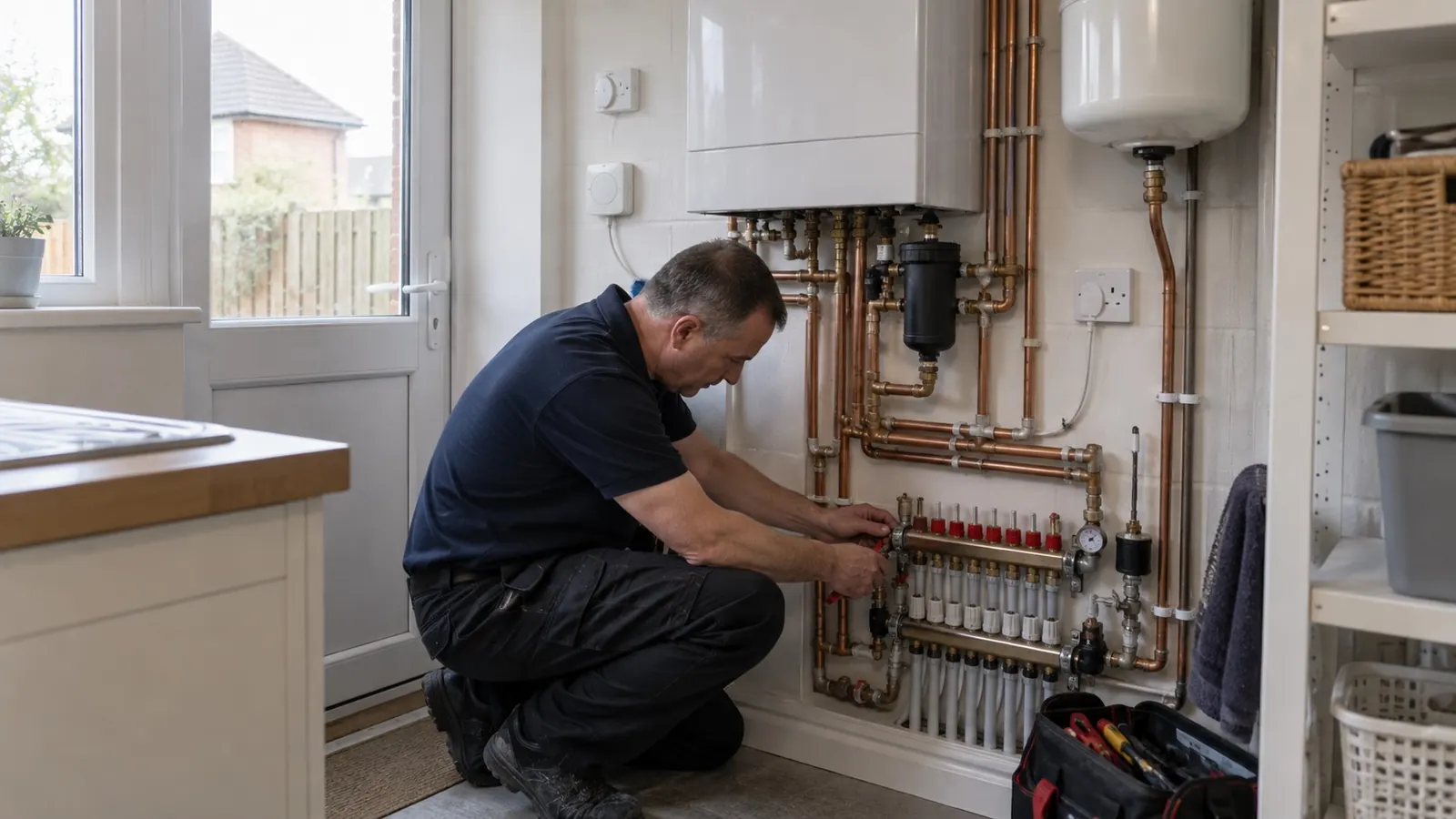
Underfloor heating has gone from a luxury to standard kit on MK new-builds around Tattenhoe, Broughton and Whitehouse, and it is one of the most requested upgrades when people extend a 1970s or 1980s grid-square house or refit an older cottage in Olney or Stony Stratford. The question we get asked most is simple: can my combi run it? The short answer is yes, with limits. This guide explains how the two work together, where it goes wrong, and what a survey needs to look at.
Underfloor heating itself is a wet plumbing job. The boiler that feeds it is a gas appliance, and any work on the boiler, its gas supply or flue is for a Gas Safe registered engineer.
How wet underfloor heating works
Warm water circulates through plastic pipe laid in the floor, either buried in screed, clipped between joists, or set into a low-profile overlay board on top of an existing floor. The water goes in at a much lower temperature than radiators need, and the whole floor becomes a gentle radiator. Because the surface is so large it can heat a room at flow temperatures that would leave a radiator lukewarm.
To run that from a boiler designed for radiator temperatures you need:
- A manifold with a flow meter and valve for each loop of pipe.
- A blending (mixing) valve on the manifold that mixes hot boiler water with cooler return water to bring the flow down to floor temperature. Without it you cook the floor and can crack a screed or damage a timber finish.
- A circulation pump on the manifold, usually built in.
- Zone controls. A thermostat per room driving actuators on the manifold, plus a wiring centre that tells the boiler when any zone wants heat.
This kit is what makes UFH compatible with any wet heating boiler, including a combi. Our main underfloor heating page covers the different floor build-ups.
Where a combi struggles
A combi heats water on demand and has no store. That creates three friction points with UFH that a system boiler with a cylinder does not have.
- Minimum output and short-cycling. UFH wants a low, steady heat input. Many combis cannot turn down low enough for a single small zone, so the boiler fires, satisfies the demand in a couple of minutes, shuts off, and repeats. That wears the fan, diverter valve and PCB early and wastes gas. Newer boilers with a wide modulation range are far better at this than older units. Where the smallest zone is very small, a buffer vessel smooths the demand out.
- Output ceiling. Combis are sized for hot water flow, not heating load, and a big combi in a small house is not a problem. The reverse is. A large ground floor of UFH plus radiators upstairs can exceed what the boiler can deliver on a cold day, and the boiler will simply fall behind.
- Hot water priority. When a tap runs, a combi diverts everything to hot water. UFH is slow to recover, so a household with several long showers back to back will feel the floor cooling. In most homes this is a non-issue. In a busy family house with two bathrooms it is a reason to choose a system boiler and cylinder instead.
Where combi and UFH works well
- One to three bedroom homes with one bathroom
- One or two UFH zones, typically a kitchen-diner extension or a ground floor
- A modern modulating combi, or a new one being fitted at the same time
- A well insulated floor with proper edge insulation, so the heat goes up rather than into the ground
It struggles or fails in:
- Larger houses with extensive UFH across three or more zones and more than one bathroom in regular use
- Older non-modulating combis from the 2000s
- Poorly insulated floors, where the zone never satisfies and the boiler runs all day
- Homes where the combi is already marginal for hot water
Retrofitting into an older MK house brings its own questions about floor height, insulation and door thresholds. Our UFH retrofit guide goes through those.
Sizing: the bit that decides whether it works
The honest point most UFH sellers skip: the boiler does not decide whether the floor gets warm. The heat loss of the room does. A conservatory or a poorly insulated extension can need more heat per square metre than a floor can safely give off, whatever boiler is behind it. Before anyone quotes, someone should calculate the heat loss room by room, check the floor construction and insulation, and confirm the floor finish (tiles, engineered wood, carpet with underlay) will pass enough heat through. If a quote arrives without those numbers, it is a guess.
What decides the installed cost in Milton Keynes
We do not quote per square metre in a blog because two rooms of the same size can be very different jobs. What actually moves the price:
- Floor build-up. Pipe in a new screed on a new-build or extension is the cheapest per square metre. A low-profile overlay board on an existing floor costs more in materials but avoids digging up the floor. Between-joist systems on a suspended timber floor sit in between.
- Number of zones. Each zone adds a loop, a thermostat, an actuator and wiring. A single-zone manifold is a fraction of the work of a four or five zone one.
- Connecting to the existing boiler. Mixing valve, manifold, wiring centre and a new heating zone valve for the radiators, so the two systems can call for heat independently.
- Whether the boiler is up to it. Sometimes the right answer is a new modulating combi at the same time, or a system boiler with a cylinder. That is a separate quote and a separate conversation.
- Controls. Basic dial thermostats through to a wired or wireless multi-zone smart controller.
- Insulation and making good. Floor insulation, edge strip, door trimming, and refitting the floor finish.
One MK-specific point: Anglian Water classes our water as hard, and UFH pipe is narrow. Sludge or scale that would be a nuisance in a radiator can be very hard to clear from a floor loop. Every UFH system here should have inhibitor dosed on commissioning and a magnetic filter on the boiler return. Our UFH maintenance in hard water guide covers the upkeep.
What you can do yourself
- Set the room thermostats and learn the schedule
- Test each zone by setting a different temperature and feeling the floor after an hour or two
- Read the flow meters on the manifold so you know what normal looks like
Leave to a heating engineer: sizing the boiler against the heat demand, installing or altering the manifold, setting the blending valve temperature, connecting the UFH to the boiler, and anything on the boiler itself.
Frequently asked questions
Can a combi boiler power underfloor heating?
Yes, in most Milton Keynes homes, provided the UFH has a manifold with a blending valve and the boiler's output and modulation suit the zones. It works best in smaller homes with one bathroom; large multi-zone houses do better with a system boiler.
Do I need a new boiler to add underfloor heating?
Not necessarily. A modulating combi from the last several years usually copes with UFH alongside radiators in an average house. Older non-modulating combis often short-cycle. A survey will tell you.
Is underfloor heating cheaper to run than radiators?
It can be, because it runs at lower flow temperatures where a condensing boiler is most efficient, and the gain is largest in well insulated modern homes. In an older house with poor floor insulation the running-cost advantage is small, and the comfort is the reason to do it. Our radiators vs underfloor heating comparison goes deeper.
Can I run UFH downstairs and radiators upstairs from one combi?
Yes, that is the most common arrangement. The two circuits need separate zone valves and controls so each can call for heat on its own.
Talk to us before you buy the kit
We install wet UFH and pair it properly with new or existing boilers across Milton Keynes, Newport Pagnell, Woburn Sands, Bletchley, Wolverton, Stony Stratford, Olney, Buckingham and Bedford. Get in touch and we will do the heat loss numbers first, then tell you whether your combi is up to it.
Need Professional Advice?
Our Gas Safe registered engineers are ready to help with all your heating needs. Get a free, no-obligation quote today.