Underfloor Heating Retrofit in Older Milton Keynes Homes
TL;DR
Wet underfloor heating can be retrofitted into most older Milton Keynes homes, but the floor decides how hard it is. Suspended timber floors in the older stone towns are the easiest, because pipes go between the joists. Uninsulated concrete slabs on the 1970s and 1980s grid-square estates are the hardest, because you need insulation plus an overlay, which raises the floor. It pays off when done with a refurb; as a standalone job in an uninsulated house, it rarely does.
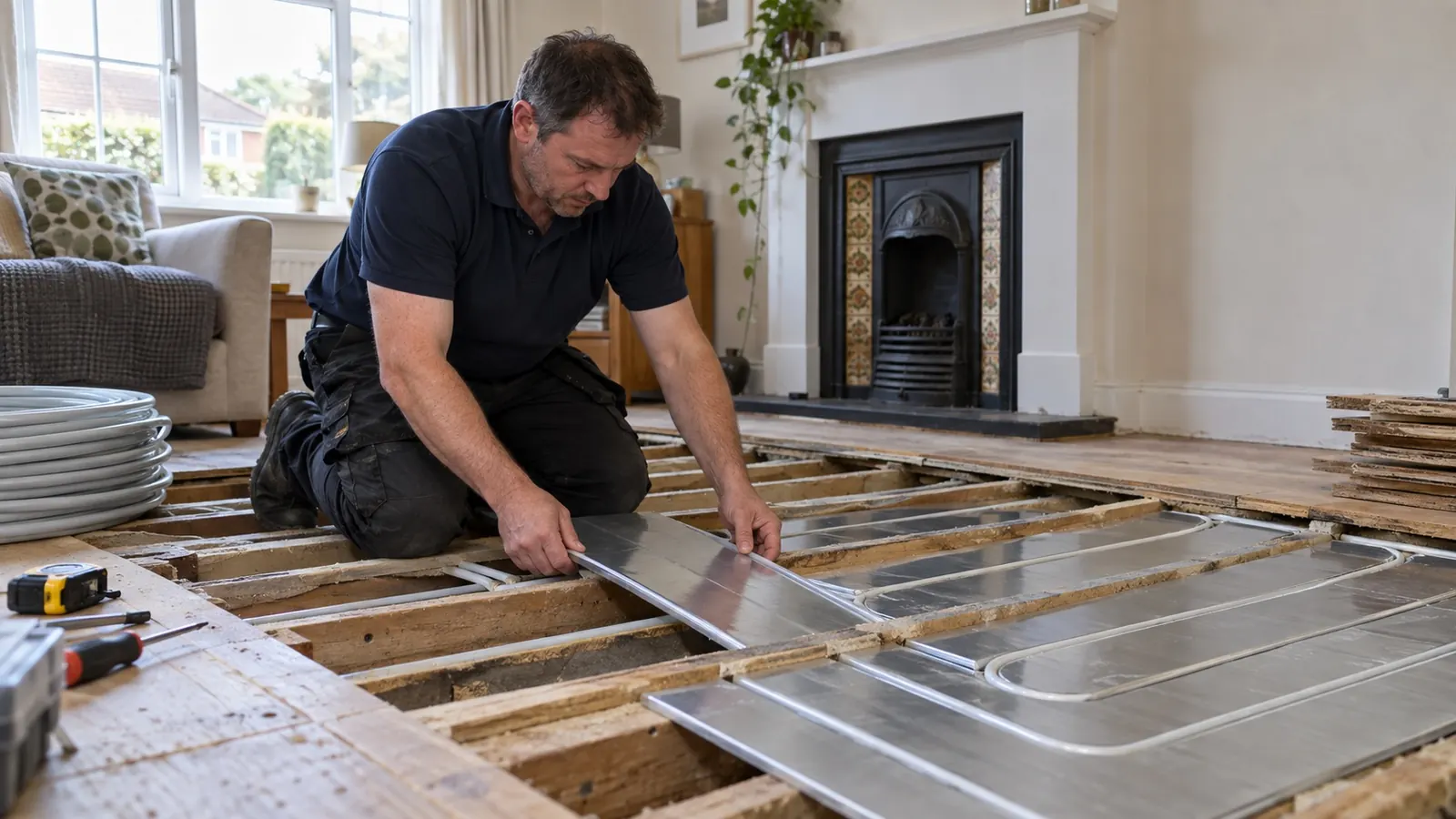
Milton Keynes has a wider spread of housing ages than most towns its size. Victorian and older stone houses in Stony Stratford, Newport Pagnell and Olney. The 1970s and 1980s grid-square estates in Fishermead, Netherfield, Coffee Hall and Bletchley. The 1990s and 2000s estates at Walnut Tree, Old Farm Park and Shenley. Each has a different floor under the carpet, and the floor is what decides whether underfloor heating is a sensible retrofit or an expensive mistake.
One thing first: laying underfloor heating pipe is plumbing work, not gas work, but connecting it to the boiler is. Anything that touches the boiler or its controls needs a Gas Safe registered engineer.
Why retrofit is harder than new-build
In a new house the pipes go into the screed before the floor exists. There is no height constraint and the room is designed around it. In an existing house the floor is already there and you have three choices:
- Lift the floor, install, refinish. Best result, most disruption.
- Lay a low-profile overlay system on top of the existing floor. Less disruption, but it raises the floor by somewhere between 15 and 50 mm depending on whether insulation goes under it.
- Electric mat under a tiled finish. Fine for a bathroom or a small utility room, expensive to run in a big space.
Which one is right depends entirely on what is underneath.
Floor types in older Milton Keynes homes
Lift a corner of the carpet or laminate and you will usually be able to tell which of these you have.
Suspended timber floors
Boards over joists with a void underneath. Common in pre-1960s houses in Stony Stratford, Newport Pagnell, Olney, Wolverton and the villages. This is the easiest retrofit. If there is access from below, pipes can be clipped between the joists on aluminium spreader plates with insulation beneath them, and the floor above is never touched. If not, the boards come up, the same thing goes in from above, and the boards go back. Either way there is little or no change in floor height, and the insulation you add underneath is often the single biggest comfort improvement in the whole job.
Concrete slab on the ground
The standard floor on the 1970s and 1980s estates: Fishermead, Netherfield, Beanhill, Coffee Hall and much of Bletchley. This is the hardest retrofit. The slab was poured with no insulation under it, so any heat you put into the floor leaks down into the ground unless you put insulation between the slab and the pipes. That means insulation board plus an overlay panel, which together add 30 to 50 mm to the floor. Doors need trimming, the bottom stair riser changes height, kitchen units and the threshold at external doors need thinking about. Digging the slab out and re-laying it with insulation is the proper answer, and it only makes sense as part of an extension or a full ground-floor strip-out.
Floating floors over insulation
Houses from the 1990s onwards, and some 1980s ones, often already have insulation under the floor. Retrofit is mid-difficulty: the floor finish comes up, a thin overlay system goes down, and the finish goes back. Height gain is small, usually 15 to 25 mm.
Upstairs
Possible between the joists, but rarely worth it. Bedrooms want less heat and the payoff is smaller. Most people in MK do the ground floor, usually the kitchen-diner, and keep radiators upstairs.
What the price is made of
We do not publish per-square-metre figures because the same 20 square metre kitchen can be a straightforward job or a difficult one. What a survey needs to establish, and what moves the price, is:
- The floor type and therefore the system: between-joists, overlay, or dig out and re-screed.
- Insulation. Whether it is already there and, if not, how much can be added within the height available.
- Floor area and how many zones. Each zone needs its own loop, actuator and thermostat.
- The manifold and blending valve, which take the boiler's flow temperature down to the 35 to 45 degrees underfloor heating wants.
- Controls. Wired or wireless room thermostats, and whether they tie into a Hive or similar.
- The boiler interface. Whether your existing boiler can run a low-temperature zone alongside radiators, or whether it needs a zone valve, a new wiring centre or, on an older boiler, replacing.
- Making good. Door trimming, skirting, thresholds and the new floor finish are usually quoted separately or by your kitchen fitter, so check what is and is not in the number.
Ask for all of those to be itemised. If a quote is one line, you do not know what you are buying.
When it makes sense
- You are already refurbishing the room. If the kitchen is coming out and the floor is coming up anyway, the extra cost of adding underfloor heating is a fraction of doing it standalone.
- You are extending. A new slab can be insulated properly and the pipes go in the screed, which is the best-performing version of the system.
- The finish will be tile or stone. These conduct heat well and feel cold without it.
- You are insulating at the same time. Underfloor heating in a well-insulated room runs at low temperature and costs little to run. In a leaky room it never catches up.
- You are thinking about a heat pump later. Heat pumps like large, low-temperature emitters. Underfloor heating is exactly that, and a floor done now is a floor you do not redo in ten years.
When it does not
- The room is otherwise staying as it is and the floor is a concrete slab. The overlay, the door trimming and the disruption add up to a lot of money for warm feet.
- The house is poorly insulated and you are not fixing that. A low-temperature system in a high-heat-loss room will run all day and still feel cool.
- Head height or steps are tight. A 40 mm rise at the kitchen door is a trip hazard.
- The boiler is old and would need replacing to run it. That may still be the right thing to do, but it belongs in the budget from the start.
- You plan to sell soon. Buyers like it but they do not pay for it.
Running it from a combi
A modern combi that modulates down to low output will run a ground-floor underfloor zone alongside upstairs radiators without complaint, provided there is a blending valve on the manifold and the zones are wired properly. An older combi that can only run flat out will short-cycle against a low-temperature circuit and wear itself out. Part of the survey is checking which sort you have. For most Milton Keynes homes with a boiler under ten years old, the answer is that it will cope.
Hard water and underfloor heating
Underfloor heating is a sealed circuit, so limescale from Milton Keynes's very hard water does not get into the pipes the way it does into a combi's hot water side. What does matter is the system water: the loops need inhibitor, and if you are connecting to an existing radiator system that has years of sludge in it, that system needs cleaning first, or the sludge ends up in your new manifold. We would always flush the existing system before joining anything new to it.
The honest bit
Underfloor heating is a comfort upgrade, not a money-saver. In a well-insulated room with a modern boiler it costs about the same to run as radiators, sometimes a little less because it runs at lower temperature. In an older house that has not been insulated, it costs more, because the floor is trying to heat a room that leaks. If a salesperson tells you it will pay for itself, ask them to show the working. Ours is that the right time to do it in an older Milton Keynes house is when the floor is coming up for another reason, and if that is not now, we will tell you to wait.
Thinking about it?
Our underfloor heating service starts with a survey of the floor, the insulation and the boiler, and an itemised quote you can compare. Plumbline MK is Gas Safe registered (957816) and covers Milton Keynes, Newport Pagnell, Stony Stratford, Olney, Bletchley and the surrounding towns. Get in touch and tell us what is under the carpet.
Need Professional Advice?
Our Gas Safe registered engineers are ready to help with all your heating needs. Get a free, no-obligation quote today.